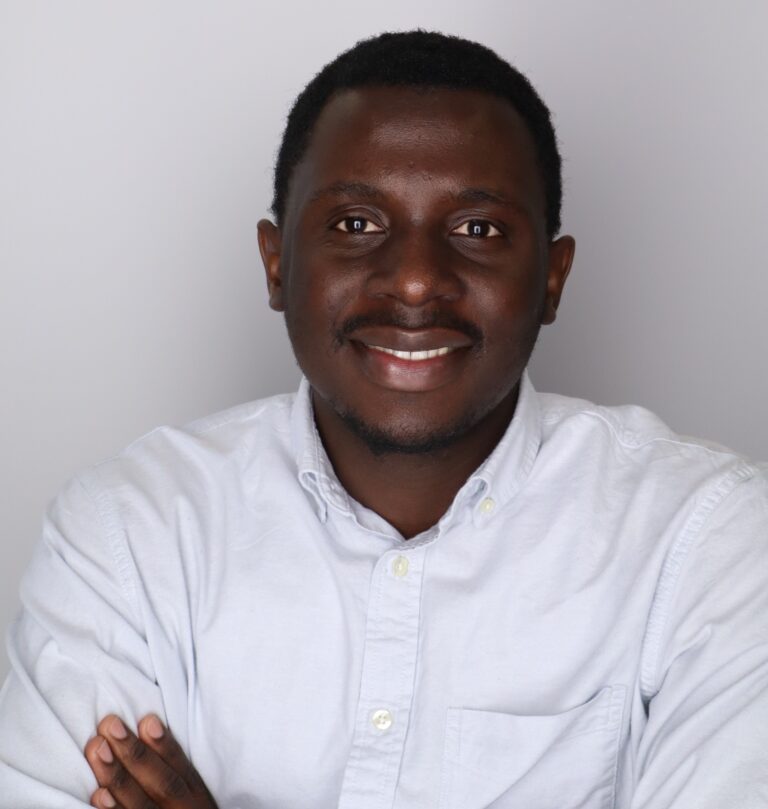
When John Omokayode stepped onto the stage for Marquette University’s 2026 Three Minute Thesis (3MT) competition, he had exactly three minutes and one slide to explain years of doctoral research. By the end of the night, the audience had voted his presentation their favorite, awarding him the People’s Choice Award.
For Omokayode, a third-year doctoral student in Mechanical Engineering, the moment represented more than a win. It showed that complex scientific ideas about cities, air and climate can resonate with people when communicated clearly. “It was very rewarding because it showed that the audience connected with my research and the way I communicated it,” Omokayode said.
The Three Minute Thesis competition challenges graduate students to explain their research to a general audience in just three minutes. The format pushes participants to translate complicated technical ideas into a story that anyone can follow.
Preparing for the competition required Omokayode to rethink how he presented his work. “The competition pushed me to simplify complex ideas and communicate my work in a way that anyone could understand,” he said. “That skill is incredibly valuable, not only for presentations but also for collaborating with researchers in other fields and sharing research with the public.”
Much of his preparation involved refining his speech and gathering feedback. “I often think back to the evenings I spent refining my speech and reaching out to friends and colleagues for feedback,” he said. “Those moments helped me connect with my research from a completely different perspective.”
Originally from Osogbo in Nigeria’s Osun State, Omokayode is pursuing a doctoral degree in mechanical engineering while studying how urban environments influence the air people breathe and the temperatures they experience. His research asks a deceptively simple question: how can cities remain vibrant economic centers while still being comfortable and healthy places to live?
To answer that question, Omokayode is developing a computer model that simulates complex interactions within urban microclimates. The model captures processes such as sunlight heating rooftops, wind flowing between buildings, pollutants released from vehicles, and the influence of trees and vegetation. By solving equations that describe how wind, heat and pollutants move through cities, the simulations reveal how urban design affects environmental conditions at street level.
His current study focuses on the Marquette campus, examining the area between 6th Street and 20th Street and from Kilbourn Street to Canal Street. Early simulations suggest that wind accelerates along major corridors like Wisconsin Avenue and between clusters of buildings. These same narrow spaces can also trap pollutants and create warmer pockets compared with nearby open areas. He also studies how green infrastructure, such as trees and vegetation, might help reduce heat and improve air quality in those spaces. Omokayode’s hopes his work will help city planners and engineers make more informed decisions about building placement, urban design and green infrastructure.
For example, the models he’s helping to create could help answer questions like how tall a new building should be to avoid creating uncomfortable wind conditions for pedestrians, or where trees should be planted to maximize cooling and improve air quality. Ultimately, Omokayode hopes the research will contribute to healthier and more sustainable cities. “My goal is to help create cities where people can enjoy the benefits of urban life while still having clean air, comfortable temperatures and sustainable living environments,” he said.
Omokayode said he was drawn to Marquette by its mission and motto, “Be The Difference,” which emphasizes using education to positively impact society. He has conducted his research under the mentorship of Dr. Somesh Roy, whom he credits as a key supporter of his academic journey. “Dr. Roy has been incredibly supportive throughout my graduate journey,” Omokayode said. “I attribute much of my progress to his patience in instruction, his attention to detail in research and his commitment to mentoring students professionally.”
After his experience, Omokayode strongly encourages other graduate students to participate in the Three Minute Thesis competition. His advice is simple. Focus on telling a story. “Think about why your research matters and how it affects people,” he said. “When you do that, it becomes much easier for an audience to connect with your work.”
Graduate students can learn more about the competition through announcements from the Marquette Graduate School and MUGS NEWS, which regularly posts opportunities for events and professional development.
Outside of research, Omokayode enjoys exploring Milwaukee and its surrounding suburbs, spending time outdoors, and discussing topics that range from technology to everyday life with friends. He also enjoys reading and is currently exploring the city’s many coffee shops in search of the perfect place to study.
Want to read similar stories or have a success story to share? Visit Stories of Graduate Student Success to learn more.