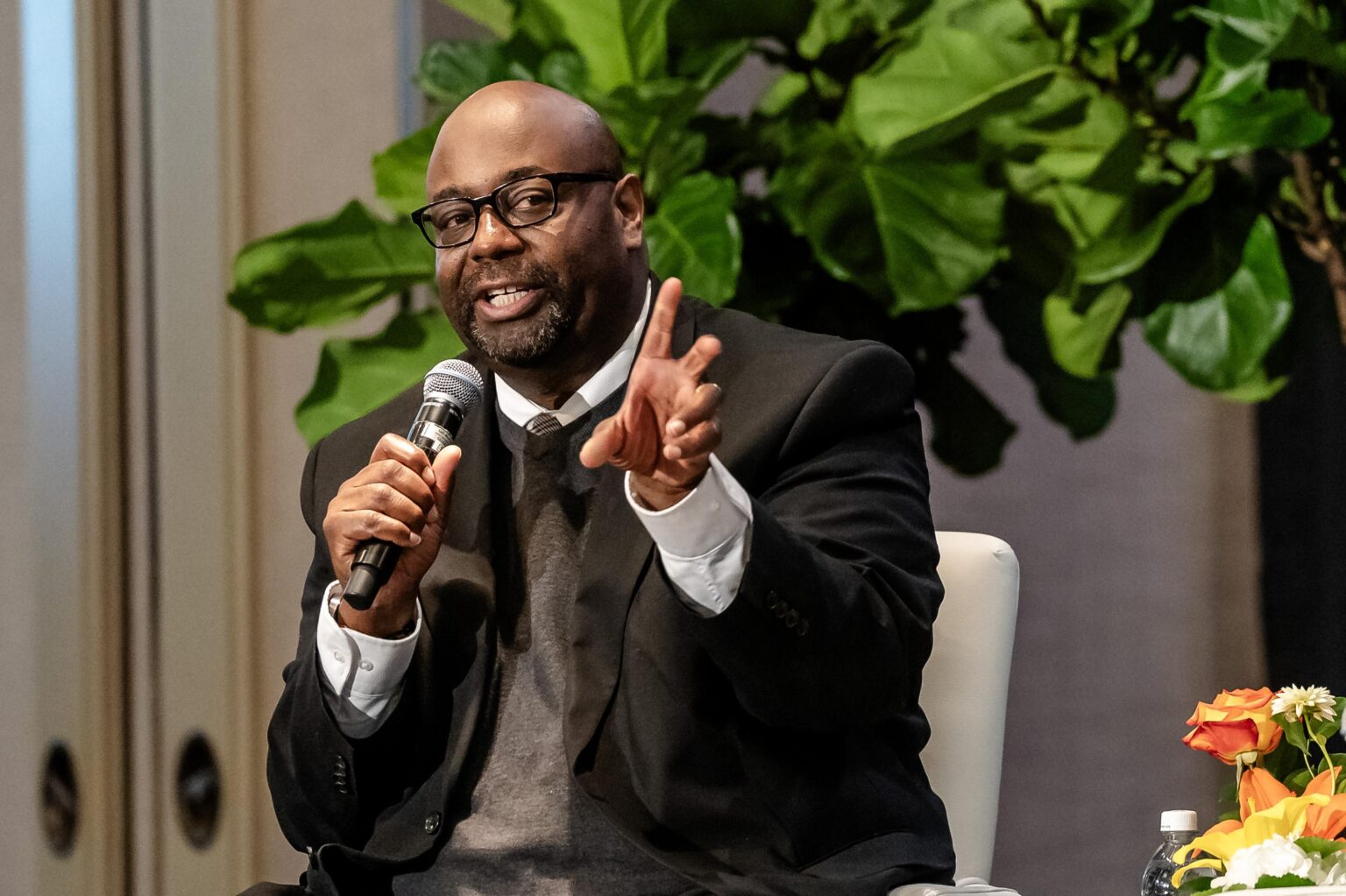
For over a decade, Derek Mosley, Law ’95, director of the Lubar Center for Public Policy Research and Civic Education and former City of Milwaukee judge, has shared a daily Black history fact on his social media throughout February.
“I initially started researching and sharing the facts to educate my children and then decided to share them with everyone else,” Mosley says. “After 15 years, I have quite the repository of facts.”
His posts can be found on a variety of social media platforms including Facebook (Derek Mosley), LinkedIn and Instagram (@judgemosley). He encourages everyone to share his Black history content on their own social media outlets.
Here in a Q&A, Mosley discusses the feedback he’s received from his posts over the years, some of his favorite facts, and why preserving and sharing Black history is more important than ever.
Black history is American history, but it’s not always taught extensively in school curricula. Where do you find the facts that you post about?
Not only is it not being taught extensively in schools, but in some states and school districts they have passed laws that limit, restrict, or effectively banned the teaching of Black history. States like Florida, Texas, Oklahoma, Tennessee, Missouri and several other states have begun removing books, restricting curriculum and eliminating courses related to Black history. Fortunately, there are plenty of books that are available to the public via libraries and bookstores that have been invaluable in my research. The internet also gives you unprecedented access to the Library of Congress.
What kind of feedback have you gotten from your social media followers?
The feedback from the posts has been very positive. I receive messages from all over the country, including from teachers who say they use the posts for teaching history in class, and grandparents who read the stories to their grandchildren. The posts have also given me access to meet some living legends like Milwaukee’s own Anna Mae Robertson of the all-Black, 6,888th Postal Battalion (The Six Triple Eights).
How important is it to share and remember these American history facts?
It’s important not only for historically accurate portrayals of history, but it also reinforces that every group that calls this country home played a vital role in our 250 years as a nation. Here’s an example: Growing up, I had no idea that Black soldiers played key roles in WWII, including storming Omaha and Utah beaches on D-Day, because you rarely, if ever, see them portrayed on film. Arguably, the highest grossing war film, “Saving Private Ryan,” doesn’t have one Black soldier in it. A million and a half Black soldiers fought in WWII.
What’s your favorite piece of Black history you’ve shared over the years? They’re all fascinating but maybe there’s one that always sticks with you.
There are so many, but one with a local flavor involves a lynching of two Black teens in Marion, Indiana, in 1930. A picture was taken of that lynching that was printed in magazines and newspapers across the country. It was seen by a teacher in New York who wrote a poem about what he saw and how he felt when viewing the picture. He titled the poem “Strange Fruit.” Billie Holiday would sing the famous song “Strange Fruit” based on the poem — a song that Time Magazine called the “Song of the Century.” The local connection is that a young man who also should have been lynched that day escaped that same lynching and eventually settled in Milwaukee. He would create a museum in Milwaukee, America’s Black Holocaust Museum, to tell the story. The museum still exists today on the corner of Vel Phillips Street (formerly 4th Street) and North Avenue in Milwaukee. The boy’s name was James Cameron, a Milwaukee icon. If you haven’t, please visit the museum.
Mosley is speaking at a number of engagements throughout February including at the 10th Annual Wauwatosa Black History Celebration at the Wauwatosa Public Library on Feb. 19 at 6 p.m. and at the Germantown American Legion Post #1 on Feb. 24, sponsored by the Germantown Community Coalition.