Sophomore Molly Milos couldn’t stand the sound coming from her over-ear headphones.
“There were doors slamming and siren noises playing in the headphones,” Milos says. “That was pretty terrifying.”
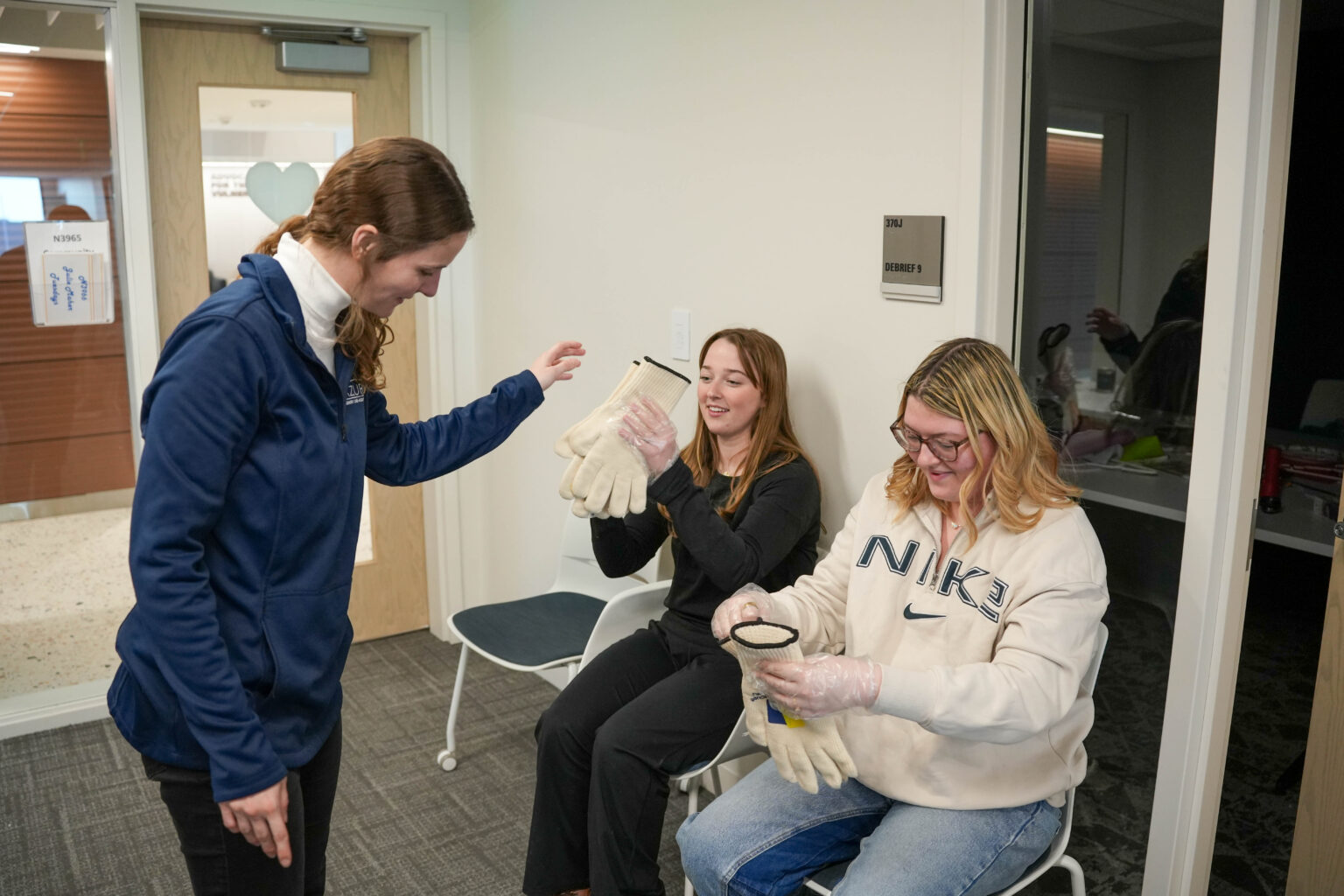
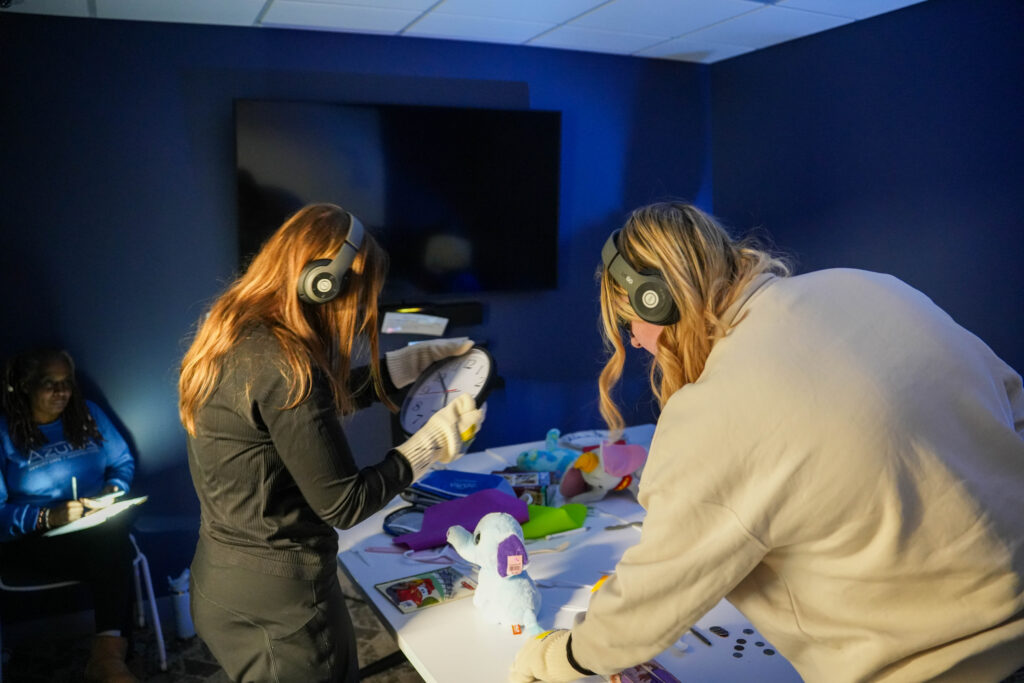
Milos was going through the College of Nursing’s annual dementia simulation, a collaborative effort with Azura Memory Care. Sophomores in the Foundations II: Health Assessment and Fundamentals class donned special glasses, headphones, gloves and shoe inserts to simulate various common symptoms of dementia patients. They were then led into a dark room and asked to complete five tasks that would be considered simple under normal circumstances, such as organizing items on a table. However, the tasks are anything but simple in their altered state.
“The biggest feedback I get from nursing students is that they didn’t know how hard it would be,” says Marie Schulist, senior engagement specialist for Azura. “They are interested. They’re like ‘wow, I didn’t know that they experience this or this makes them sad. It opens their eyes a little.”
Each piece of the simulation is meant to inhibit students’ senses in some way. The spiky shoe inserts simulate neuropathy, a common symptom of diabetics, who are over-represented among dementia patients. The gloves have the thumb, pointer finger, and middle finger sewn together, eliminating the wearer’s most dexterous digits. Dark tinted glasses give students tunnel vision and compromise their depth perception. Loud noises played through headphones give the effect of auditory hallucination.
“I want my patients to feel safe and heard when I’m caring for them; this simulation helped me put myself in their shoes so I can do that.”
Molly Milos, College of Nursing sophomore
The combined effect is that students are, for five minutes, transported into the lived reality of a person living with dementia.
“There are a lot of stimuli that just feel completely random to you,” says sophomore Abby Miller. “And everything in the room is a mess, too. You can’t find anything you’re looking for with everything you have going on. It’s overwhelming.”
The simulation is followed by a debrief in which students are asked to share their reflections about what they experienced. Azura staff also walk them through what each part of the simulation was meant to do.
“We have a rapidly aging population, and more people are unfortunately going to have dementia. We feel it’s super important that nursing students have an idea of how to approach, communicate and talk with people who have dementia,” Schulist says.
Check out our Instagram account to see what the dementia simulation was like for our students.
“I’ve worked with a lot of dementia patients over the last couple years and actually have a few family members who have experienced it as well, and I would notice that they always looked fearful,” Miller says. “I would try to talk to them, but it would never seem to help. This simulation put into perspective why that is.”
During the debrief sessions, Azura instructors provided helpful tips on how to best care for dementia patients. Students were advised to speak slowly and give them one task at a time to counteract feelings of overstimulation. Schulist even pointed out the rug in the debriefing room could be off-putting to dementia patients — it had dark spots that people with depth perception issues would perceive as holes, rather than the smooth, lightly-colored rug in the hallway.
All Marquette nursing students are required to complete at least one eldercare clinical rotation. They are also required to take a course related to care for older adults, often in their junior year. This ensures that nursing students graduate with experience in both the theory and practice of caring for older populations.
“I want my patients to feel safe and heard when I’m caring for them; this simulation helped me put myself in their shoes so I can do that,” Milos said.