
Graduates of Catholic universities like Marquette are more likely to feel a strong sense of belonging, feel more satisfied with their mental health and have higher rates of income and homeownership, a recent study found.
The second Higher Education Holistic Impact Report (HIR), commissioned by St. Mary’s University in San Antonio and conducted by research company YouGov, examined how Catholic institutions of higher education shape values and inspire direction in life.
“It is highly encouraging — and not surprising — that this report finds Catholic higher education leads to improved outcomes related to mental health, a sense of belonging and an appreciation for a breadth and depth of thinking,” says Brian Troyer, vice president of enrollment management. “The national data reinforces that Marquette’s commitment to offering a transformational education both inside and outside the classroom will continue to have positive outcomes for our graduates’ lifelong well-being.”
Impacts on mental health and belonging
The new report builds upon the inaugural 2024 study, which found that Catholic university students are more likely to report an ideal life and stronger sense of direction, weigh morality in decision-making, and find greater social and community fulfillment than secular college graduates.
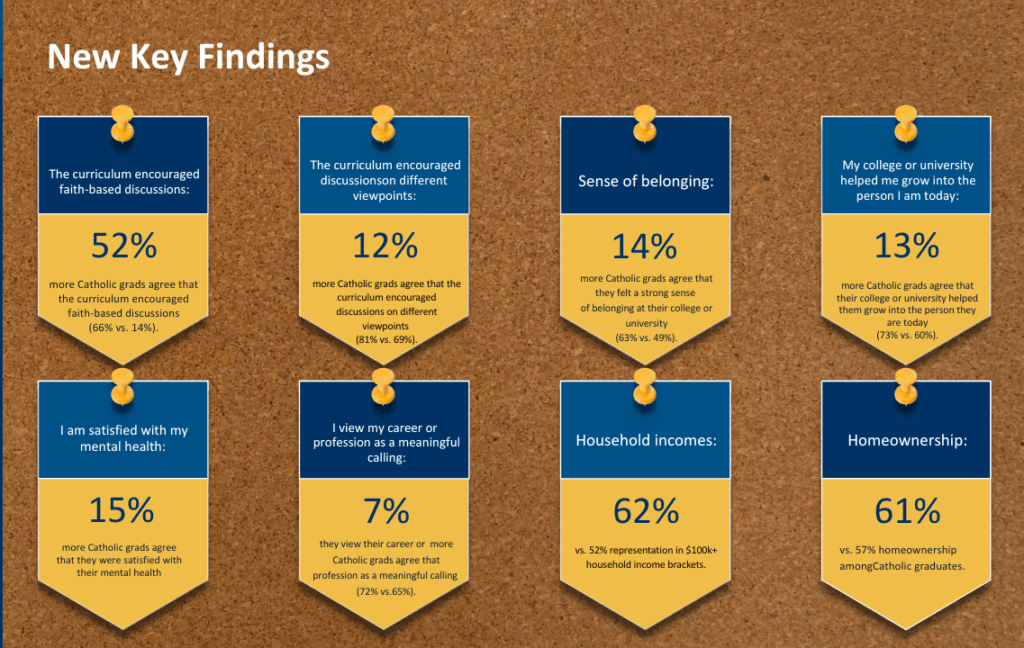
A key finding of the 2025 study found that Catholic school graduates are 15% more likely to be satisfied with their mental health. Additionally, 63% of respondents reported a strong sense of belonging during their time in college — 14% higher than secular graduates.
The findings come as Marquette approaches the one-year anniversary of opening its Wellness + Helfaer Recreation facility, which brings fitness, recreation, medical and counseling services into one central location. In nearly one year, Campus Recreation has seen nearly 400,000 access swipes, while the Medical Clinic saw 4,163 unique patients and the Counseling Center had over 1,000 unique students for clinical appointments. Of those students who sought counseling, 84% reported improvement as a result of their services and 84% also stated that the services made their Marquette experience better.
“The Holistic Impact Report reinforces what we see every day with the transformative education we offer our students through our mission and work,” says Luis de Zengotita, chief wellness officer. “Rooted in our Catholic, Jesuit tradition, we believe education must form the whole person intellectually, spiritually, physically and emotionally. When universities intentionally integrate cura personalis (care for the whole person), belonging and spiritual formation into the student experience, it leaves a life-long impact.”
In his role, de Zengotita leads the development of a holistic, sustainable, multidisciplinary strategy for student health and well-being at Marquette, embedding these principles into various facets of the student experience.
Marquette students and alumni also fold community service into their well-being. The HIR found that Catholic school graduates are 20% more likely to have volunteered in the past six months. Marquette was recently ranked the No. 1 school in the country for community engagement for the second consecutive year by The Princeton Review, and a 2021 survey found most alumni had engaged in community service within the previous year.
More faith-based discussions in college
For the first time, the St. Mary’s study examined faith-based discussions and curricula. The report found 66% of graduates agreed that their college curriculum encouraged faith-based discussions, compared to just 14% of non-Catholic school grads. Additionally, 81% said they were encouraged to take part in discussions on different viewpoints than their own, a 12% higher mark than their counterparts.
Those numbers align with results of Marquette’s 2025 Graduating Senior Survey, which found that 85% of students discussed faith, spirituality or religion with people who held different religious beliefs.
“The Holistic Impact Report affirms that the transformational nature of Catholic higher education extends beyond financial benefits,” Troyer says. “Marquette’s Core Curriculum is a fantastic example of how and where this transformation is taking place. It also speaks to our top-ranking undergraduate faculty, who care deeply about incorporating cura personalis and contribute to these remarkable outcomes.”
Strong financial outcomes
While postgraduate financial results are not the primary focus of the St. Mary’s study, the 2025 version shed light on earnings and job placement for the first time.
Notably, 62% of Catholic university graduates were represented in households with an income of $100,000 or more, compared with 52% of secular graduates. Sixty-one percent of those surveyed were homeowners, also more than secular college grads.
In the workforce, graduates of Catholic colleges are more likely to view their career or profession as a meaningful calling, with 72% reporting such satisfaction.
The findings are consistent with Marquette’s strong position nationally across all colleges in career outcomes. Named a “Best Value” school by The Princeton Review, Marquette ranks No. 6 nationally for job placement 10 years after graduation. According to the U.S. Department of Education’s College Scorecard, Marquette graduates earn 45% more 10 years after graduation than the average undergraduate student. These were among the reasons that the Wall Street Journal/College Pulse ranked Marquette as the top school in Wisconsin based on student outcomes.
“While the new findings on income and job placement affirm that Catholic higher education is delivering positive outcomes to students and alumni, it’s clear from this report that the benefits extend even further,” Troyer says. “Our graduates consistently receive a strong financial return on investment for their education.”