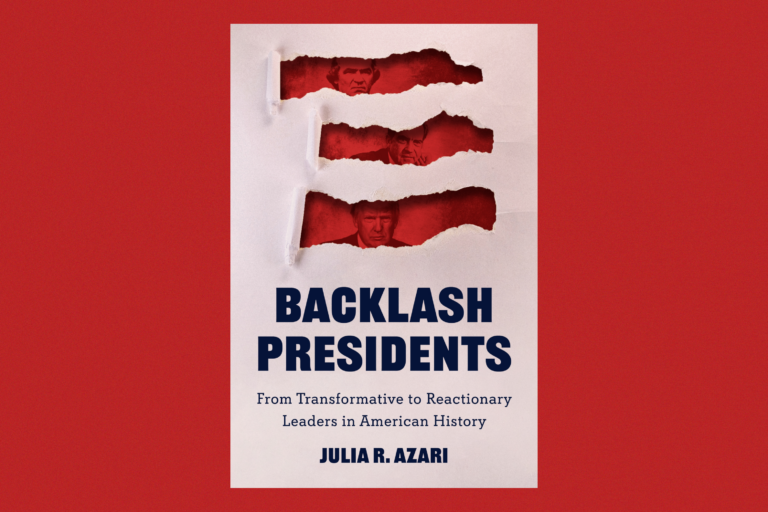

When Barack Obama won the White House in 2008, becoming the nation’s first Black president, the stage was set for Donald Trump’s eventual rise to power. “Backlash Presidents” shows how, throughout American history, administrations that challenge the country’s racial status quo are followed by presidents who deal in racially charged politics and presidential lawlessness, culminating in impeachment crises.
In this incisive book, Julia Azari traces the connections between racially transformative presidents and their successors, examining the presidencies of Abraham Lincoln and Andrew Johnson, Lyndon Johnson and Richard Nixon, and Obama and Trump. When he signed long-awaited civil rights legislation in 1964, Lyndon Johnson unleashed a perfect political storm that swept Nixon into the White House. Azari demonstrates how Nixon’s rhetoric, relationship to Congress, and attitudes about executive power exhibit striking parallels with Andrew Johnson and Trump. She discusses how their actions are linked to race and racialized institutions—the Department of War during Reconstruction, the FBI during the Nixon years, and elections today—and looks at what happens after impeachment, describing how the rush to establish a new order perpetuates many of the same problems as the old.
Learn more or purchase this book at Princeton University Press
Dr. Azari answered some questions about her new book, including where the idea for the book came from, her favorite part of the writing process and how the book complements her teaching and research.
How would you describe the book in one sentence?
Racially transformative presidents—Lincoln, Lyndon Johnson, Obama—have been followed by presidents who faced impeachment and bear striking similarities in their approach to the presidency.
Where did the idea for this book come from?
Back in 2017, I was invited to a number of meetings to discuss the health of American democracy with other academics and practitioners. After Trump fired FBI Director James Comey in May 2017, there were a number of analyses comparing Trump to Nixon – who demanded that the Attorney General fire the special prosecutor in the Watergate case. There were a few historical deep cuts that compared Trump to Andrew Johnson back in the 1860s – he was impeached for firing a Cabinet official in violation of existing law. Johnson, Nixon, and Trump are easily compared in terms of their temperaments and issues with rule of law. But it occurred to me that there’s something else that these three presidents had in common: their predecessors. Each disrupted the racial status quo in some way: the Great Emancipator, the civil rights president, and the first African American president.
Is this your first book? What is your publishing history?
My first book, “Delivering the People’s Message,” was published in 2014 by Cornell University Press. I have published a number of articles, book chapters, and public-facing pieces on the relationship between presidents and political parties, the role of political norms, and presidential elections. I’ve also co-edited two volumes, The Presidential Leadership Dilemma, with Lara Brown and Zim Nwokora (SUNY, 2013), and Trump’s First Term, with Bert Rockman and Andrew Rudalevige (University Press of Kansas, 2026).
What was your favorite part of the writing/editing process?
Reading news reports and documents from the 1968 election and Watergate: there is a striking story about race in the trajectory of Nixon’s presidency, which has not been covered at great length in any of the literature that I found.
What do you hope to accomplish with this book?
I hope to get people to think seriously about how these patterns regarding race keep recurring. The reason that Lincoln, L. Johnson, and Obama were so disruptive to established patterns of politics is that American politics rests on uncomfortable compromises about race that preserve widespread inequality and injustice. Presidents help to maintain that status quo. I hope that this book helps people understand that some of what we have seen in the Trump presidency is part of a long-standing pattern in American history.
How does this book advance or complement your research and/or teaching?
I teach two courses on the American Presidency—one on the 21st century presidency and one with a historical focus. I hope to continue on several related trajectories with my research, looking at the complex relationship between race and presidential politics, as well as at impeachment and accountability.
If you have recently published a book, or if you have one coming out, we would like to feature your publication in an upcoming Marquette Bookshelf feature. More information on the submission process is available online.
Book Details
- Publisher: Princeton University Press (Sept. 23, 2025)
- Language: English
- Print Length: 288 pages x
- ISBN-10: 0691246955
- ISBN-13: 978-0691246956