In 2011, long before earning his Ph.D., Dr. Andrew Sen found himself on the periphery of a catastrophic natural disaster. As an undergraduate studying abroad in New Zealand at the University of Auckland shortly after the devastating February earthquake in Christchurch, Sen saw the real-world impact of structural failure firsthand. Little did he know then that the experience would help shape his career as an earthquake engineer studying structural steel systems.
Today, Sen is an assistant professor of civil, construction and environmental engineering in the Opus College of Engineering and recipient of the The American Institute of Steel Construction’s 2026 Milek Fellowship. As part of the annual fellowship, he receives a four-year, $300,000 grant from the AISC Committee on Research that will provide funding for his project, “Balancing Safety and Efficiency in Moderate-Ductility Braced Frames,” which aims to develop new intermediate ductility steel building systems to better serve regions beyond those with very high seismic activity.
“What this research is trying to do is think about building systems — specifically steel braced frame building systems — that could be appropriate in regions of high seismic risk like the West Coast but also other places where the seismic risk isn’t as high,” Sen explains. “The research is about giving engineers more options that will hopefully make their designs more efficient and safe.”
One of the Milek Fellowship’s goals is to help early-career faculty advance their research programs and empower them for a rewarding career in structural steel focused research.
Dr. Chris Raebel, vice president of engineering and research at the American Institute of Steel Construction, says the results of Sen’s research will be extremely valuable to designers, fabricators and building owners.
“Steel braced frames are an attractive option to resist lateral forces in buildings, but the use of moderate ductility braced frames has limitations for some applications,” Raebel says. “Andy’s research seeks to improve the efficiency of moderate-ductility seismic force-resisting systems and expand their use to make them more competitive with other types of systems.”
Balancing ductility, cost and safety
Current steel building designs force a trade-off: high-seismic regions use expensive built-in fuses to absorb earthquake forces, while lower-risk regions rely on structural strength alone. Sen is working to find a “Goldilocks approach” that balances ductility, affordability and safety for any region.
“We’re looking to put distinct fuses in systems that yield and dissipate energy under large earthquakes,” Sen explains. “In parts of the country dominated by wind risk, there’s no designated fuse — you’re relying on strength without the ability to deform inelastically. In both cases, the intended performance is actually the same, meaning the risk of collapse. They just achieve that performance in different ways.”
The fuse is the designated failure point of structures in regions of high seismic risk where if a collapse did occur, its strategic placement would keep the integrity of the structure as much as possible.
Sen compares the fuse to the crumple zone of a car.
“In regions with low seismic risk, the analogy would be similar to an old Cadillac that doesn’t have a crumple zone, and you just get the full brunt of the impact,” Sen says. “But the idea with regions with low seismic risk is that the actual impact isn’t that large, so, even without a fuse, the design is still safe in that scenario.”
Dr. Brian Schmit, associate dean for research in the Opus College of Engineering, says Sen’s work addresses an important issue of how to provide buildings with enough ductility to be safe during an earthquake without requiring the complexity and expense of highly ductile building structures.
“There is a gap between basic steel building systems and the more complex systems designed to withstand the strongest earthquakes,” Schmit says. “Andrew’s research is focused on that middle ground. If we can provide the right level of protection with a simpler design, it could make better earthquake protection practical for many more buildings.”
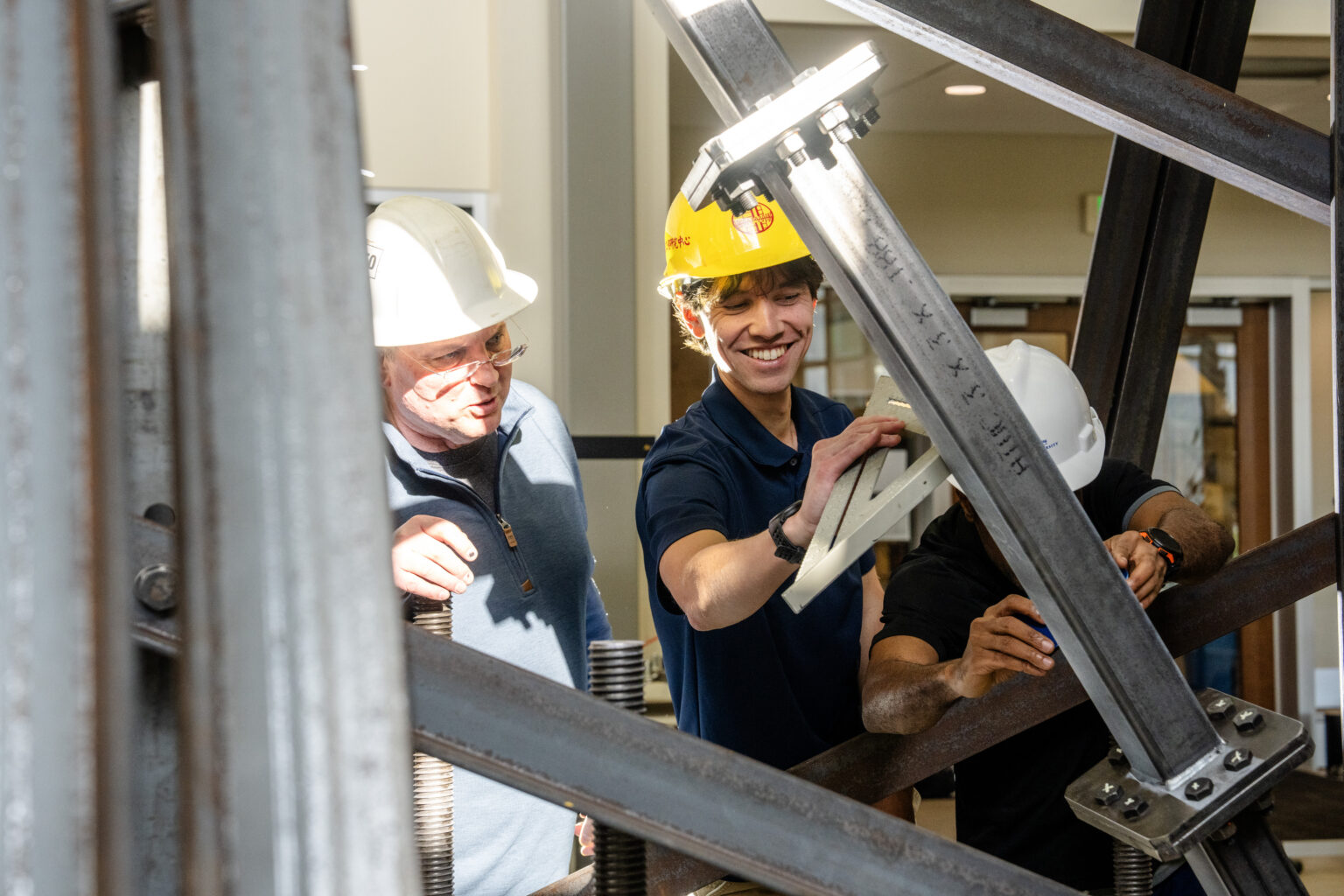
Sen’s project is set to begin this fall and continue through the four-year grant period. It will be broken into two primary research tracks involving brace-framed systems — one that concentrates on concentrically braced frames, where diagonal braces meet directly at beam- column intersections and the braces act like the primary energy-dissipating elements. The second track focuses on eccentrically braced frames, where braces are offset, and energy dissipation happens through portions of the beams instead.
“The research Andy is conducting will advance novel, cost-effective solutions across a range of applications and markets throughout the United States,” Raebel says. “It gives designers more options when selecting the appropriate lateral force-resisting system for a specific application and location.”