During Delaney McElvain’s first year at Marquette, a sophomore lab partner told her about an intriguing opportunity. A guest lecturer in one of the partner’s classes was encouraging students to take part in a medical imaging “hackathon.” Because she was already familiar with coding, McElvain should consider going, the friend suggested.
It sounded completely outside McElvain’s comfort zone, but that was part of the appeal.
“I had no idea what I was signing up for,” McElvain, Eng ’26, says about her first trip to the Society for Imaging Informatics in Medicine (SIIM) Hackathon, which draws competitors — mostly working professionals — from many engineering and healthcare fields. “When we got to the actual hackathon part, we learned we were the only team of college students there.”
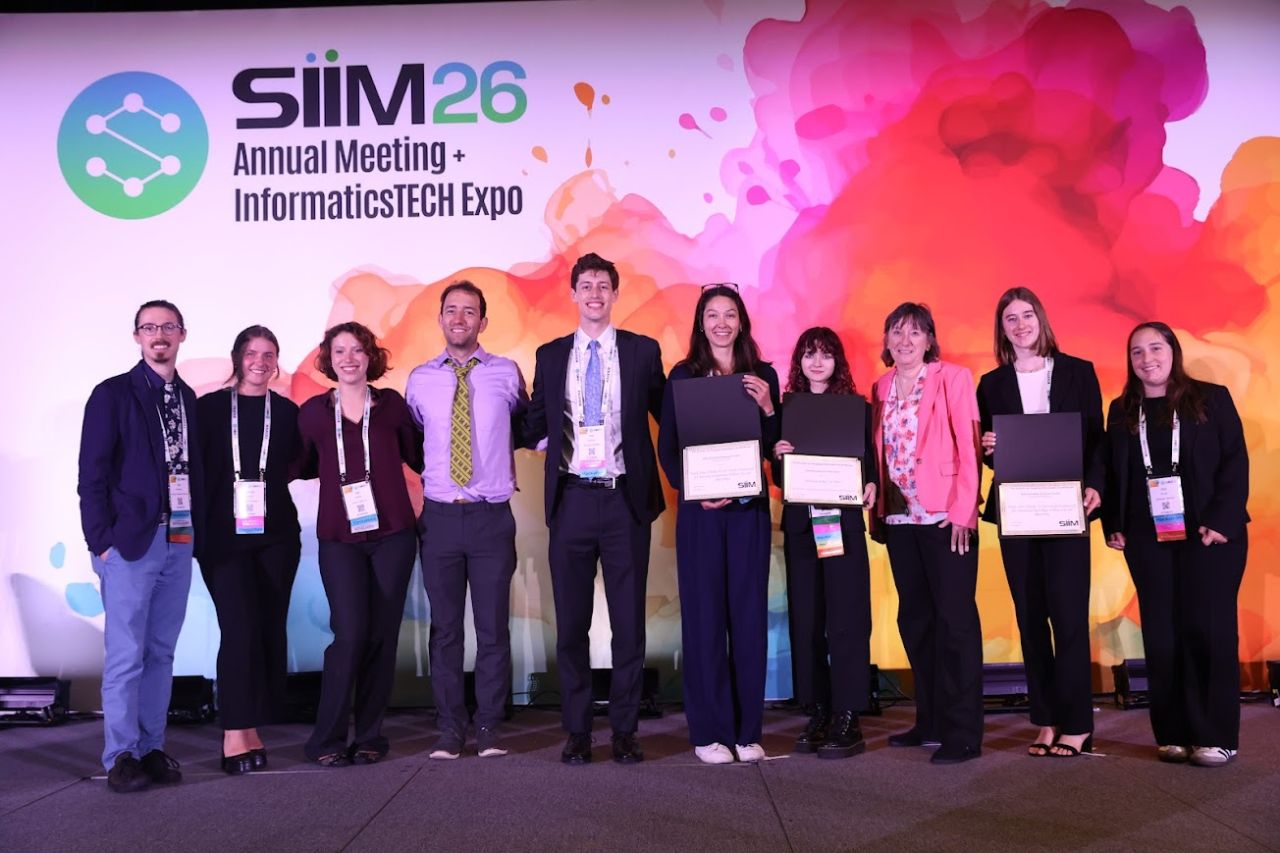
The trip to Austin, Texas, was her first time traveling without her family. She arrived with older students she barely knew and walked into a conference filled with industry professionals. But McElvain kept going back. This June, weeks after graduating with a degree in biomedical engineering and cognitive science, she concluded her four-year hackathon run with a trip to Pittsburgh as part of a Marquette team that placed second; two other Marquette squads earned honorary awards.
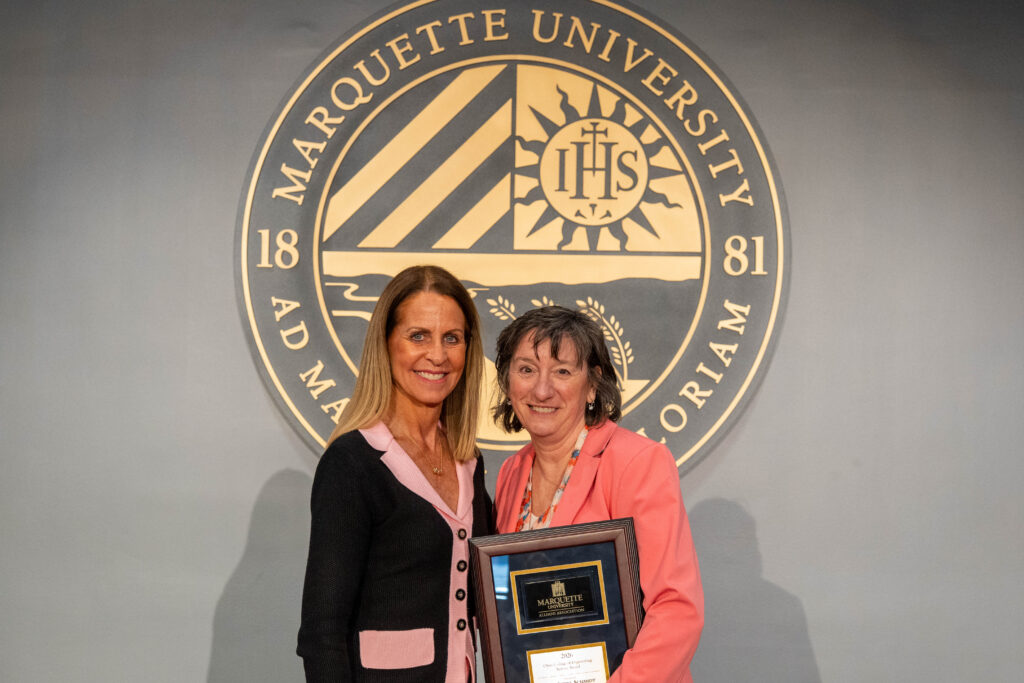
Those achievements reflect the strength of a student-alumni partnership led by Teri Sippel Schmidt, Eng ’87, Grad ’90, a SIIM fellow and imaging informatics industry leader who has brought Marquette students to the competition for years. She’s also recruited fellow alumni and professionals to mentor them, including Alex Barrington, Eng ’18, Grad ’19, and Thomas O’Sullivan.
Sippel Schmidt was the lecturer who announced the opportunity to participate in the SIIM hackathon to McElvain’s lab partner years earlier, and McElvain praises Sippel Schmidt’s efforts to increase access for students. A Marquette student-professional team finished first in the 2024 competition and many others have garnered top six placements. The total number of teams competing in each hackathon typically ranges from 12 to 20.
The hackathon gives students hands-on involvement with imaging informatics, a field that develops, improves and adapts information technology for medical imaging. That work not only helps care providers address immediate clinical needs but also helps them better understand patient health over time, in part through advances in image archiving, retrieval and analysis.
“This is a burgeoning field,” says Sippel Schmidt, who launched Marquette’s one-credit biomedical informatics course. “We need more technical people to investigate longitudinal patient records across a patient’s lifetime to direct treatments, from cardiac care and brain care to cancer.”
The hackathon condenses that process, as teams are given clinical data and a limited amount of time to develop an application addressing a real healthcare need. Sippel Schmidt has students divide responsibilities: coding, project management, clinical storytelling and presentation. She also encourages them to attend conference sessions to glean information related to their project and to network and get feedback from experts in the field.
McElvain’s second-place team targeted a real-world case from a Colombian hospital where a device had generated major image description errors that delayed care. The team created an interface to verify the image’s information via the patient’s electronic record before the radiologist’s review.
Biomedical engineering major Abigail Bunch was a member of that team as a first-year student. In that hackathon experience, she became the agile sprint manager who broke the project into smaller tasks for group members. Developing the project and winning an award was worthwhile enough, but Bunch found even more value in her contact with professionals who introduced themselves and offered advice.
“Later on, we’d find out the person we were talking to was the Mark Zuckerberg of the imaging informatics world,” says Bunch, now a sophomore. “They’ll go that extra mile to get you to understand and appreciate what you’re learning, and that makes the experience so much more impactful. Sometimes you don’t get that from the regular classroom or a project you work on outside of class.”
Will Ricamato, a first-year doctoral student studying in the joint biomedical engineering department of Marquette and the Medical College of Wisconsin, found his way to the hackathon the way most of his peers did: word of mouth from classmates and unwavering encouragement from Sippel Schmidt. He said working alongside Marquette alumni and SIIM professionals during his two years at the hackathon helped quiet the “impostor syndrome” of being in a room full of experts.

One mentor gave him a lesson he still remembers: “Draw a diagram of the system we just talked about and explain it to me,” Ricamato was told.
The advice helped him over a hurdle. “When I attempted to draw up the system we had just talked about, I realized how much I still didn’t understand,” Ricamato remembers. “It made me learn it’s one thing to think about problems in your head, but another to draw them out and explain them to other people.”
Grace Schneider, Eng ’26, attended the 2026 hackathon shortly after graduating with her degree in biomedical engineering. One month later, she began GE HealthCare’s Edison Engineering rotational program. While the Marquette informatics course she took in spring 2026 introduced her to the field, she says the hackathon forced her to “dive deep quickly” and “learn to learn on your feet,” giving her technical and interpersonal skills she’s been using in her current job.
“I’m doing the explaining now,” Schneider remembers thinking while helping present her team’s project, a workflow to confirm whether a patient was taking an Alzheimer’s medication after an MRI-documented brain hemorrhage. It’s an experience she says has strengthened the communication skills she’s using in her current role. “I increased my confidence, especially when Teri encouraged me to have one-on-one conversations with industry professionals while garnering feedback on our project.”
She adds, “While it pushed me out of my comfort zone, I’ve been told that ‘no growth happens in the comfort zone, and no comfort happens in the growth zone.’”
McElvain shared similar sentiments. Now working as a clinical research coordinator in Marquette’s joint biomedical engineering department with the Medical College of Wisconsin, McElvain hopes to use those hackathon experiences in her future career as an occupational therapist to mesh her engineering background and communication skills in creating adaptive solutions for patients.
That’s the goal driving Sippel Schmidt’s efforts to bring more Marquette students to the field. “Hearing aboutsomething and creating something are two very different things,” she says. “Hearing about something is good. But doing something can change your life.”
To help support student travel to the competition, visit the college’s give page and direct the donation to the SIIM Hackathon.