
Also:
- Partisan divides remain notable in Court approval and in perception of the Court’s siding with or avoiding ruling against Trump
- Among cases that have been before the Court, 60% say Trump’s executive order for the Postal Service to screen absentee ballots is unconstitutional; a close divide exists on right to AR-15 rifles; and 58% oppose allowing construction of White House ballroom
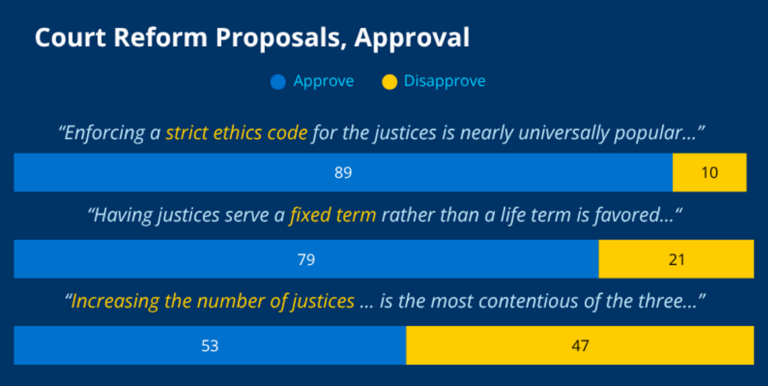
- Various “Court reform” proposals get majority support: enforcing strict ethics code (89%), limiting terms for justices (79%), and expanding the number of justices (53%)
A new Marquette Law School Poll national survey finds approval of the United States Supreme Court dipped to 43% in September, down from 47% in July. Disapproval rose to 57% in September, from 53% two months earlier. Approval in September is the second lowest rating since January 2025. The changes in approval of the Court during President Donald Trump’s second term are shown in Table 1.
Table 1: Approval of the U.S. Supreme Court
Among adults
| Poll dates | Approval | |
| Approve | Disapprove | |
| 9/2-9/26 | 43 | 57 |
| 7/22-29/26 | 47 | 53 |
| 5/20-26/26 | 46 | 54 |
| 4/8-16/26 | 42 | 57 |
| 1/21-28/26 | 44 | 56 |
| 11/5-12/25 | 44 | 56 |
| 9/15-24/25 | 50 | 50 |
| 7/7-16/25 | 49 | 51 |
| 5/5-15/25 | 53 | 47 |
| 3/17-27/25 | 54 | 46 |
| 1/27-2/6/25 | 51 | 49 |
| Marquette Law School Poll, national surveys, latest: Sept. 2-9, 2026 | ||
| Question: Overall, how much do you approve or disapprove of the way the U.S. Supreme Court is handling its job? | ||
Approval by party ID
Approval of the Court slipped by three percentage points among both Republicans and Democrats, while ticking up a single point among independents. Seventy-one percent of Republicans approve of the way the Court is handling its job, continuing a gradual decline from 84% in February 2025. The current level of support is close to the low in 2025-2026 of 70%, recorded in April 2026. Approval among independents stands at 36%, a recovery from the recent low of 26% in January 2026, but still 10 points below the level in February 2025 (46%). Democratic approval is at 19%, similar to most readings in 2026 but down from the Trump-term high of 31% in March and May 2025. Approval by party identification is shown in Figure 1 and Table 2. (All results in the figure and tables are percentages.)
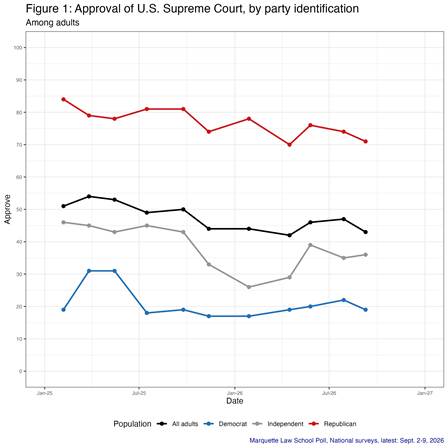
Table 2: Approval of U.S. Supreme Court, by party identification
Among adults
| Poll dates | Approval | ||
| Republican | Independent | Democrat | |
| 9/2-9/26 | 71 | 36 | 19 |
| 7/22-29/26 | 74 | 35 | 22 |
| 5/20-26/26 | 76 | 39 | 20 |
| 4/8-16/26 | 70 | 29 | 19 |
| 1/21-28/26 | 78 | 26 | 17 |
| 11/5-12/25 | 74 | 33 | 17 |
| 9/15-24/25 | 81 | 43 | 19 |
| 7/7-16/25 | 81 | 45 | 18 |
| 5/5-15/25 | 78 | 43 | 31 |
| 3/17-27/25 | 79 | 45 | 31 |
| 1/27-2/6/25 | 84 | 46 | 19 |
| Marquette Law School Poll, national surveys, latest: Sept. 2-9, 2026 | |||
| Question: Overall, how much do you approve or disapprove of the way the U.S. Supreme Court is handling its job? | |||
The survey was conducted Sept. 2-9, 2026, interviewing 1,023 adults nationwide, with a margin of error of +/-3.3 percentage points.
The perception that the Court has sided with the Trump administration rose by 5 points in September. Since the beginning of Trump’s second term, 60% of adults say the Court has ruled in favor of the administration often or fairly often, while 40% say it has done so rarely or never. In July, shortly after the end of a Court term in which several prominent decisions rejected administration arguments, 55% said the Court often or fairly often ruled for Trump. The September reading returns to about where it stood in May, at 61%, as shown in Table 3.
Table 3: How often has the Supreme Court ruled for Trump
Among adults
| Poll dates | How often for Trump | |
| Often/Fairly often | Rarely/Never | |
| 9/2-9/26 | 60 | 40 |
| 7/22-29/26 | 55 | 45 |
| 5/20-26/26 | 61 | 39 |
| Marquette Law School Poll, national surveys, latest: Sept. 2-9, 2026 | ||
| Question: Since the beginning of his second term, how often do you think the Supreme Court has ruled in favor of the Trump administration in cases that have reached the Court? | ||
Democrats are considerably more likely than Republicans to say the justices side with the Trump administration. In September, 75% of Democrats say the Court has ruled for Trump often or fairly often, compared to 56% of independents and 46% of Republicans. The September increase among all adults came from Republicans and independents, up 9 and 7 percentage points, respectively, from July. Democrats were little changed, declining from 77% to 75%. A slight majority of Republicans, 54%, continue to say the Court has rarely or never ruled for the administration. These results are shown in Table 4.
Table 4: Court has ruled for Trump, by party identification
Among adults
| Poll dates | Ruled for Trump often/fairly often | ||
| Republican | Independent | Democrat | |
| 9/2-9/26 | 46 | 56 | 75 |
| 7/22-29/26 | 37 | 49 | 77 |
| 5/20-26/26 | 45 | 47 | 79 |
| Marquette Law School Poll, national surveys, latest: Sept. 2-9, 2026 | |||
| Question: Since the beginning of his second term, how often do you think the Supreme Court has ruled in favor of the Trump administration in cases that have reached the Court? | |||
A modest majority of adults continue to think the Court is trying to steer clear of a confrontation with the president, identical to the July results. In September, 54% say the Court is going out of its way to avoid making a ruling that Trump might refuse to obey, while 46% saying it is not avoiding such a ruling. This perception has been quite stable, ranging only from 54% to 57% across the seven polls since September 2025, as shown in Table 5.
Table 5: Has Court avoided ruling against Trump
Among adults
| Poll dates | Avoided or not | |
| Is going out of its way to avoid | Is not avoiding a ruling | |
| 9/2-9/26 | 54 | 46 |
| 7/22-29/26 | 54 | 46 |
| 5/20-26/26 | 57 | 43 |
| 4/8-16/26 | 57 | 43 |
| 1/21-28/26 | 57 | 43 |
| 11/5-12/25 | 56 | 44 |
| 9/15-24/25 | 55 | 45 |
| Marquette Law School Poll, national surveys, latest: Sept. 2-9, 2026 | ||
| Question: Do you think the U.S. Supreme Court is going out of its way to avoid making a ruling that President Donald Trump might refuse to obey? | ||
The parties see this quite differently, and the gap widened in September. Among Democrats, 78% say the Court is going out of its way to avoid a ruling against Trump, as do 57% of independents, while just 28% of Republicans say so. Republicans are less likely to hold this view than in any poll since the question was first asked in September 2025, a period in which they have previously ranged from 31% to 37%. Views among independents and Democrats rose by a slight 2 percentage points from July. These results are shown in Table 6.
Table 6: Is Court avoiding ruling against Trump, by party identification
Among adults
| Poll dates | Is avoiding ruling against Trump | ||
| Republican | Independent | Democrat | |
| 9/2-9/26 | 28 | 57 | 78 |
| 7/22-29/26 | 32 | 55 | 76 |
| 5/20-26/26 | 33 | 60 | 80 |
| 4/8-16/26 | 33 | 66 | 79 |
| 1/21-28/26 | 34 | 59 | 78 |
| 11/5-12/25 | 37 | 58 | 74 |
| 9/15-24/25 | 31 | 58 | 81 |
| Marquette Law School Poll, national surveys, latest: Sept. 2-9, 2026 | |||
| Question: Do you think the U.S. Supreme Court is going out of its way to avoid making a ruling that President Donald Trump might refuse to obey? | |||
A majority of adults continue to see the justices as more motivated by politics than by law. In September, 57% say the justices’ decisions are motivated mainly by politics, while 42% say they are motivated mainly by the law. This is hardly changed from 58% in July. Opinion was evenly divided in March and May of 2025, when 50% said politics and 50% said the law, but in every other poll of Trump’s second term, a majority has said politics is the more common motivation, as shown in Table 7.
Table 7: What motivates justices’ decisions
Among adults
| Poll dates | Motivation | |
| Mainly politics | Mainly the law | |
| 9/2-9/26 | 57 | 42 |
| 7/22-29/26 | 58 | 42 |
| 5/20-26/26 | 52 | 48 |
| 11/5-12/25 | 55 | 45 |
| 9/15-24/25 | 56 | 44 |
| 7/7-16/25 | 55 | 45 |
| 5/5-15/25 | 50 | 50 |
| 3/17-27/25 | 50 | 50 |
| 1/27-2/6/25 | 54 | 46 |
| Marquette Law School Poll, national surveys, latest: Sept. 2-9, 2026 | ||
| Question: In general, what most often motivates Supreme Court justices’ decisions? | ||
More Republicans believe justices are mainly motivated by the law, 59%, with 41% saying politics. Among independents, 54% say politics motivates the justices, as do 74% of Democrats. These results are shown in Table 8.
Table 8: Motivation of decisions, by party identification
Among adults
| Party ID | Motivation | |
| Mainly politics | Mainly the law | |
| Among all adults | 57 | 42 |
| Republican | 41 | 59 |
| Independent | 54 | 46 |
| Democrat | 74 | 26 |
| Marquette Law School Poll, national surveys, latest: Sept. 2-9, 2026 | ||
| Question: In general, what most often motivates Supreme Court justices’ decisions? | ||
Heard or read about the Supreme Court
The public pays modest attention to the Supreme Court. Asked how much they had heard or read about the Court in the past month, 24% of adults say a lot, 61% say a little, and 15% say nothing at all. For comparison, 35% in this survey say they heard a lot about the national debt reaching $40 trillion, 38% heard a little, and 27% heard nothing. At the high end of attention, 78% heard a lot about the death of Dolly Parton, while at the low end just 7% heard a lot about the pennant races in Major League Baseball.
Democrats are the most attentive to the Court, with 31% hearing a lot, compared to 21% of Republicans and 13% of independents. Independents are also the most likely to have tuned out entirely, with 24% hearing nothing at all about the Court, as shown in Table 9.
Table 9: Heard or read about Court, by party identification
Among adults
| Party ID | Heard or read about Court | ||
| A lot | A little | Nothing at all | |
| Among all adults | 24 | 61 | 15 |
| Republican | 21 | 63 | 15 |
| Independent | 13 | 63 | 24 |
| Democrat | 31 | 57 | 12 |
| Marquette Law School Poll, national survey, Sept. 2-9, 2026 | |||
| Question: Thinking about the last month only, how much have you heard or read about the U.S. Supreme Court? | |||
Proposals to change the Court draw less attention than the Court itself. Just 18% of adults say they have heard or read a lot about proposals to increase the number of justices or to have justices serve fixed terms, while 55% have heard a little and 27% have heard nothing at all. Here it is Republicans who are most likely to have heard a lot, 23%, compared to 17% of Democrats and 9% of independents. More than 4 in 10 independents, 42%, say they have heard nothing at all about these proposals, as shown in Table 10.
Table 10: Heard or read about Court reforms, by party identification
Among adults
| Party ID | Heard or read about Court reforms | ||
| A lot | A little | Nothing at all | |
| Among all adults | 18 | 55 | 27 |
| Republican | 23 | 50 | 27 |
| Independent | 9 | 49 | 42 |
| Democrat | 17 | 61 | 22 |
| Marquette Law School Poll, national survey, Sept. 2-9, 2026 | |||
| Question: How much have you read or heard about proposals to increase the number of justices on the Supreme Court, or to have justices serve a fixed term on the Court? | |||
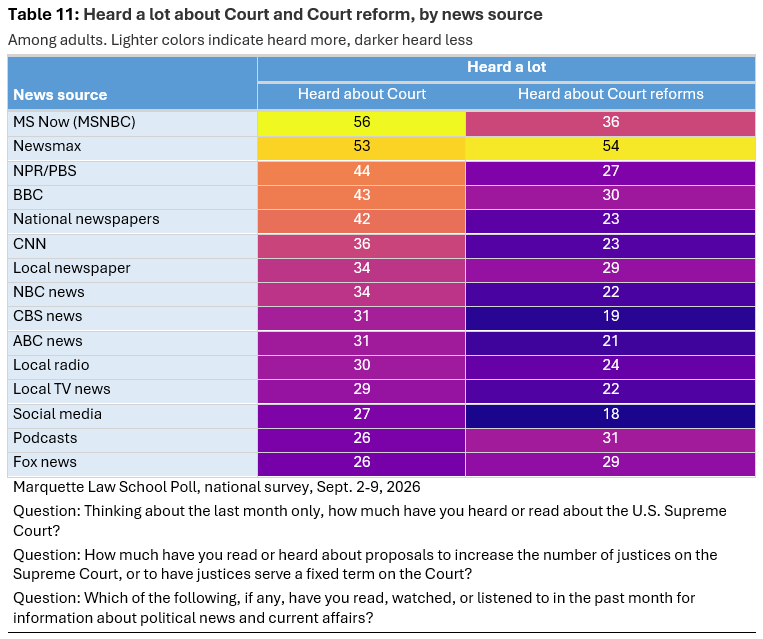
Attention to the Court and to proposals to change it varies considerably with the news sources people say they rely on, a difference that reflects both the content of those sources and the self-selected audiences that gravitate to them. The audiences for MS Now (formerly MSNBC) and Newsmax are the most likely to say they heard a lot about the Court in the past month, 56% and 53%, followed by NPR/PBS at 44% and the BBC at 43%. Those who rely on Fox News, podcasts, and social media are the least likely to have heard a lot, 26% to 27%. For Court reform proposals, attention is lower than for the Court itself among nearly every audience, with one striking exception: 54% of the Newsmax audience heard a lot about the reform proposals, slightly more than its audience that heard a lot about the Court. The MS Now audience is next, well back at 36%, while fewer than a quarter of those relying on CNN, national newspapers, the major broadcast networks, or social media heard a lot about the court reform proposals. Table 11 shows the percentage hearing a lot about the Court and about Court reforms by news source, with lighter colors indicating more attention and darker shades less.
Preferences for Court reform
Each of three proposed changes to the Supreme Court receives majority support, though by quite different margins, as shown in Table 12.
- Enforcing a strict ethics code for the justices is nearly universally popular, favored by 89% and opposed by 10%.
- Having justices serve a fixed term rather than a life term is favored by 79% and opposed by 21%.
- Increasing the number of justices on the Court is the most contentious of the three, favored by 53% and opposed by 47%.
Table 12: Favor or oppose proposed Court reforms
Among adults
| Proposal | Favor or oppose | |
| Favor | Oppose | |
| Enforce strict ethics code for justices | 89 | 10 |
| Limited terms for justices | 79 | 21 |
| Increase number of justices | 53 | 47 |
| Marquette Law School Poll, national survey: Sept. 2-9, 2026 | ||
| Question: [Increase the number of justices on the U.S. Supreme Court] How much do you favor or oppose the following proposals affecting the Supreme Court? | ||
| Question: [Have justices serve a fixed term on the U.S. Supreme Court rather than serving life terms] How much do you favor or oppose the following proposals affecting the Supreme Court? | ||
| Question: [Enforce a strict ethics code for Supreme Court justices] How much do you favor or oppose the following proposals affecting the Supreme Court? | ||
Support for an ethics code crosses party lines, favored by 91% of Republicans, 81% of independents, and 91% of Democrats. The proposal of fixed terms for justices also draws substantial majority support from each partisan group, though Democrats are the most enthusiastic at 88%, compared to 75% of independents and 71% of Republicans. Expanding the Court is the one proposal that divides the parties substantially, favored by 68% of Democrats and 56% of independents but by just 35% of Republicans. These results are shown in Table 13.
Table 13: Favor or oppose Court reforms, by party identification
Among adults
| Party ID | Favor or oppose | |
| Favor | Oppose | |
| Enforce strict ethics code for justices | ||
| Republican | 91 | 9 |
| Independent | 81 | 19 |
| Democrat | 91 | 9 |
| Limited terms for justices | ||
| Republican | 71 | 29 |
| Independent | 75 | 25 |
| Democrat | 88 | 12 |
| Increase number of justices | ||
| Republican | 35 | 65 |
| Independent | 56 | 44 |
| Democrat | 68 | 32 |
| Marquette Law School Poll, national survey, Sept. 2-9, 2026 | ||
| Question: [Increase the number of justices on the U.S. Supreme Court] How much do you favor or oppose the following proposals affecting the Supreme Court? | ||
| Question: [Have justices serve a fixed term on the U.S. Supreme Court rather than serving life terms] How much do you favor or oppose the following proposals affecting the Supreme Court? | ||
| Question: [Enforce a strict ethics code for Supreme Court justices] How much do you favor or oppose the following proposals affecting the Supreme Court? | ||
Current cases before the Court
On Sept. 14, after the completion of this poll, the Supreme Court ruled against the Trump administration’s request to allow it to move ahead with a plan for the U.S. Postal Service to screen absentee ballots against a list of registered voters and to withhold delivery of absentee ballots to voters not on that list. Earlier, on Aug. 24, the Court had allowed the Trump administration to move ahead with planning this policy while a lower court continued to weigh constitutional and statutory challenges to the legality of the president’s executive order.
Sixty percent of adults say the lower courts should rule that the executive order to the Postal Service is an unconstitutional attempt to seize control of election rules from the states, while 39% say the order should be allowed to take effect. Republicans stand apart from the rest of the public on this question, with 74% saying the order should take effect, while 64% of independents and 91% of Democrats call it unconstitutional. These results are shown in Table 14.
Table 14: Allow executive order on Postal Service and absentee ballots, by party identification
Among adults
| Party ID | Allow order or not | |
| Allow executive order to take effect | Order is unconstitutional | |
| Among all adults | 39 | 60 |
| Republican | 74 | 26 |
| Independent | 36 | 64 |
| Democrat | 9 | 91 |
| Marquette Law School Poll, national survey, Sept. 2-9, 2026 | ||
| Question: On Aug. 24, the Supreme Court allowed the Trump administration to move ahead with planning for restricting the use of mail ballots even as a lower court continues to weigh the legality of Trump’s executive order. The executive order requires the U.S. Postal Service to develop a list of eligible voters and to not deliver absentee ballots to any voter who is not on the list, even if state election officials have sent the voter a ballot. Do you think that the executive order should be allowed to go into effect, or should the lower courts rule that it is an unconstitutional attempt to seize control of election rules from the states? | ||
The Court will hear a case in the coming term asking whether the Second Amendment guarantees the right to possess AR-15 and similar semiautomatic rifles. The public is closely divided, with 52% saying the Court should rule that there is not a constitutional right to these rifles and 48% saying it should rule that there is. Republicans say there is such a right by 72% to 28%, and Democrats say there is not by 74% to 26%. Independents divide almost exactly as the country as a whole does, 51% to 49%, as shown in Table 15.
Table 15: Second Amendment right to AR-15 rifles, by party identification
Among adults
| Party ID | Right to possess or not | |
| There is a right to these rifles | There is not a right to these rifles | |
| Among all adults | 48 | 52 |
| Republican | 72 | 28 |
| Independent | 49 | 51 |
| Democrat | 26 | 74 |
| Marquette Law School Poll, national survey, Sept. 2-9, 2026 | ||
| Question: The U.S. Supreme Court will hear a case asking whether the 2nd Amendment guarantees the right to possess AR-15 and similar semiautomatic rifles. Do you think the Supreme Court should rule there is a constitutional right to possess AR-15 and similar rifles or that there is not a right to these kinds of rifles? | ||
On Aug. 31, the Supreme Court allowed construction to continue on a large ballroom on the site of the former East Wing of the White House, setting aside a lower court ruling that would have halted the work. Fifty-eight percent of adults oppose the Supreme Court decision, and 41% favor it. The partisan divide is wide, with 78% of Republicans favoring the decision, while 69% of independents and 88% of Democrats oppose it, as shown in Table 16.
Table 16: Favor or oppose decision on ballroom construction, by party identification
Among adults
| Party ID | Favor or oppose | |
| Favor | Oppose | |
| Among all adults | 41 | 58 |
| Republican | 78 | 22 |
| Independent | 31 | 69 |
| Democrat | 12 | 88 |
| Marquette Law School Poll, national survey, Sept. 2-9, 2026 | ||
| Question: On Aug. 31, the Supreme Court allowed construction to continue on a large ballroom on the site of the former East Wing of the White House. This decision reversed a lower court ruling that would have halted construction. How much do you favor or oppose this Supreme Court decision? | ||
About the Marquette Law School Poll
The survey was conducted Sept. 2-9, 2026, interviewing 1,023 adults nationwide, with a margin of error of +/-3.3 percentage points.
Wording of questions about recent Supreme Court cases: These items do not attempt to exactly frame the particular issues in specific cases but rather address the topic in more general terms. The questions were worded as follows:
- On Aug. 24, the Supreme Court allowed the Trump administration to move ahead with planning for restricting the use of mail ballots even as a lower court continues to weigh the legality of Trump’s executive order. The executive order requires the U.S. Postal Service to develop a list of eligible voters and to not deliver absentee ballots to any voter who is not on the list, even if state election officials have sent the voter a ballot. Do you think that the executive order should be allowed to go into effect, or should the lower courts rule that it is an unconstitutional attempt to seize control of election rules from the states?
- The U.S. Supreme Court will hear a case asking whether the 2nd Amendment guarantees the right to possess AR-15 and similar semiautomatic rifles. Do you think the Supreme Court should rule there is a constitutional right to possess AR-15 and similar rifles or that there is not a right to these kinds of rifles?
- On Aug. 31, the Supreme Court allowed construction to continue on a large ballroom on the site of the former East Wing of the White House. This decision reversed a lower court ruling that would have halted construction. How much do you favor or oppose this Supreme Court decision?
Interviews were conducted using the SSRS Opinion Panel, a national probability sample with interviews conducted online. Other data from this survey focusing on national political issues were released on Sept. 16. The detailed methodology statement, survey instrument, topline results, and crosstabs for this release are available on the Marquette Law School Poll website.