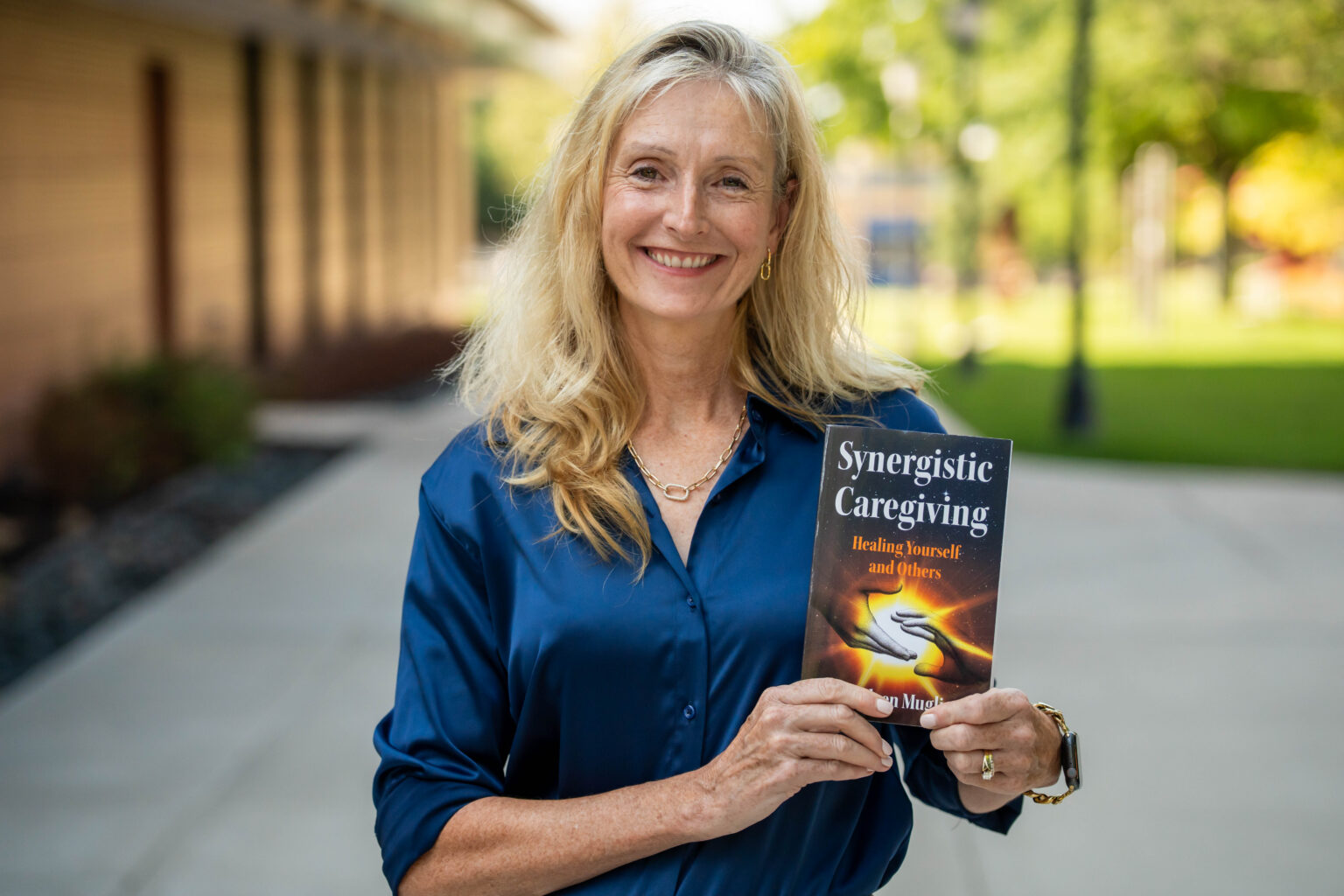
When Dr. Kathleen Muglia, clinical professor in the College of Nursing, was writing her book, she had her father on her mind.
“He helped me become the caregiver that I am,” Muglia says.
She also thought of her mother, still volunteering at the senior center and driving others to doctor appointments at 87 years old. She thought of her husband, who she says gives her the support necessary to care for others, both as a nurse and as a professor. She thought of her children, her co-workers and a hundred other people who provided inspiration for the book, either through their own caregiving or by demonstrating its necessity.
They all helped form the basis of “Synergistic Caregiving: Healing Yourself and Others,” which came out in late 2025. In the book, Muglia asserts that caregiving is not a one-way act of sacrifice, but rather a relationship in which both caregiver and recipient can experience growth, healing and transformation.
BOOK EXCERPT:
I remember sitting across from a mother in my office. Her teen daughter had been spiraling down with her grades dropping, friends disappearing, and the brightness in her eyes fading. But as much as she tried to help her, nothing was working. The harder she pushed, the more distant her daughter became. As her daughter became more irritable, disrespectful, and sad, her mom became more frustrated, irritable, and sad. She couldn’t reach her daughter because she hadn’t yet learned how to reach herself.
The mother’s struggle was familiar, one I’d witnessed again and again. Trauma trickling down through generations. She carried the weight of anxiety and depression from her own childhood, and now, as she tried to support her daughter through similar pain, old wounds reopened, sharp and stinging, like salt poured into a cut. The harder she worked to care for her child, the more depleted she became. What she really needed was permission to care for herself; to put on her own oxygen mask first.
True caregiving isn’t about prioritizing others’ needs before our own. We need to look inward to see how we can help ourselves, so we can better help others. When parents heal, especially the mother, the entire family benefits.
Could you define what synergistic caregiving means?
It’s an idea I developed that providing care for others is mutually beneficial if you’re caring for yourself, as well. In caring for yourself, you are better able to care for others, and it will lead to a synergy where you’re both better off.
What was the impetus for writing this book?
I’ve been a pediatric nurse practitioner specializing in mental health for 30 years. I’ve seen a lot of burnout in my line of work that got me thinking about how we can do things better. I also think people need to realize we are all caregivers. This is not a book for professional nurses, doctors and therapists. It’s a book for everyone. We care for ourselves, our families, our neighbors, our pets and our colleagues, among many other things. In a way, we are all caregivers.
To what extent is getting people to recognize that they are a caregiver part of your broader mission to care for them?
A lot of people need to recognize themselves as caregivers. When they do, I think they can benefit from what professional caregivers have to teach them. A lot of the audience for this book is women who are in what we’re calling the sandwich generation, where they’re taking care of their elderly parents and then still taking care of children too. That’s the kind of person I had in mind when writing this book.
What kind of feedback have you gotten on the book?
A lot of people have liked that the book gives specific tips that are easy to follow. Some examples of the subjects we cover are guilt and how not to feel guilty about caring for yourself. Many people feel guilty taking care of themselves, and so I try to help people see the connection between caring for others and making sure that they’ve taken care of themselves.
People have said that this really resonated with them; that they could take these little nuggets of information and apply them immediately to their life. Others have said that it felt like having a conversation with a good friend who really understood what they were going through.
You are an animal-assisted therapist; what potential do you see for animals to help in people’s self-care process?
Animals, especially horses, have a huge ability to help us heal. They don’t see our title, they don’t see our bank account, they can slow our heartbeats and help us regulate our nervous systems. People learn things like trust, boundaries and respect when working with animals that they can apply to the rest of their lives.
You mention that there are a lot of stories in this book about caregivers. Where are those stories drawn from?
They’re psychiatrists, therapists, professors — people from all walks of life. They’re everyday caregivers, people who have been through traumatic brain injuries and recovered, family members of mine who have cared for ALS victims. There’s one person in the book who has multiple sclerosis. She’s bedridden, but she has so much joy in her life, and I wish everyone could live with her mentality.
What I want people to take away is that this is not an academic book. It’s not about how to be a caregiver. It’s about how to care for yourself as you do it. We know people learn through stories and tend to remember them; that’s why I included so many in this book.