By the time most courses reach exam week, finals often follow a familiar formula: a research project, the big semester-long essay or a cumulative exam. Finals are designed to test students’ knowledge and understanding — but one course in the Klingler College of Arts and Sciences pushes the boundaries of what a final can be.
In ENGL 4616: Moby Dick, taught by Dr. Amy Blair, professor of English, students are tasked with a project that feels almost too simple: combine their major field of study withi what they’ve learned from Herman Melville’s classic novel and create something entirely new.
The assignment has inspired years of inventive interpretations, revealing how a nearly 200-year-old novel continues to resonate in surprising ways. For students from across the university, the project becomes an opportunity to connect their academic interests, professional aspirations and creativity through a fresh reading of “Moby-Dick.”
Before students begin their final projects, Blair helps them recognize the novel’s enduring influence on modern culture.
“’Moby-Dick’ has become a huge part of our culture. People recognize the characters and the basics of the story — and that’s become a big part of the media we enjoy today,” Blair says. “It’s impossible to look at films like ‘Jaws’ or ‘Star Trek II: Wrath of Khan’ without seeing the direct references to Moby-Dick.”
A midterm assignment encourages students to explore those connections firsthand. They search their hometowns, favorite childhood media and popular culture for traces of Melville’s influence. Whether it’s cartoons, music, movies or even the name of Starbucks, students begin to see how the famous white whale jumps off the page and into the world around them.
From there, students begin to plan how they can adapt “Moby-Dick” into a project that speaks to their interests, their major, and their future aspirations.
Throughout the final project, Blair guides students to think outside the box and challenge themselves to see a new perspective into the classic novel. The result is rarely a traditional paper. Instead, students produce projects that blend literary analysis with the knowledge and skills they’ve developed in other disciplines.
“This is the opportunity to be as creative as you can be,” Blair says. “I’ve had business students write budgets and investment strategies for the ship’s crew; physical therapy students create simulations of the stress on Captain Ahab’s wooden peg-leg; engineering students who discuss the force required for whale hunting and so much more.”
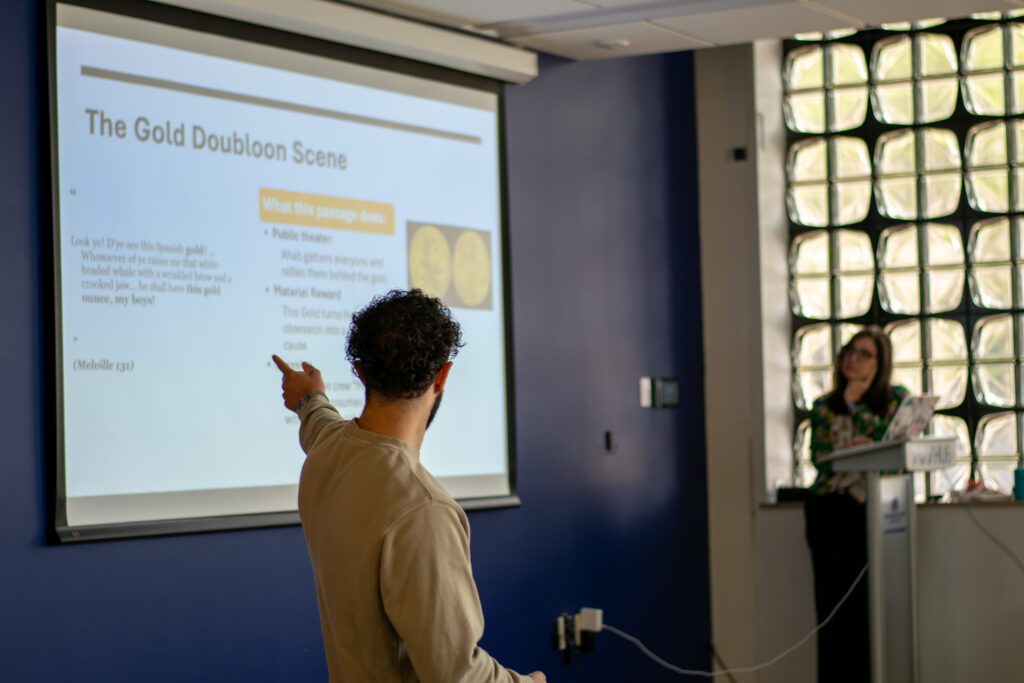
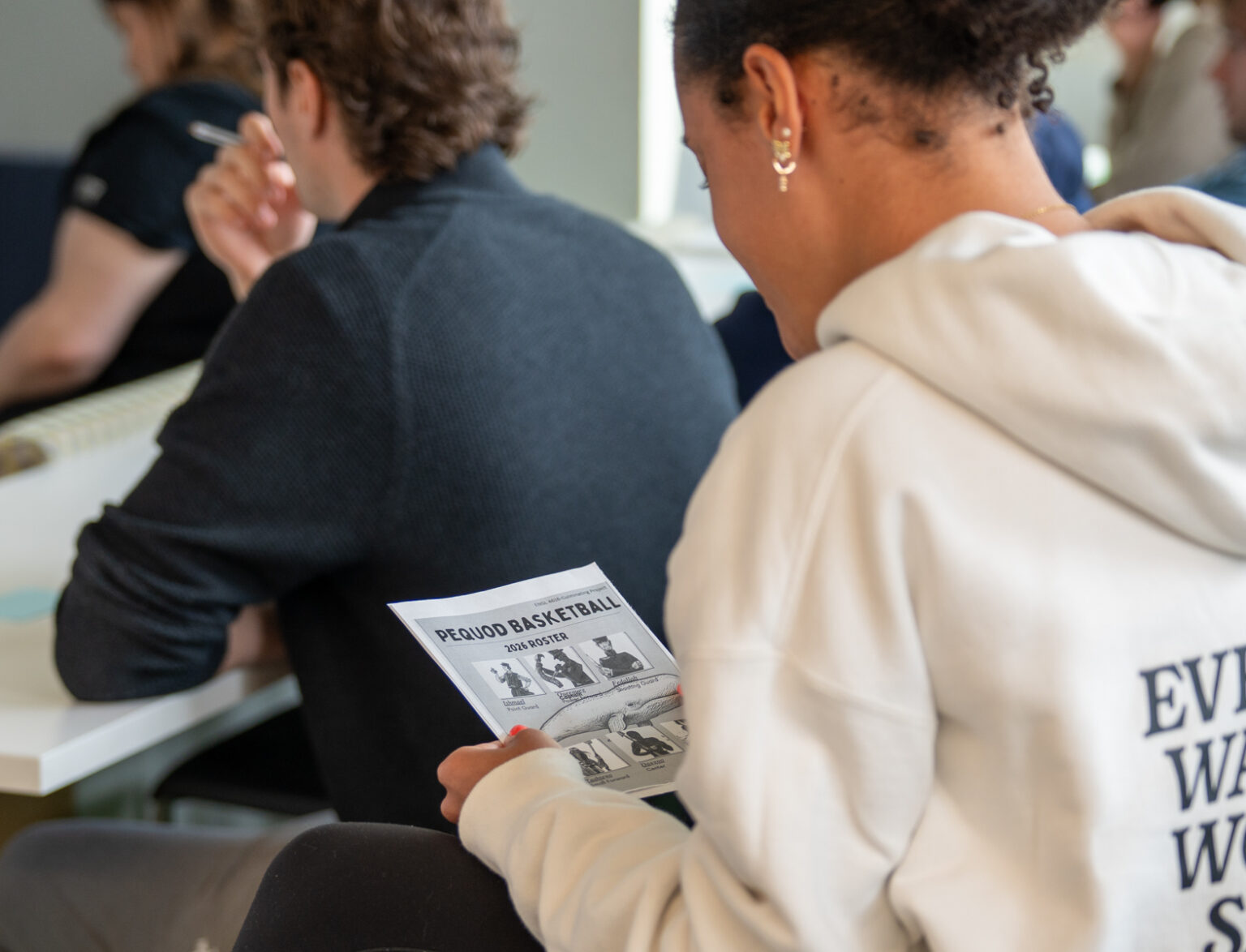
Other projects have included modernizations of “Moby-Dick,” with students creating onboarding videos for the crew’s modern-day human resources team aboard the Pequod or designing professional websites for whaling-based digital commerce. A day that would have been full of presentations turns into a gallery of inventions and interdisciplinary learning.
Blair is especially proud of the project management skills that students gain from such an open-ended assignment. “Taking the time to find something new, creating a plan to design it and research it, and following a timeline to reach that goal on time, are all important steps for any student after college,” Blair says. “This project gives them an opportunity to practice all of those skills in a meaningful way.”
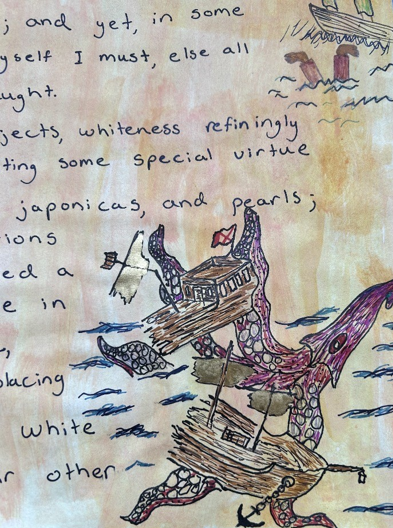
Mari Huglin, Arts ’25, currently serves as a reporter on the South Coast of Massachusetts, not too far from where “Moby-Dick” begins. Huglin took the course in her last semester at Marquette and utilized the project to blend her three majors — English literature, international affairs and history, along with a minor in Innovation and Entrepreneurship.
Combining a love for medieval literature with the study of language and politics, Huglin created a replica medieval manuscript retelling the chapter “The Whiteness of the Whale” in medieval English — complete with hand-drawn illustrations modeled after illuminated manuscripts.
“There’s just so much going on in “Moby–Dick” that everyone can connect to something from it,” Huglin says. “It’s such a fun read because it is broad yet specific, and incredibly relatable. I really enjoyed learning through the lens of my classmates, and I hope they also learned something from mine.”
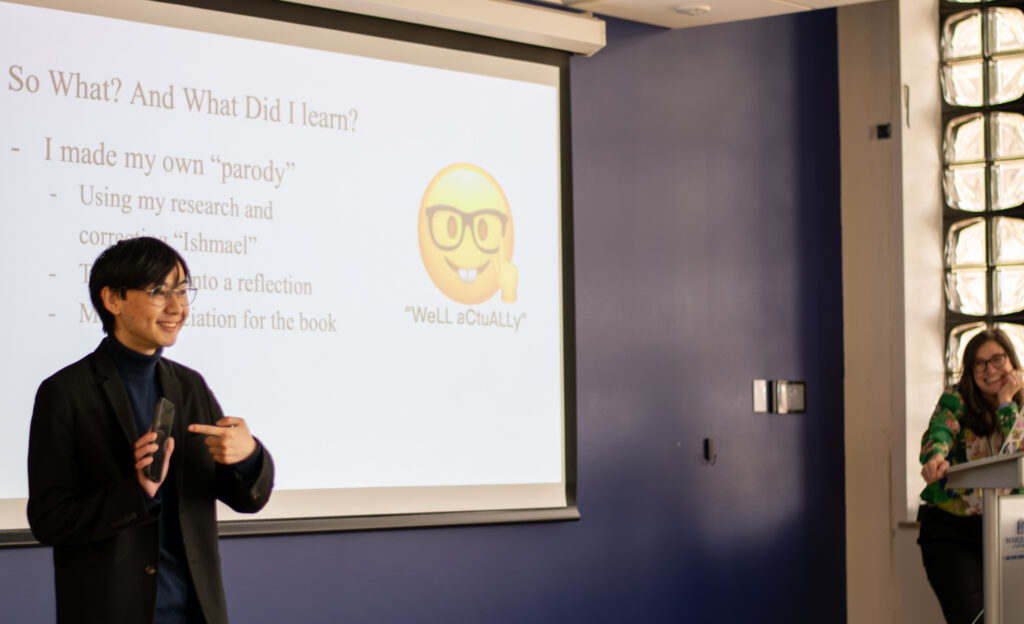
The final presentations provide students with perspectives they might never encounter elsewhere. One project might offer a theological interpretation of the novel, while another uses artificial intelligence to analyze shifts in tone and language throughout the text. In sharing their work, students teach one another as much as they learn themselves.
By the end of the semester, “Moby-Dick” feels less like a traditional literature course and more like a collaborative exploration of ideas, creativity and discovery. For a novel written nearly two centuries ago, Melville’s white whale continues to inspire students to venture into uncharted waters — and to find new meaning in a classic work along the way.