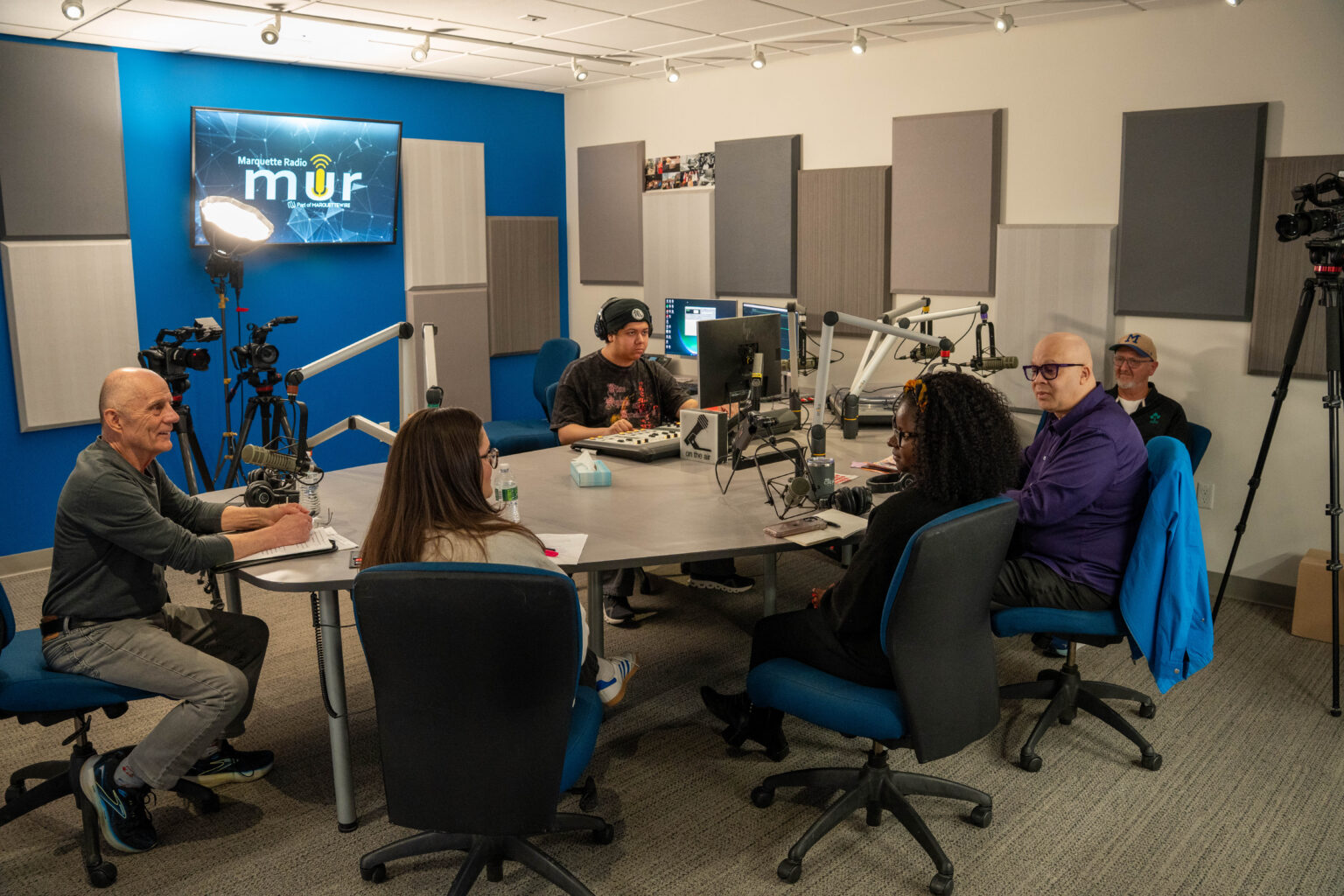
An audio studio sits in the middle of the second floor of Johnston Hall. Through its door is a booth; on the wall is the schedule for that week’s student radio show lineup scrawled on a large whiteboard. Another door leads to a recording room: a large table ringed with eight microphones, accompanying headsets, an audio control board and a computer sits in the middle of it.
It is, as Don Hertz calls it, “one of the largest and best equipped audio recording spaces in the Midwest.”
“I’d never worked in a recording space this nice,” says Hertz, Johnston Hall’s manager of technical services.
Dave Murphy needed just such a space. The former vice president of marketing and communication for the university is also a member of Milwaukee’s Rotary Club and host of the organization’s Connections podcast. Murphy works closely with fellow Rotarian and host Tom Luljak, the former interim director of Wisconsin Public Radio. Together, they invite outstanding members of the club to talk about the impact they’ve made on southeastern Wisconsin.
When Murphy and Luljak saw the recording studio for the first time, they knew they’d found a powerful asset to bring their podcast to the next level.
“It’s so spacious there, and it gives us the option to have a panel of people,” Murphy says. “We’re even exploring the idea of doing video podcasts. To have that component available to build into this is so exciting.”
Connections is far from the first time that Johnston’s recording studio has hosted people from off campus. Gesu Parish has produced a podcast there. Authors have stopped by the studio to record audiobooks. Students have become essential parts of these productions, taking jobs setting up the studio and editing the product as a way of gaining hands-on experience.
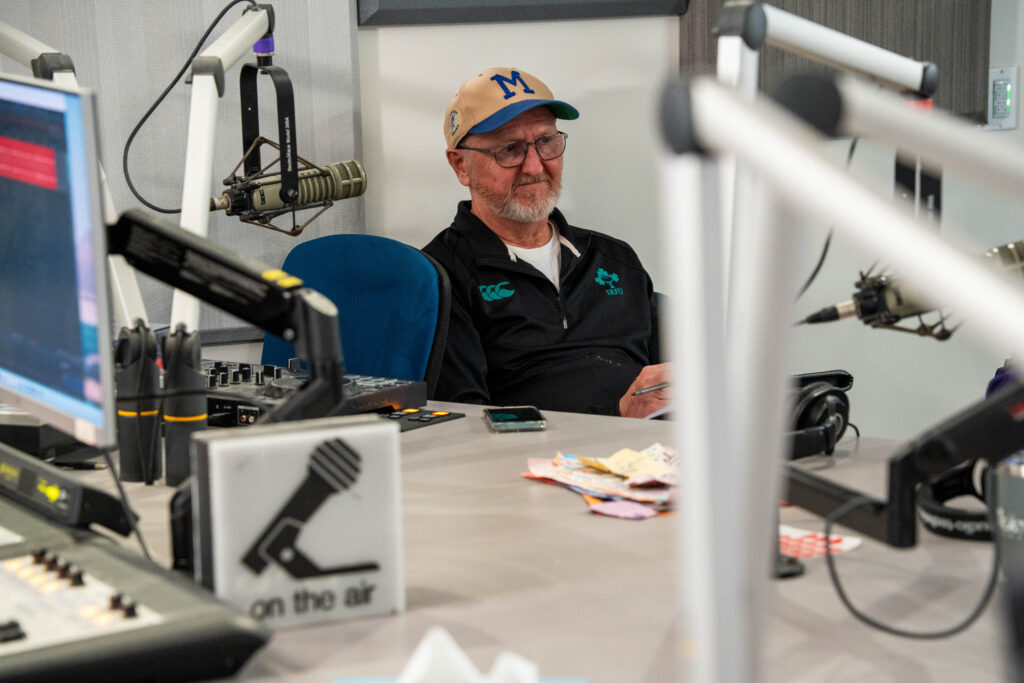
“Our goal is to always be focused on student education, so when we receive requests for using the studio, we’re always considering how to incorporate our students into the experience and what they can learn from it,” Hertz says. “Most of these podcasts are engineered, edited and posted by students with a long-term interest in professional audio production.”
Sometimes, the podcasts feature Marquette students, as the last episode of Connections did when Murphy and Luljak talked to Laura Johnson, a senior in the Opus College of Engineering and president of Marquette’s Engineers Without Borders chapter. The Rotary Club partners with the chapter to bring clean water to rural communities in Guatemala.
For Murphy, the podcast allows for a sense of connection to his former employer. He worked at Marquette for 13 years, and while he has been retired for five years, he still misses the youthful energy of campus.
“You see the redevelopment of the Wellness + Helfaer Recreation Center and all the building projects completed around campus: the energy is just palpable,” Murphy says. “I like to keep my finger on the pulse of this place. Plus, it’s always fun seeing students when I come in.”
The connection is more than a personal one for Murphy — he also sees clear ties between the two organizations’ missions.
“When you look at Marquette’s mission, it’s about searching for truth. That’s no different than Rotary,” Murphy says. “We have a weekly gathering where we invite speakers from all sectors to talk about different subjects. It’s ongoing learning, it’s community engagement, there’s a service aspect to Rotary too: there’s so much overlap.”
“The Rotary Club has been fantastic to work with. They bring in a variety of interesting guests from around Milwaukee and it’s fun to show off our facilities, as well as our students,” Hertz adds.
A second, spin-off podcast focusing on the local media landscape is under development in the same space. That podcast will be a partnership with the Milwaukee Press Club. Students are once again going to edit the podcast, extending the partnership between the Rotary Club and the Diederich College of Communication even further.