Hannah Anderson, a doctoral candidate at Marquette University and the Medical College of Wisconsin’s Joint Department of Biomedical Engineering, has received a Ruth L. Kirschstein National Research Service Award (F31) from the National Institutes of Health (NIH) – National Institute of Diabetes and Digestive and Kidney Diseases (NIDDK). This is a competitive federal fellowship that supports promising doctoral students conducting biomedical research.
Anderson, who has been in the PhD program in Biomedical Engineering for 2.5 years, credits an earlier milestone, the Marquette University Graduate School Dean’s Research Enhancement Award, with helping her sharpen her proposal and ultimately secure the prestigious NIH fellowship.
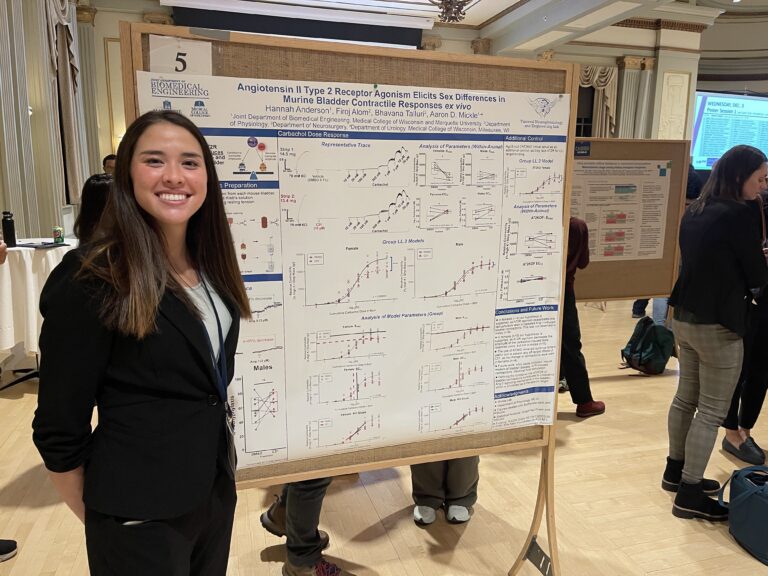
Anderson’s research focuses on whether the Angiotensin Type 2 Receptor plays a role in bladder function. Using a drug known as Compound 21, she studies its effects in mouse models to better understand its therapeutic potential. “This receptor is known to have positive roles in other bodily functions like blood pressure and blood flow,” Anderson explained. “I’m studying whether it could also have a beneficial role in bladder function.”
Her work has implications for patients living with interstitial cystitis/bladder pain syndrome, a debilitating chronic pain condition. Persistent bladder pain can significantly disrupt patient quality of life, limiting work, sleep, and overall well-being.
“Testing the efficacy of this drug in mice is the first step in seeing its potential for these patients and improving quality of life,” she said. “Conversely, if the drug has limited efficacy, that would still fulfill a knowledge gap in this area of research that’s been ongoing since the 1980s.”
Anderson first learned about the Dean’s Research Enhancement Award through an email announcement. At the time, she was already preparing an NIH F31 style grant proposal, a requirement of her doctoral qualifying exam in the Joint Department of Biomedical Engineering. Applying for the Dean’s award proved to be more than just a funding opportunity. The application required her to distill a six-page research training plan and a 15 plus page personal training plan into a concise, accessible format.
“Looking at my grant from a bird’s eye view for the Dean’s application helped me improve my NIH grant as I was making edits,” she said. The experience strengthened her proposal before she submitted it to the NIH’s National Institute of Diabetes and Digestive and Kidney Diseases, the funding institute for her fellowship.
Anderson is quick to emphasize that the NIH award was a collective achievement. Her advisor, Dr. Aaron Mickle, supported her throughout the process, candidly discussing the workload while encouraging her pursuit of independent funding. Dr. Justin Grobe served as a co-mentor and provided valuable guidance. She also benefited from a grant writing course at MCW taught by Dr. Joseph Barbieri. Departmental support was critical. Lisa Lahmann (BME) and Heather Clift (MCW Graduate School) reviewed her documents for clarity and completeness and assisted her with submission logistics amid shifting NIH guidelines.
Several faculty members reviewed drafts and offered scientific insight, including Dr. Curt Sigmund of MCW, Dr. Jim Hokanson of Marquette and MCW, and Dr. Ranjan Dash of Marquette and MCW. Her letters of recommendation from Dr. Dash, Dr. Nicholas Phillips of St. Jude Children’s Research Hospital and Dr. Jack Judy of the University of Florida were instrumental. Lab mates also contributed through data collection and daily research support. “It was a lot of work,” Anderson said. “But it was truly a team effort, and I was blessed to have so many resources supporting me.”
Anderson began working on the NIH proposal in August 2024, submitted it in April 2025, received her scientific review score in July 2025 and was officially notified of the award in February 2026.
The F31 fellowship supports promising predoctoral students who are United States citizens or permanent residents enrolled in research doctoral programs. The award is highly selective, particularly in today’s competitive funding climate.
“My motive for applying was to achieve a milestone during my PhD,” Anderson said. “I never expected the outcome. It was more of an exercise to create a scientific training plan and gain experience submitting an NIH grant. However, this funding now shows that I am able to obtain independent funding as a graduate student, which will be valuable for postdoctoral applications,” she said. “It also gave me confidence that I designed a research plan that a panel of experts considered viable. That confidence will drive the remainder of my dissertation and my career in science.”
Anderson hopes her experience will inspire other graduate students to pursue external funding. “There are many external funding sources,” she said. “Find the right one for you and your timeline. Besides NIH and NSF grants, there are also private fellowships that may be relevant to your project.”
Her strongest advice is simple. “Just apply. Even if you don’t think you will get it, the skills you gain from preparing an application are highly translatable to all areas of research. I learned so much about my project and myself through the process.”
She also encourages students not to be intimidated. “While it can be scary to ask for help, those around you will likely be impressed by your initiative and support you in any way possible.”
For Anderson, the Dean’s Research Enhancement Award was steppingstone that helped lead to the larger NIH award. By refining her vision and strengthening her proposal, it helped propel her toward national recognition and position her for a future of independent scientific discovery.
Want to read similar stories or have a success story to share? Visit Stories of Graduate Student Success to learn more.