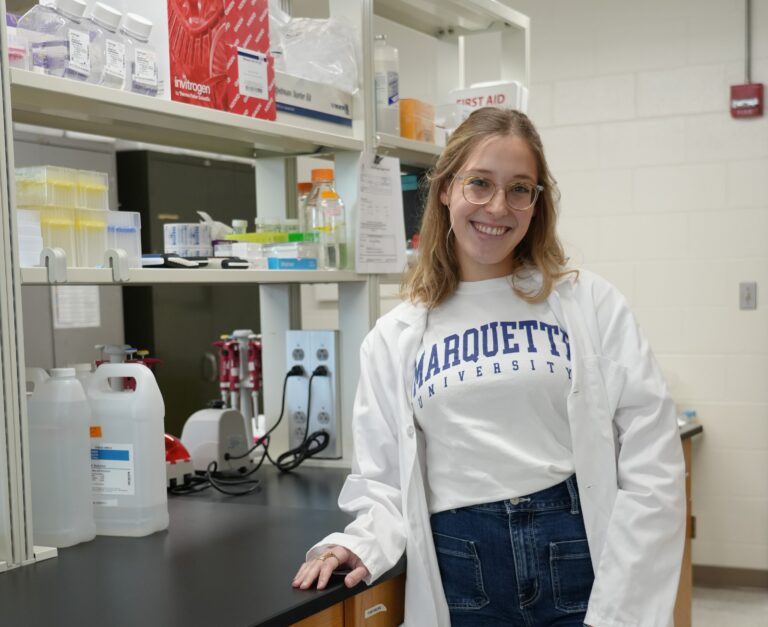
As she prepares to complete her fifth year as a doctoral student in the Neuroscience program at Marquette University, Gabriella Marino is shedding new light on how one of the most constant elements of daily life affects one of the most essential functions of survival. In recognition of her innovative research and scholarly impact, Marino has been awarded the Richard W. Jobling Distinguished Research Assistantship, a competitive honor that supports and encourages outstanding Ph.D. students in science and engineering. For Marino, the award is both affirming and transformative, providing critical support as she advances her research and mentorship efforts.
“The Jobling assistantship has alleviated my teaching responsibilities, so I have had far more time to conduct research and be an active and involved member of my lab,” she said. “It has provided me with the time and resources necessary to advance my own science and facilitate others’ science.”
Originally from Orland Park, Illinois, Marino earned her undergraduate degree at Marquette and chose to stay for graduate school because of the university’s tight knit and collaborative research environment. “I didn’t want to leave,” she said. “I consider myself very lucky to work side by side with such talented researchers.”
Marino’s dissertation focuses on an unexpected but critical relationship: the connection between light exposure and breathing. While both are constant features of everyday life, their interaction remains largely unexplored.
Previous research suggests that common respiratory diseases, such as asthma and sleep apnea, tend to worsen during the winter months, likely due to reduced light exposure. Marino aims to understand which light conditions can alter breathing patterns and to identify the specific cell populations and brain regions that link these processes.
Her findings so far are striking. “My favorite discovery is that even five minutes of light exposure in the dark can change your breathing for over an hour after the lights are turned back off,” she said. In a world where screens glow long after sunset, her work carries real world relevance. “You always hear people say, ‘Don’t go on your phones at night, it is bad for you.’ But the reasons why are not fully understood,” Marino said. “I am certainly guilty of using my phone and laptop long after the sun has gone down, so I find my work interesting because it applies to my own life, as well as to everyone around me.”
By uncovering how light affects breathing at the neural level, Marino hopes her research will inform future therapeutic targets for respiratory diseases and deepen understanding of how modern technology use may influence overall health.
Marino credits much of her growth and success to her research advisor, Dr. Deanna Arble, who she describes as “simply the best.”
“Dr. Arble is excited for me in the good moments and gives me a shoulder to lean on in the bad moments,” Marino said. “She shows up 100 percent for her students and strives to give them a fulfilling and holistic research experience. I would not be where I am today without her.” Marino also expressed gratitude to her dissertation committee, Drs. Mynlieff, Gilmartin and Streeter, for their mentorship over the past five years.
The Jobling assistantship has allowed Marino to deepen those mentorship experiences herself. With more dedicated research time, she has been able to work closely with undergraduate students in the Arble Lab. This semester, all four undergraduate researchers in the lab will attend a conference, a milestone Marino says makes her “so proud.”
Marino enthusiastically recommends the Jobling assistantship to other graduate students. She encourages applicants to share not only their research achievements but also their personal journeys. “The award committee wants to know who you are beyond just being a researcher,” she said. “Do not be afraid to talk about all of the cool things you have done to become the scientist you are today.” Students interested in learning more can connect with their Director of Graduate Studies or visit the Graduate School distinguished fellowships webpage.
When she is not in the lab studying neural circuits and light exposure, Marino can often be found with a book in hand. An avid reader, she has set a goal to read 40 books in 2026 and frequently visits the Department of Biological Science’s free little library to add to her growing list.
As she moves toward completing her doctoral degree, Marino’s research continues to illuminate how everyday habits, like flipping on a light or scrolling through a phone at night, may ripple through the brain in ways scientists are only beginning to understand. With the support of the Richard W. Jobling Distinguished Research Assistantship, she is well positioned to keep exploring those connections and inspiring the next generation of researchers along the way.
Want to read similar stories or have a success story to share? Visit Stories of Graduate Student Success to learn more.