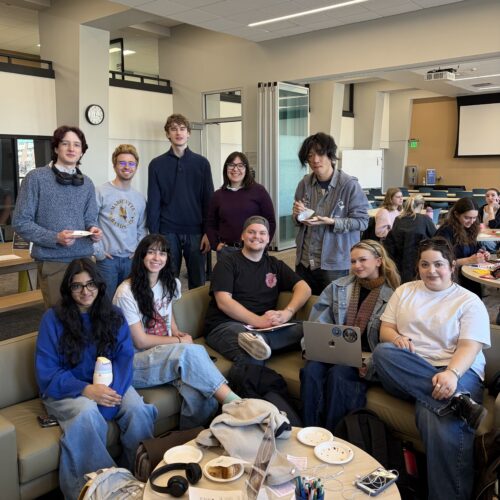

Some of the discussions in Assistant Professor of Journalism and Media Studies Dr. Patrick Johnson’s classes resemble philosophy more than journalism. While his students certainly learn how to use AP style and interview subjects for stories, Johnson doesn’t start his courses that way. Instead, he asks them some fundamental questions.
‘Where do students’ ethical and moral codes come from?’ ‘How do we question the way things are?’ ‘How can we be better?’
“The first thing I say to students in my classes is that I don’t care so much about what you want to be; I want to know who you are, because that is what matters,” Johnson, Ed ’11, Grad ’13, says.
That ethos underpins the Diederich College of Communication’s curriculum. As one of just two American Jesuit schools with freestanding communications colleges, Marquette places a premium on training communicators with a strong ethical foundation. In addition to a core curriculum rich in liberal arts subjects such as philosophy and theology, communication students are required to take multiple courses that teach professional ethics. These experiences help future communicators discern their own professional moral compass.
Discernment has become especially necessary in an environment where trust in media has fallen to its lowest level in history. Trust in many other core institutions has also declined precipitously. Deepfakes, spambots and large language models have all made the spreading of disinformation at scale easier than ever before, creating a hostile information environment for consumers to navigate.
“If a CEO or a leader makes a harmful decision, we talk about the implications of that decision and how it might have been made.”
Dr. Katharine Miller, assistant professor of organizational and corporate communication,
Multiple tenured and tenure-track faculty members in the College of Communication study the dynamics of how to restore this trust. Johnson, an assistant professor of journalism and media studies, studies how the news can represent marginalized communities, engage new audiences and strengthen democracy. He regularly incorporates concepts from his research into applied classroom experiences.
“I’m super project-based and I love to do service learning as well,” Johnson says. “We just partnered with the Urban Ecology Center on a project in our class and we had a big discussion about if it was ethical to use any AI on the materials we were developing for them. And as soon as we found out how much water it wasted, we thought it wouldn’t be good to do that for a project about safeguarding the environment.”
The focus on ethics goes well beyond journalism. Dr. Young Kim, an associate professor of strategic communication, spends his time developing best practices for crisis communicators. A former public affairs officer in the Korean military, Kim came to America almost two decades ago because he wanted to study a deeper understanding of crisis communication theories and their appropriate applications. The communications climate has shifted more in that time than most people could have imagined.
“My current project has to do with the correction of misinformation and disinformation, particularly driven by AI, and I’ve shared a lot of information with my classes about deepfakes, AI and the potential impacts for organizations that fail to be proactive,” Kim says. “You have to make your correction messages authentic and transparent, and establishing a reputation for that can help you enhance resilience against misinformation and disinformation.”
Meanwhile, Dr. Katharine Miller, assistant professor of organizational and corporate communication, focuses on approaches to measuring and implementing corporate social responsibility initiatives. Her courses favor case studies as a method of learning, pulling recent examples from news headlines and walking through them with students.
“If a CEO or a leader makes a harmful decision, we talk about the implications of that decision and how it might have been made,” Miller says. “Where was the misalignment from an organizational standpoint, and how would students have righted the wrong if they oversaw communication? We try to work through how that decision might work.”
For both Johnson and Miller, the inclination toward ethics as a research focus started when they were students at Marquette. Johnson recalls taking classes from college stalwarts like Professors Emerita Dr. Karen Slattery and Dr. Ana Garner. Now, Johnson occupies Slattery’s old office.
“Karen taught the graduate-level ethics class, and she also taught the undergraduate media ethics course that I now teach, so it was this passing of the torch both in terms of classes and in terms of physical space,” Johnson says. “They were really the ones who instilled this importance of discernment around media ethics.”
“Being back at Marquette, now teaching a lot of the social responsibility principles we both learned as students, that’s a really cool, full-circle moment for both of us,” Miller says.
As advances in technology pose new challenges for communicators, moral clarity will be an increasingly important asset. The Diederich College of Communication puts development of this clarity in sharp focus, preparing the next generation of communications professionals for whatever the future holds.