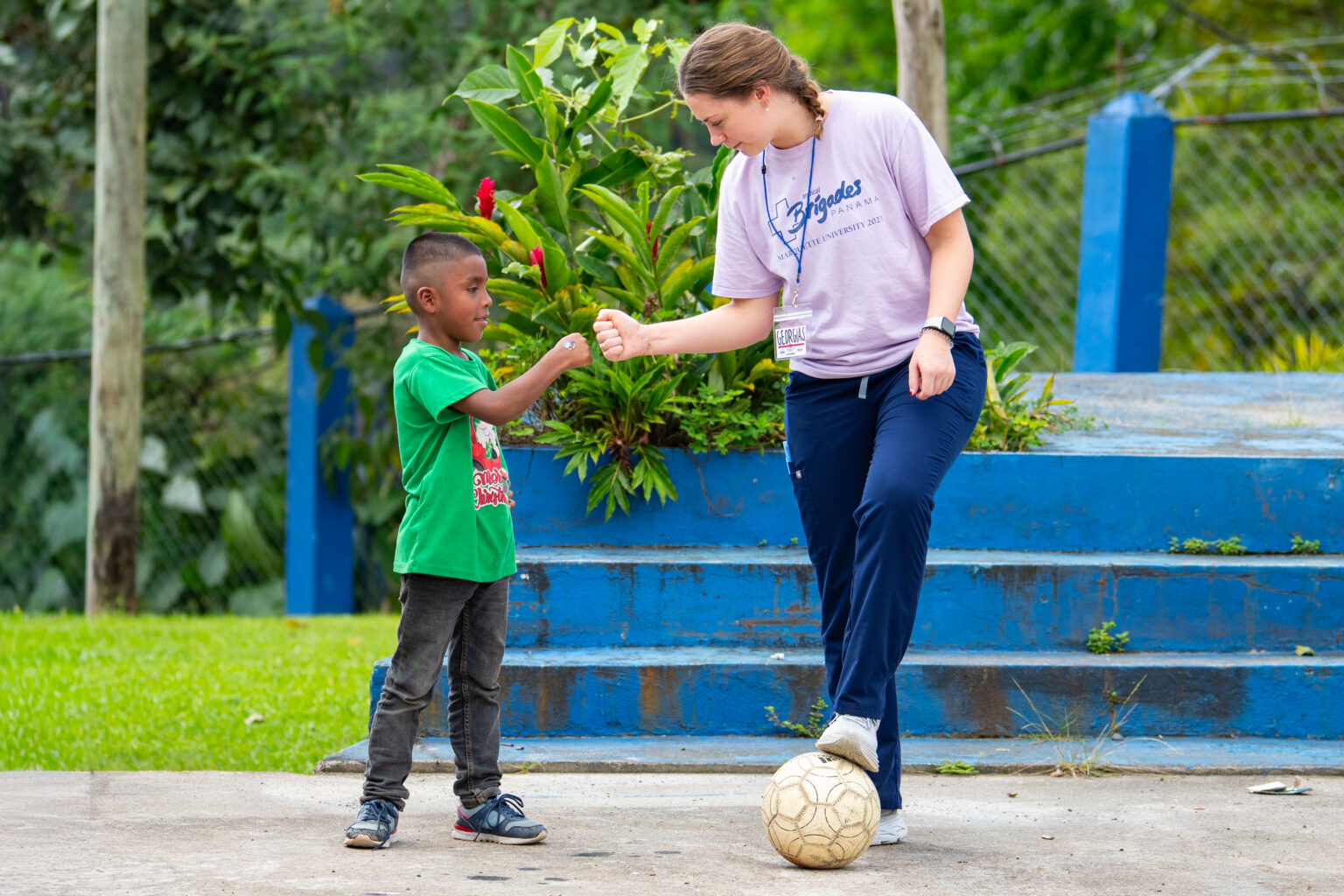
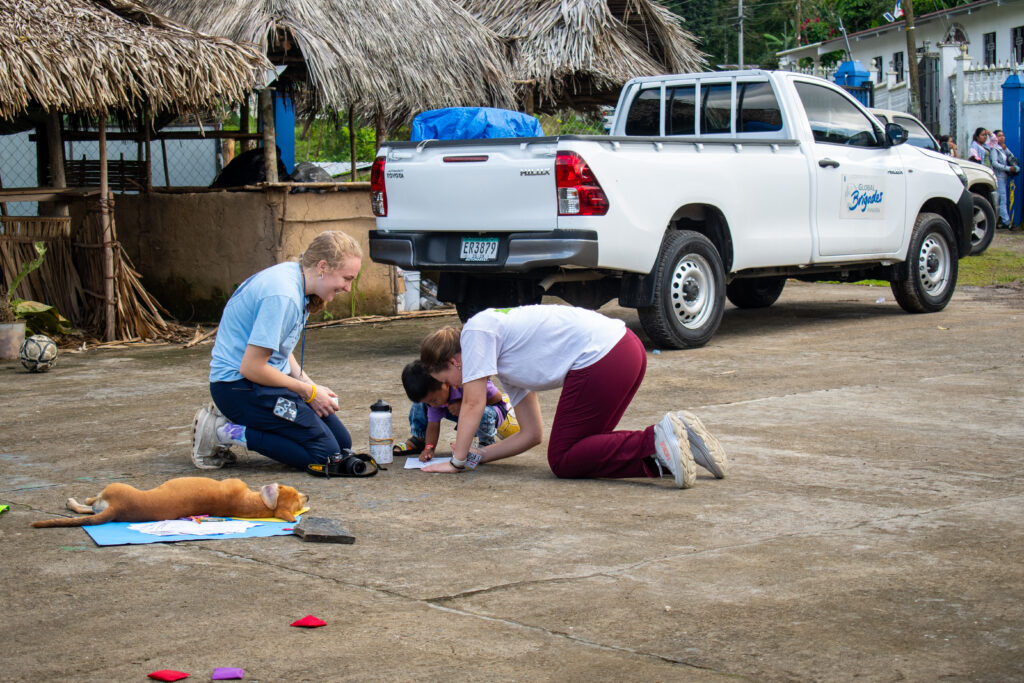
On a humid, sunny day in Coclé, Panama, the sound of soccer balls skipping across cement fills the air. Children run around with faces full of stickers, the sound of their laughter echoing off the cinderblock walls. Coloring sheets flutter in the breeze as unattended crayons roll away.
It looks like a school, maybe a midday recess period. But instead, those sounds are the result of Marquette University students and their work volunteering with Global Brigades.
The week that some 40 students spend on the Global Medical Brigade is packed full of valuable learning experiences, including shadowing physicians and dentists and practicing basic triaging skills. Most impactful of all, however, is the chance to work in the “charla” room.
“Charla” means “chat” in Spanish. It is arguably the most important aspect of Global Brigades as the nonprofit works to provide sustainable care to people in need.
“It is crucial to find a way to make the brigade impactful beyond the few days that we are there,” says Global Brigades Student Leader Sarah Winkler. “Charla is one of the most tangible ways this mission of sustainability comes through.”
Biomedical Sciences student Tess Roubik was in and out of the charla room throughout this year’s brigade. She recognized how Global Brigades sets itself apart from other organizations by committing to work with communities, rather than simply providing care, then leaving.
“Through our presentations, we were able to connect with community members because we met them where they were, rather than assuming a single approach would work for everyone,” Roubik says. “Charla is not only about the information we share, but also about the effort we make to meet people in their own language and on equal ground.”
This year’s Charla topic was oral hygiene. Before the three days of clinic, students created posters to present to community members. Both the posters and the oral presentations were in Spanish.
They even went so far as to dress up as large tubes of toothpaste and toothbrushes to entertain community members while using large props to show how to properly brush teeth and floss.
Even though not every student was fluent in Spanish, they fought through their pronunciation mistakes to educate people and spread newfound knowledge throughout the community.
“During our first presentation, I stumbled and stuttered over my words, but instead of disinterested stares, I was met by community members leaning forward, fully invested in the information we were presenting,” says Biomedical Sciences student Niraj Abraham.
As a student leader, Winkler was able to see firsthand how excited students were for charla presentations and the impact the station had on them. This allowed her and fellow leaders to take their presentations to the next level. They investigated substitutes for toothbrushes, floss and toothpaste and expanded their presentations to include how the whole body suffers the consequences of poor oral health, concluding with why it’s important to take care of baby teeth even if they’re going to fall out.
“Incorporating all of this deeper, more nuanced information engaged the community and gave them a better understanding of why we presented the initial material,” Winkler says.
Winkler spoke with a 97-year-old man who needed dental work during the clinic and while he was in the charla room, she says he was “immensely engaged” and had not heard most of the information before.
“Afterwards, he said he was going to tell his grandchildren about the presentation, hand the flyers we gave him to other community members, and even told us that the work we were doing was so beneficial for their community,” Winkler says. “Watching that man’s posture and attitude summarizes the reason we do Charla, and the reason Global Brigades changes lives forever.”
Molding mission-driven leaders
The Global Brigades experience can play an important role in helping students discern what kind of clinician they want to be and how they ultimately want to practice.
“I learned the importance of connecting with individuals and building a sense of mutual trust,” Biomedical Sciences student Georgia Sabbe says. “I believe my time and lessons learned in Charla will help me become a more caring, empathetic and compassionate health care provider.”
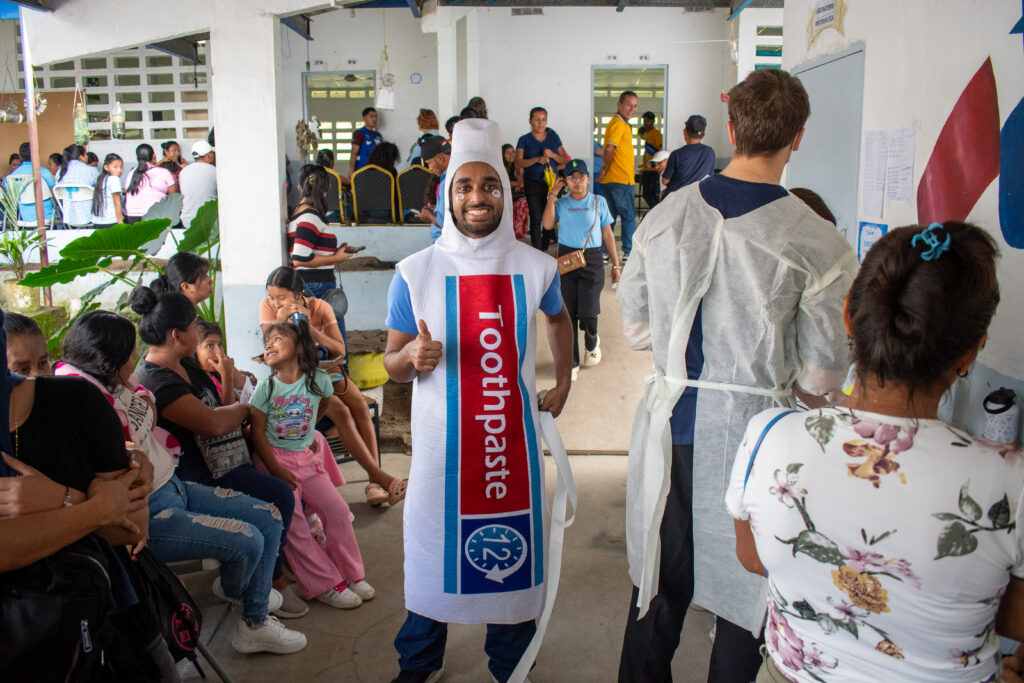
The charlas aren’t solely about education. A large part of students’ responsibilities during charlas is simply building relationships with the community. With community members and their families lining up for care as early as 2 a.m. — seven hours before the clinic even opened — it can be a long day for those seeking care. Students assigned to charlas also took turns entertaining children while their parents received their medical consults or had dental work completed.
“Going with my mantra to always give my all, I was fully dressed in the toothpaste costume, trying to play soccer without falling because I saw the kids’ faces light up with joy,” Abraham says. “It was the first time I had seen kids grab their stomachs in pain due to laughing so much.”
“Working with kids is particularly important because it encourages them to create a positive relationship with healthcare and personal hygiene,” Roubik added. “Playing soccer, sitting with them, and offering stickers and coloring sheets usually lead to children spending most of the day in charla and learning more.”
Abraham has career aspirations of becoming a physician and wants to use what he learned from what he experienced during charlas to ensure every patient is heard.
“I want every patient to be respected as a human being with their own aspirations, dreams, troubles and fears,” Abraham says. “I want each patient to feel secure and open to talk about their struggles and hardships. Through charla, I’ve learned to better connect with others with compassion and empathy, even when facing a language barrier.”
“Being in Charla has taught me that compassion must be in the heart of any interaction between provider and patient.”
During her time on brigade, Roubik says she learned to be more mindful of the language she uses, even growing averse to the word “help,” feeling that it focuses on an individual’s own virtue rather than the partnership needed to make sustainable health care a reality.
“We serve communities, working with them to ensure their independent success,” Roubik says. “Developmental growth would not be possible without the community members’ continued effort and engagement, and our role in that is to provide them with the resources they need to succeed on their own.”
Through Charla, Sabbe realized how special an opportunity it is to connect with the community.
“Over my years as a brigader, Charla has become special to me because of the personal connections I have made with community members, in a way that you do not always get in other parts of the brigade,” Sabbe says.
Roubik says during her time at Marquette, she has learned to embody Cura Personalis and see people as the result of countless social, cultural and systemic factors instead of their medical conditions.
I think it’s important to avoid labeling people simply because we are providing a service,” Roubik says. “We are all people, and I choose to ground my work in empathy. Charla, and Global Medical Brigades as a whole, taught me why that approach matters.”