“I want to talk.”
For most people, it’s a polite ask to add to a conversation; other times, it’s a stern demand to get their point across.
But for Nathan Justus, 34, it was more than that. It was a desperate plea to get back the one thing in his life he so badly wanted to regain.
Nathan was working on July 3rd, 2024, when he was the victim of a tragic road rage incident, suffering a gunshot wound to the head.
What followed were months of intensive rehab to try to bring his life back to a state of normalcy. He’s working on regaining use of his right arm. He learned how to walk again.
“Speech has been the hardest thing to relearn,” Nathan says, slowly, but confidently and clearly.
As a result of his traumatic brain injury, Nathan developed aphasia — a disorder that limits someone’s ability to speak as well as understand spoken and written language — and his initial speech interventions were not what he hoped for in terms of regaining his speaking abilities.
His wife Courtney Justus says other therapists would drill him to make sure he could say five things perfectly: his name, birthday, Courtney’s name, his dog’s name, and what happened to him.
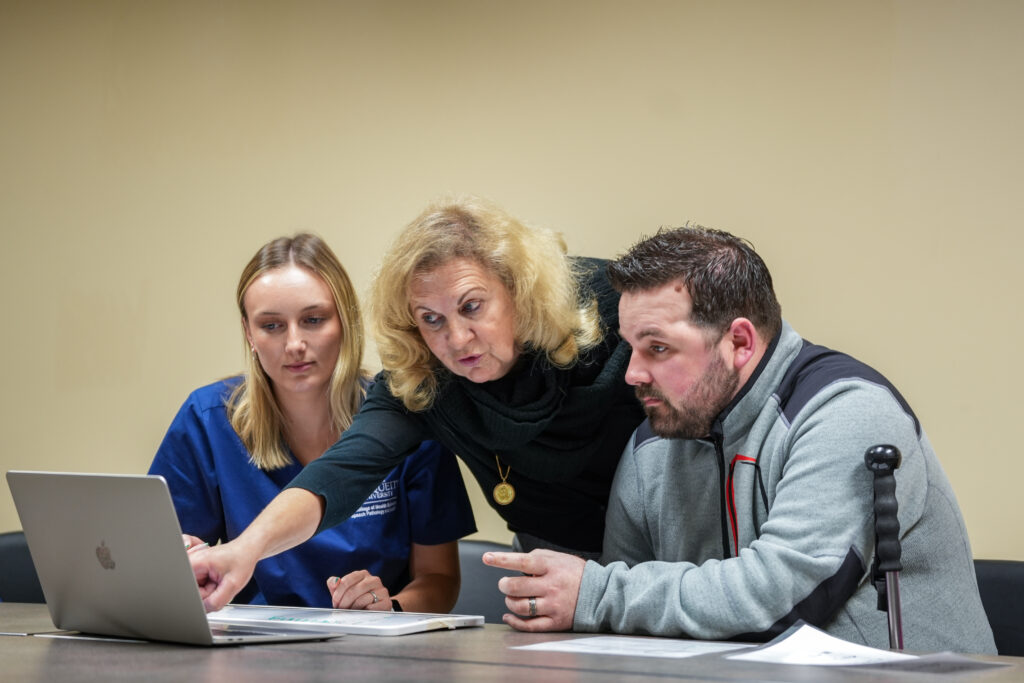
And when the speech pathologists would have him use a communication tablet, he would keep pressing one phrase: “I want to talk.”
Enter Marquette University’s Intensive Comprehensive Aphasia Program, which piloted its first client in 2008 and was one of the first programs of its kind in the U.S.
The program is a rare resource in Wisconsin and the Midwest that designs individualized programs for clients in the chronic state of aphasia and necessitates incorporating the principles of neuroplasticity.
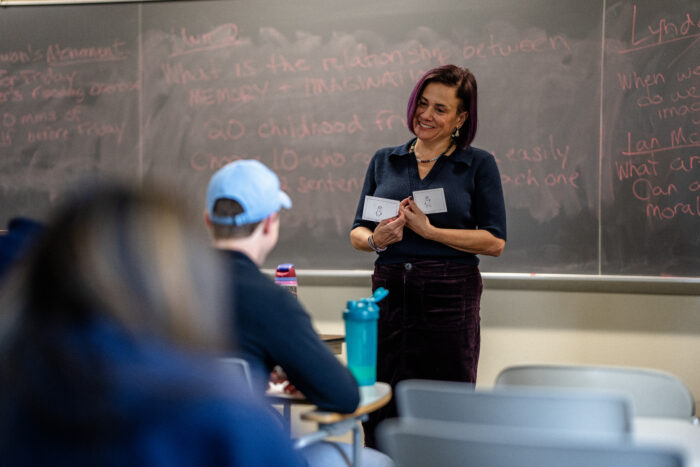
Tina Puglisi-Creegan, clinical associate professor of speech pathology directs the ICAP and designs its therapy interventions. She spoke of the close team effort needed to make this a successful experience.
“My colleagues Katie Cording and Mary Kalhagen are invaluable to the clinical education and hands-on training of our graduate students in this practicum,” Tina says. “They work tirelessly ensuring that students are delivering interventions as taught and that clients are progressing as anticipated.”
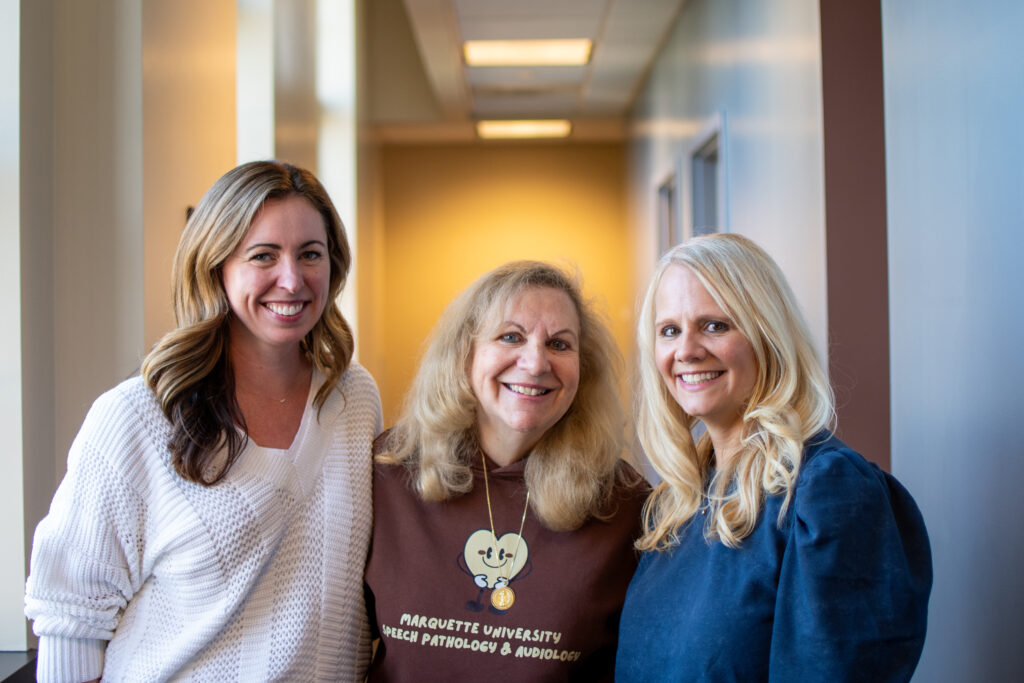
Tina calls the program a powerhouse and a statewide asset because of its state-of-the-art therapy techniques, its impact on students and clients and its affordability as clients oftentimes have heavily reduced fees thanks to donations from Marquette benefactors.
“Katie, Mary and I are a well-seasoned team that has been involved in this kind of therapy delivery for a long time,” Tina says. “It is satisfying to pass these specialized therapy skills down to our students. They are the future of aphasia rehabilitation and the skills are hard to come by.
Tina says there are two components which elevate Marquette’s program from a standard intensive aphasia program to the comprehensive status it holds: conversational group therapy and client/family education, which are integrated in the experience.
“Our clients and their families must understand how to apply the strategies used and replicate them at home,” Tina says. “The client is with us three plus hours per day for 3 weeks learning how to access semantic networks and improve their verbal output, but progress can stagnate if they are not speaking enough or using multiword output at home.”
Courtney says she has enjoyed learning Nathan’s therapies on the fly, and it has helped her keep him accountable at home.
“No more one-word answers,” Courtney says. “I watch the students work with him here and they assure him that he doesn’t have to get every test 100% right; he can make progress toward the right answer. Slowly, it has this ladder effect. The more in-depth they get with his therapy, the faster it all comes together for him and now he is speaking in full sentences.”
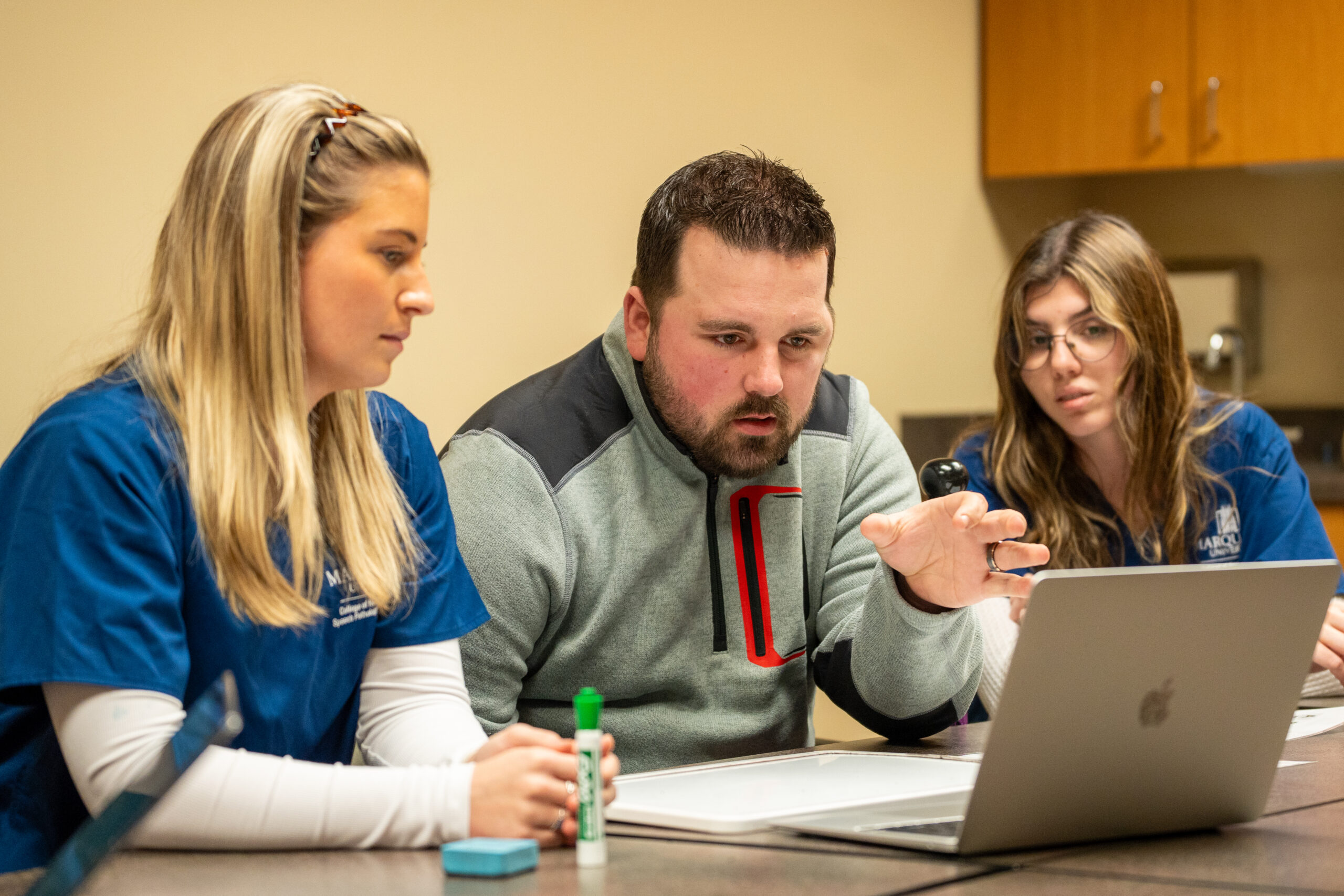
Throughout his therapy, students present goal-directed activities that target specific language skills. This method enhances language reorganization toward improved sentence formulation.
“Our students are rigorously trained, and we’ve developed resources to teach, reinforce, and promote reorganization of speech and language abilities.”
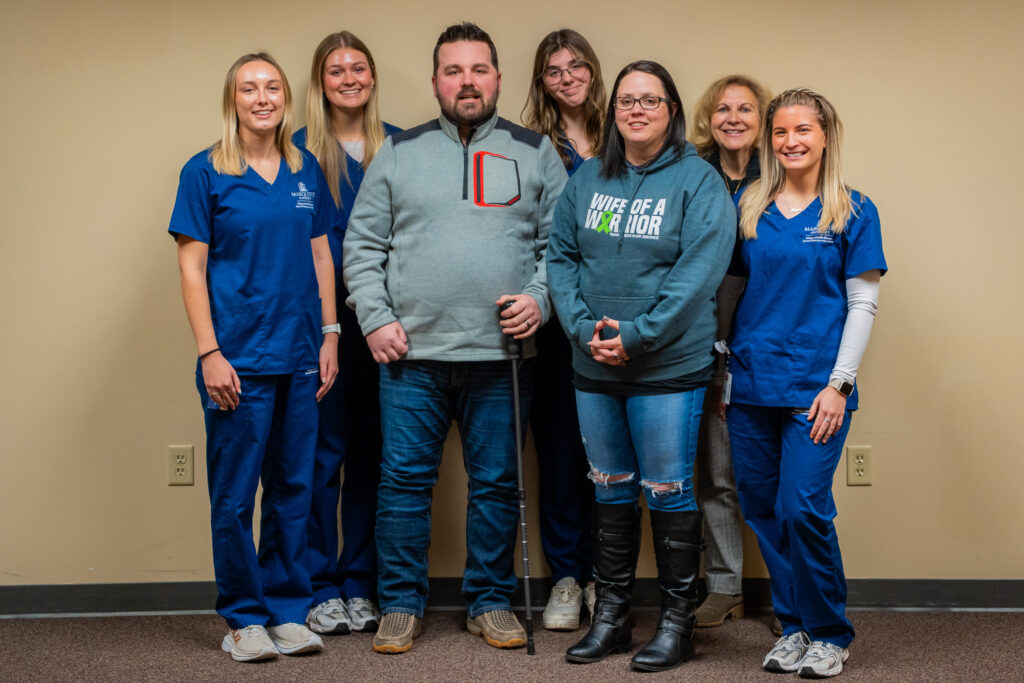
Courtney says the whole team’s energy level and how they’ve treated Nathan throughout his therapy has made her appreciative. She says prior to his therapy at Marquette, Nathan was reserved and closed off, rarely leaving the house.
“He’s the most social he’s been since his accident,” Courtney says. “He’ll come out into the living room when we have people over now. I’ve even walked in on him having a conversation with his friend on the phone, which I was beyond shocked about.
“It’s all those little things that Tina, Katie, Mary and the students do that make us and other people comfortable with coming here.”
Nathan says it has been refreshing to participate in Marquette’s program, going as far as to say it’s been, in a good way, overwhelming.
“All the time, the students teach me,” Nathan says. “They got my voice back.”
For more information on Marquette’s Intensive Comprehensive Aphasia Program, click here.