A good caregiver made all the difference in the world to Elise Battle’s family growing up.
The Marquette alumna has a brother with special needs that necessitated frequent medical interventions. Elise paid careful attention to how nurses attended to her brother. She always felt better when those nurses went the extra mile.
“I remember what a difference it would make to have a nurse or a nurse practitioner who took really good care of us, and how much better we would all feel going home from the hospital,” Battle says. “I knew I wanted to become something like them, to care for patients in ways similar to how they cared for us.”
That conviction led Battle to enroll in the Doctor of Nursing Practice program with a focus on pediatric acute care. Marquette offers six certificate and degree paths in pediatric nursing spread out over three programs: a post-master’s certificate, a Master of Science in Nursing degree and a Doctor of Nursing Practice degree, all in both acute care pediatrics and primary care pediatrics.
Jill Kuester, director of the pediatric acute care nurse practitioner program, says Marquette trains its future NPs to think more broadly about health care by centering on families, not just patients.
“You’re not just working with the kid — you have to work with a family dynamic and that can run the gamut of a single parent, two parents, all the way up to grandparents, aunts and uncles,” Kuester says. “You get to see how important this little person really is to them. Building that trust can be challenging, but also very rewarding as well.”
“There’s a lot of communication happening there, both verbal and nonverbal, because you have to share information with the family and then think about what’s the right way to share it with the child in an age-appropriate way,” adds Betsy Flasch, a clinical pediatric instructor and the primary care program director.
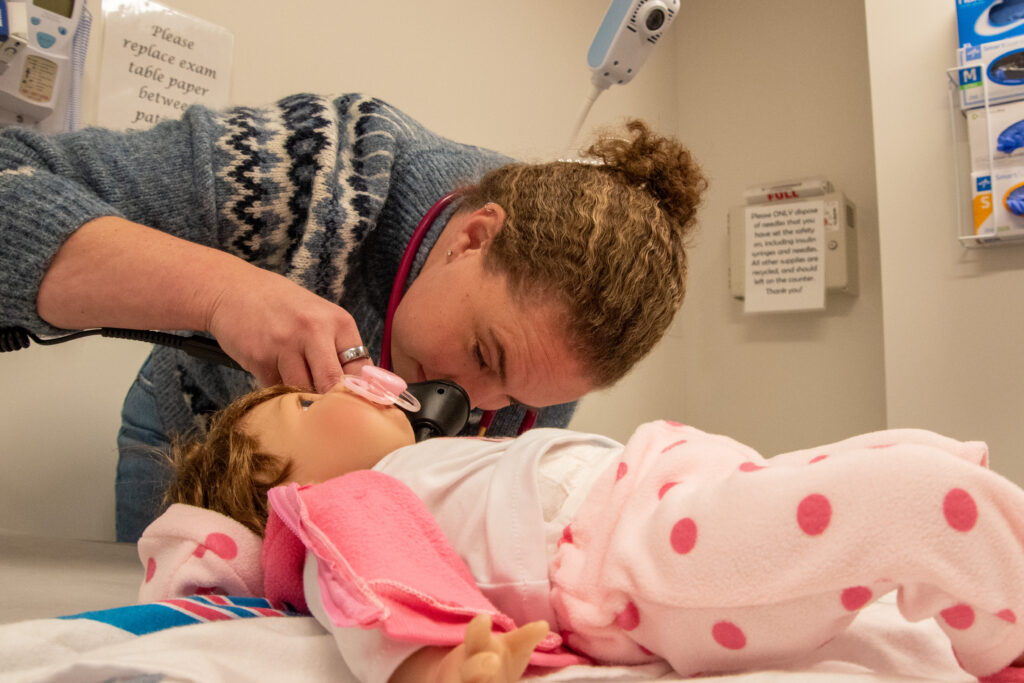
Marquette designs its program to make it as straightforward as possible for students to fulfill their degree requirements. Unlike many advanced practice programs, Marquette has clinical placement coordinators that match students with high-quality preceptors, forming the basis of long-lasting relationships. Most of that is made possible by program graduates, who appreciate the wisdom passed down from their own preceptors and want to do the same for the next generation of advanced practice nurses.
The curriculum also ensures that students earn more than enough clinical hours. While 500 clinical hours are the requirement for certification, MSN students complete 750. Building these extra hours into the graduation requirements ensures that Marquette nurses will enter the field very well prepared for their post-graduation jobs.
Marquette also offers a dual-track program: if students take four semesters of clinicals instead of three, they become dually trained in primary care and acute care and are eligible to take both certification exams and practice across the continuum of care.
“I love Marquette. I couldn’t ask for a better job or career pathway than to teach the future of nursing at a place like this.”
Betsy Flasch, primary care pediatric program director
Although the acute care program comes with rigorous requirements, it’s also flexible enough to allow students to maintain their careers. During Battle’s time in the program, she spent three days per week working 12- to 14-hour shifts in the pediatric intensive care unit at Children’s Wisconsin. When her clinicals started, Battle dropped down to two days per week of work, which allowed career and academics to exist side by side.
“I was lucky I had a very supportive fiancé who did not let me touch a dish or do a load of laundry, but it all worked out,” Battle says.
Students who go through these programs learn more than just how to take care of patients. Kuester intentionally includes leadership development and social justice education in the curriculum, in accordance with Marquette Nursing’s mission to be a force for positive change in the profession. Events like Nurses Day at the Capitol and service-learning opportunities in classes give students a chance to put that mission into practice.
The intentional formation of the nurse as a person, not just as a professional, is a big part of the reason Flasch feels such an attachment to Marquette.
“I love Marquette. I love everything about it,” Flasch says. “I couldn’t ask for a better job or career pathway than to teach the future of nursing at a place like this.”
Although pediatric nurses have to deal with emotionally heavy cases, those who choose the profession find that the constant presence of children brings lightness to the job that makes even the most challenging days worthwhile.
“Even when kids are sick, they’re still kids. You can always have a little fun with them,” Kuester says. “They’re incredibly resilient in a way that’s inspiring.”