Stress is a universal part of the human experience — and universally miserable when it turns chronic or severe. It can raise your blood pressure, disrupt your sleep, weaken your immune system and so much more. But some of its most damaging, and least understood, effects happen inside the brain, says Marquette’s Dr. Matthew Hearing, H Sci ’03, associate professor of biomedical sciences. Prolonged stress can impair decision-making, increase vulnerability to depression and anxiety, and reduce the brain’s ability to adapt to meet life’s challenges.
With nearly $4.5 million in federal research funding, Hearing is investigating how the brain changes in response to both chronic stress and opioid use — two separate conditions that show surprising parallels in how they damage the prefrontal cortex, the brain’s decision-making center. One project, funded by a $2.42 million R01 grant from the National Institutes of Health, is testing the hypothesis that chronic stress reduces the brain’s ability to adapt flexibly to changing conditions through reductions in the size and connectivity of cortical dendrites. The other, funded by a $2.01 million NIH R01 grant, studies how brain regions responsible for cognitive control and habit behavior change during the transition to opioid addiction — and how factors such as biological sex influence this development.
Across both projects, his cutting-edge techniques and novel insights are revealing how these neurologic changes occur and how they might be reversed.
Watching Brain Signals in Real Time
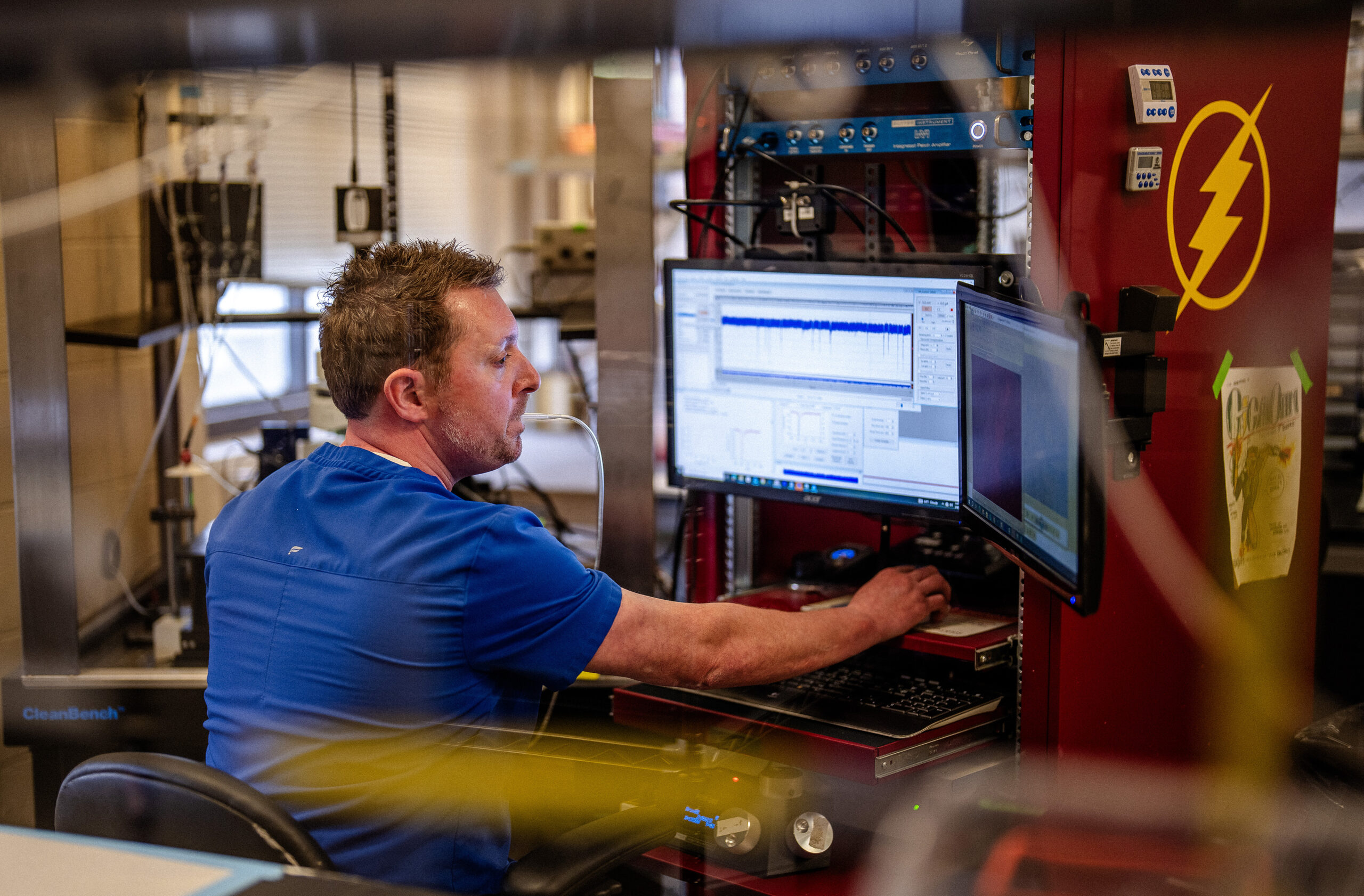
To understand exactly how stress and opioids change the brain, Hearing’s team uses state-of-the-art imaging technology developed in collaboration with departmental colleague Dr. Robert Wheeler, professor of biomedical sciences. The team alters neurons in mice subjects to produce a fluorescent protein that glows when the cells fire. A tiny brain-implanted camera captures this activity while the mice engage in certain experiences in their habitats, whether that’s self-administering opioids by learning to press a leveror navigating stressful situations and their aftermath.
“Anytime a neuron fires, it lights up like a Christmas tree,” says Hearing. The researchers can track the same neurons over weeks, pinpointing precisely when dysfunction begins and how it aligns with behavioral changes.
Unexpected Sex Differences
This technology has helped reveal something Hearing didn’t expect: Under both chronic stress and the onset of opioid addiction, male and female brains don’t change in the same ways. Under chronic stress, males, but not females, develop impairment in cognitive flexibility — their ability to adapt their behavior and shift strategies when needed. Females develop more impulsivity.
In the addiction research, the sex differences are even more dramatic. Female mice develop prefrontal cortex dysfunction in half the time as males during opioid self-administration, shifting from controlled drug use to out-of-control behavior much faster. What’s more, the underlying mechanisms are completely different: Females show reduced activity in certain neural pathways, while males show decreased activity in different pathways (after an initial increase). In both cases, addiction’s onset disrupts impulse control, but through opposite mechanisms. In females, opioid use reduces glutamate, a neurotransmitter that activates neurons in the prefrontal cortex. In males, it increases GABA, a neurotransmitter that suppresses neuron firing.
Prime Suspect: The REDD1 Protein
At the center of Hearing’s related research linking chronic stress and reduced cognitive flexibility is a protein called REDD1, identified by collaborator and co-primary investigator Dr. John Mantsch, Florence J. Williams Professor and Chair of Pharmacology and Toxicology at the Medical College of Wisconsin.
Scientists know that REDD1 levels are elevated in people with major depression — and in mice exposed to chronic stress. The protein regulates the structure of neurons, specifically the tiny protrusions called dendritic spines where brain cells receive signals from one another.
As REDD1 rises, neurons begin to lose these spines, reducing their ability to communicate effectively. It’s especially damaging in the prefrontal cortex, where the brain loses its ability to face challenges, solve problems flexibly and find healthy ways to cope — what researchers call “positive adaptive behavior.”
If males and females reach dysfunction through different pathways, they will need different treatments to reverse it. “It highlights that we should really consider not treating sexes in the same way when we treat substance use disorders.”
Dr. Matthew Hearing
By artificially overexpressing REDD1 in male and female mice, Hearing’s team is testing whether the protein alone causes the same cognitive impairments as chronic stress, and ultimately, whether targeting REDD1 can reverse the damage.
Targets for Treatments
Understanding the specific brain changes that occur under chronic stress or opioid use is the first step toward developing targeted treatments. For instance, ketamine may promote the regrowth of dendritic spines and protect existing spines from elimination. Hearing’s team is investigating whether ketamine can reverse damage from REDD1.
The sex differences Hearing has found could also point to new precision medicines. If males and females reach dysfunction through different pathways, they will need different treatments to reverse it. “It highlights that we should really consider not treating sexes in the same way when we treat substance use disorders,” Hearing says.
The Marquette Advantage
This kind of ambitious research agenda requires strong institutional support — and Hearing has found it at a place he knows well. As an undergraduate in the Department of Biomedical Sciences in 2002, he volunteered in the neuroscience lab of a new faculty member, Dr. David Baker. Today, Baker is chair of the department, an accomplished researcher and, once again, working alongside Hearing. “To witness the arc of his professional growth, from undergraduate student to faculty colleague, has been an eye-opening and uncommon privilege,” says Baker.
Marquette’s College of Health Sciences has built a reputation as a powerhouse in the neuroscience of both mental health and addiction. That has provided a platform for support from the Charles E. Kubly Mental Health Research Center, established at Marquette in 2015, the Kubly family and other donors to have a real, scalable and outsized impact on advanced cutting-edge science. “Without their support during the early stages of my career at Marquette, it would have been incredibly difficult to establish parallel lines of research in stress pathology and neuropsychiatric disease,” Hearing says.
His two R01 grants embody that dual focus. “I like studying the impact of stress. I like studying the impact of opioids, but what very few people are doing is looking at them together,” Hearing says. By pursuing both lines of research simultaneously, Hearing’s lab is building a more complete understanding of how the brain loses, and might regain, its ability to adapt and function, thereby building a foundation for treatments that address not just what goes wrong in the brain, but how to make it right.”