Every spring, Dr. SuJean Choi sits on a stool at the front of her classroom and answers questions from her neuroanatomy students for the final exam — not as an instructor, but as a patient.
“Can you stick out your tongue?”
“What does your gait look like?”
“Do you show an abnormal plantar reflex?”
Based on Choi’s answers, the students must determine where in the brain the patient has suffered trauma.
Easier said than done.
“For a majority of their undergraduate studies, students learn the makeup of the brain through 2D methods,” says Choi, professor of biomedical sciences. “They’re looking at CT and MRI scans and diagrams to understand the brain in 3D space. It becomes really challenging.”
Those challenges led Choi to seek other ways for her students to learn neuroanatomy. The first solution was building a 3D brain model in Marquette’s Visualization Lab in Engineering Hall. That model worked, but it had to be operated by Choi and other staff members, and students couldn’t access the space outside of class time.
Choi was looking for a way to immerse students in anatomy — a tool that could get as close to the impact that the college’s Gross Anatomy Lab has on students’ understanding of the fine workings of the human body. She found a solution in virtual reality.
“The biggest benefit is that when students put on the headset, they can learn at their own speed,” Choi says. “Everyone has a different path to mastery and individual headsets allow for more experimentation to get the full picture and a good grasp on the concepts.”
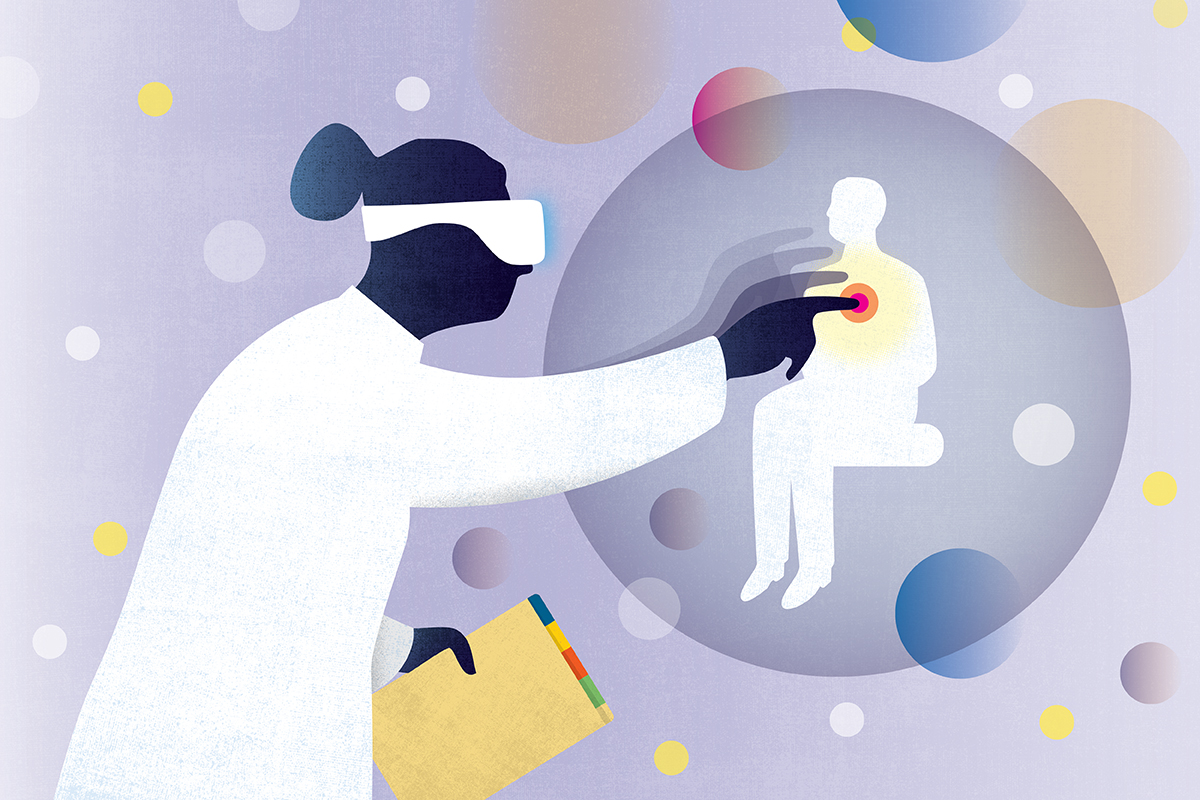
With four VR headsets already available, graduate student Grace Schamber is working with Choi to develop a simulation that allows students to talk to a “patient” and ask them the same questions they’d ask Choi in the classroom.
“The simulation is going to solidify what students are studying in diagrams,” Schamber says. “Students can manipulate the structures of the body and see deeper within the body as opposed to looking at diagrams or working with plastic models.”
As part of the simulation, students interact with the virtual patient presenting with symptoms. Based on the patient’s answers, the student will be responsible for a diagnosis.
“If they fail, they can take time to review where their thinking went wrong and go back into the simulation to try again,” Choi says. “It’s a great learning platform because there are no risks. No student wants the patient to be harmed or die, but they’ll be learning at an exponential rate as they fix their mistakes to achieve a positive outcome for the patient.”
Furthermore, Schamber says the VR simulation will help students answer a critical question when viewing neuroanatomical structures: “Where am I?”
“It’s the first question Dr. Choi asks students trying to figure out what part of the brain they’re looking at. And as you can expect, it takes a long time for students to confidently answer that question,” she says. “The VR simulation will allow students to learn the brain structures in a 3D space, which expedites their understanding of the brain and allows them to spend more time in class understanding the minutiae of brain function.”
Perfect for pre-medical school students
Along with developing the VR program for the neuroanatomy class, Choi wants to leverage new headsets into a full VR lab with enough headsets to allow larger classes in other subject areas to utilize the simulations.
Choi is also developing a capstone course for biomedical sciences students that weaves together the breadth of work they’ve done in their undergraduate careers to prepare them for graduate programs in any health profession.
“Our curriculum is already a mini medical school in how it integrates all of the parts of the body,” Choi says. “A capstone anchored in the VR lab would allow us to show students how disciplines like microbiology, biochemistry and anatomy are actually related, and in a more digestible way.”
Schamber says the simulation and the capstone would be great assets for students on a research or pre-health track.
“VR has applications for students of all different populations,” Schamber says. “It spans across learning modalities and will be an asset for future generations of students preparing for their graduate careers.”
Choi gave an example that a student would be given a case, such as a patient with a respiratory issue, and have to recall what they learned in multiple previous classes to localize the source of the current pathology.
“The students may struggle in their first few attempts, but they’d be developing the critical and analytical thinking skills that we in the College of Health Sciences are routinely instilling in our students and future practitioners,” Choi says. “Our graduates already excel in medical and dental school with the experiences they encounter — from gross anatomy and human physiology to pathology and medical genetics. This capstone, centered around virtual reality and that ‘hands-on’ experience, would be an expansion of that excellence.”