Sometimes it’s not a straight line that leads you to a good destination.
That’s the case for each of three new faculty members at Marquette Law School this fall. As much as each is enthusiastic about arriving at the Law School, none of them made it to Eckstein Hall on a nonstop ticket. An indirect, even complicated route has delivered each of them, eager to be part of the law school community.
Aaron Hernandez returns to Marquette
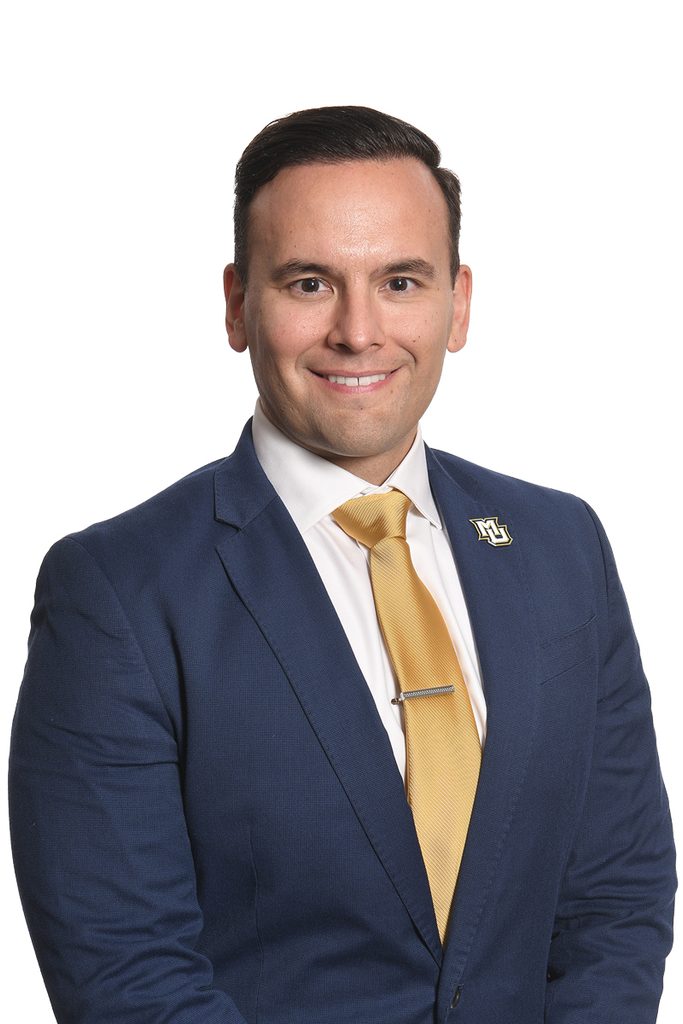
The closest to a simple path is Aaron Hernandez. A 2013 Marquette Law graduate, he immersed himself in the Law School’s sports law program from the time he arrived as a law student, after getting an undergraduate degree from the University of Notre Dame. He was successful in pursuing a career in sports law. He spent six years working for the National Collegiate Athletic Association, where he focused on enforcement operations in football. In 2019, he took a position at Arizona State University, where he became executive director of the Allan “Bud” Selig Sports Law and Business Program at the Sandra Day O’Connor College of Law.
He maintained strong connections with Marquette Law School, taking part in programs for current students every year except during the 2020 pandemic period. He received Marquette’s Charles W. Mentkowski Sports Law Alumnus of the Year award in 2019.
Hernandez, a native of El Paso, Texas, says he felt “firmly entrenched” at Arizona State. “I wasn’t looking for a job. I was quite content.” Then the Law School approached him about returning to Marquette and becoming the director of the National Sports Law Institute (NSLI), based at the school. Paul Anderson, associate professor of law and director of the Sports Law Program, was prepared to give up his NSLI title to recruit his former student.
Hernandez says he considered the move for nine months, talking with people in the sports world and consulting with what he called his informal “board” for career advice. The feedback was unanimous: “This is Marquette” and he should say “yes.” “The cachet, the credibility of the program, is the best in the world,” Hernandez says.
So he has returned, as associate professor of practice and head of the NSLI. And he is excited about the opportunity for him—and, more so, the opportunities ahead for the institute. This semester he is teaching with Professor Matt Mitten, one of his mentors, who has stepped down as executive director of the NSLI but is remaining as a member of the full-time faculty and serving as senior advisor to the institute.
Hernandez says he wants the institute to continue to do its “amazing work,” even while it seeks to raise further the Law School’s national profile. Working with Mitten and Anderson, he wants Marquette to be recognized as “the first stop for everything sports law related.”
Life lessons shape José Girón’s commitment to the law and others

José Girón traces his commitments to working on criminal justice issues and to increasing respect for others to his childhood in Colombia, a time when violence and extreme disorder were a part of daily life. The country was “traumatized by the struggles to be governed by and to live by the rule of law,” he says.
Girón’s family moved to Florida when he was six. He graduated from the University of Southern California and from Yale Law School. He served as a law clerk to Judge Stephanos Bibas of the U.S. Court of Appeals for the Third Circuit, for whom he has immense respect—“the best man I know,” Girón says. “The most lasting lesson he taught me was how to be a wonderful mentor.”
After several years practicing in Washington, D.C., in the appellate and Supreme Court practice at Covington & Burling, Girón was looking to be involved in teaching. He had never been to Milwaukee, but when Marquette Law School posted an opening for an assistant professor of law, focusing on teaching criminal law and procedure, the opportunity strongly appealed to him.
Growing up and into his professional life, he was boosted by people who believed in him and mentored him. He wants to do likewise for others at Marquette. “I’m fortunate that this desire of mine is so congenial to the mission of this Jesuit institution,” Girón says. “I can’t believe my luck.”
Another important goal: cooling the emotions that divide people. “The world can’t be painted as a canvas in black and white,” he says. He wants to be an advocate for tolerance and respect through rigor and humility, while teaching students both the rules of the criminal justice system and how to develop professional attitudes and conceptions of justice.
Life lessons prepare Eric Liberatore to help students succeed

Eric Liberatore took an unusual path to his new role at Marquette Law School. “I tried a lot of different things,” he says.
These included studying accounting, being a substitute special ed teacher and a job coach for people with disabilities, getting a master’s degree in strategic leadership, working as a lawyer in the Wisconsin governor’s office, and, most recently, teaching courses remotely for an undergraduate program at the University of Cincinnati.
Even his law school path was varied. Liberatore excelled in law school at the University of North Carolina before dropping out in his second year because he wasn’t sure he was ready for a legal career. He later finished law school at the University of Wisconsin, where he found himself also serving as a teaching assistant in a statistics course.
Through everything and more than anything, Liberatore came to realize his deep interest in helping others succeed. His path makes him a good candidate to help law students, he says. “Been there, can help you with that,” one might say of his approach. And that’s what Liberatore is doing as assistant teaching professor and assistant director of student success at Marquette Law School. His work includes overseeing the Academic Success Program, a structured program for first-year students that Marquette has developed over the past three decades.
When he saw the posting for the Marquette Law School position, “I had to go for it,” Liberatore says. “I was so impressed with the institution.” In particular, he says he saw the compassion and the bigger holistic picture that the Law School shows students. And now he is part of offering these to students.
This article was first featured in the Fall 2026 issue of Marquette Lawyer Magazine.