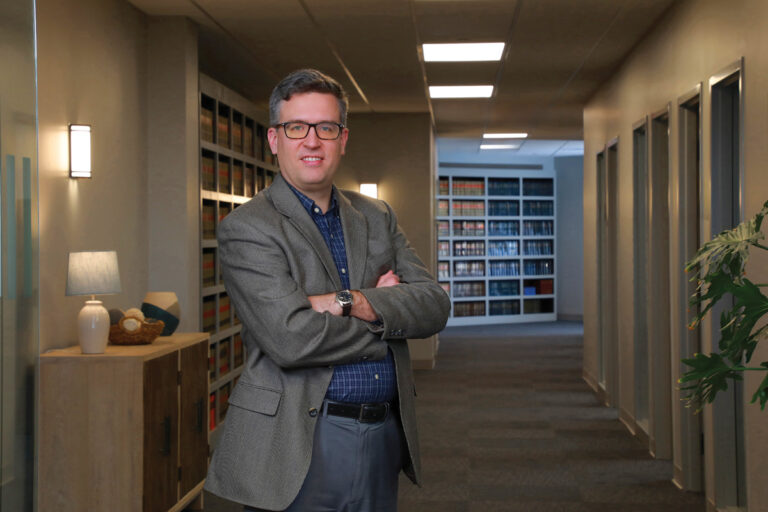
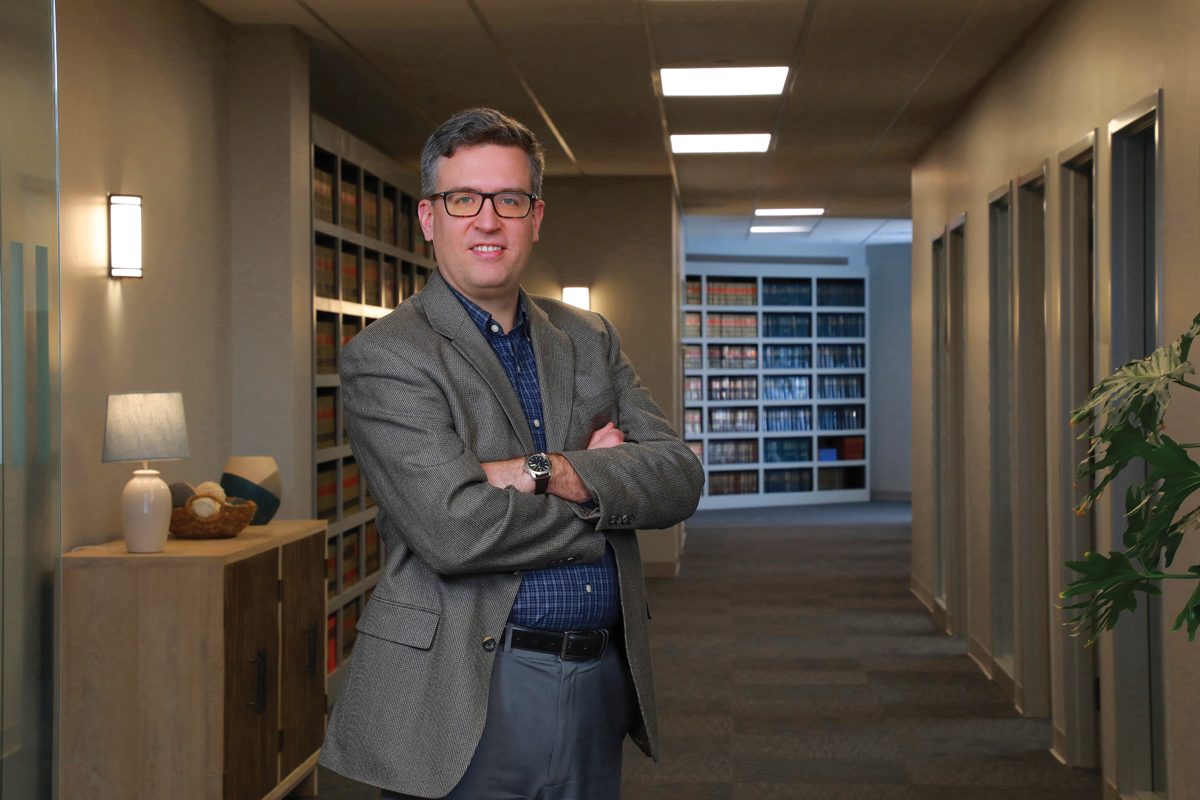
In July 2026, Daniel R. Thies was coming to the end of his term as chair of the Council of the American Bar Association’s Section of Legal Education and Admissions to the Bar. The council is the nationally recognized accrediting body for American law schools. Thies has been involved in law school accreditation matters since his days as a student at Harvard Law School, from which he graduated in 2010.
He is a member of Webber Thies in Champaign–Urbana, Ill., where he has practiced since 2018. Before returning to his hometown, Thies practiced at Sidley Austin in Chicago and clerked for judges on the U.S. Court of Appeals for the Fifth Circuit and the U.S. District Court for the Northern District of Illinois.
The Marquette Lawyer interviewed Thies about his experience in law school accreditation and what he sees ahead. Joseph D. Kearney, dean of Marquette University Law School, and James B. Speta, the Elizabeth Froehling Horner Professor at Northwestern University Pritzker School of Law, conducted the interview. This is an edited and excerpted transcript of the conversation.
Joseph Kearney – Daniel, your service to the profession and to law school accreditation in particular—that started rather early in your career, even as a law student. Can you just give us a sense as to how that came about?
Daniel Thies – Sure. I come from a family that’s been involved in service to the profession for a long time. My grandfather was on the board of governors of the American Bar Association back in the late ’80s, early ’90s. And he stayed involved up until the time I went to law school. He encouraged me to get involved in service to the profession as a 1L.
And I did, by going to the dean of students at Harvard and asking for money to attend the ABA’s midyear meeting. And she—Dean Ellen Cosgrove—was gracious enough to offer me money to go out to Los Angeles for that year’s meeting. I showed up at an info session where the chair of the law student division was speaking about how to get more involved.
At the end of the presentation—there were about four people in the audience—I went up to talk to him. We got chatting, and he said, “Well, I’ve got one more liaison spot that we need to fill. How would you like to be a liaison to the section of legal education?” My work as liaison was my first connection to the Accreditation Council, and I ended up serving two years as the law student member of the council.
Of course, I’m from Illinois, and I was frequently transiting through Chicago on my way home during school breaks. So I stopped by the accreditation office and met Bucky Askew, who was the consultant at the time. He was extremely gracious in explaining to me what the council did. I just stayed involved from that point.
It’s always been interesting work. I feel like some of the most important questions facing the profession are addressed by the Accreditation Council. And I’ve always enjoyed the sincerity and the intellect of council members as they wrestle with those questions. So it’s kept me coming back over the years.
James Speta – Also as a law student, you published an article in the Journal of Legal Education. You said, in part, that legal education was being pushed toward a breaking point, by cost, debt, employment conditions, and insufficient practical preparation. We’re a decade and a half later now, a little more than that, in fact. Do you have a take on the state of legal education today?
Thies – Well, back then, there was a lot of criticism of legal education, including the complaints about the “law school scam.” My article was attempting to grapple with that reality—to answer the question, “Where are the market forces going to push law schools over the next decade, and what, if any, role should the council play in that?”
And just to highlight a success, before going to the current day, the council did have a role with respect to a few law schools in that era that were throwing open the doors of their admissions office to admit too many students who may not have had a good chance of passing the bar and becoming lawyers. It was really giving legal education a bad name across the board—unfairly. And over the next decade, the council was able to help curtail that. Nine institutions closed or lost their accreditation over that period, after facing action from the council.
So that is an example of the positive contribution that the council can make to the good name of legal education as a whole, making sure that certain schools aren’t able to continue to operate in a way that might harm students or harm the public.
We’re facing a different set of challenges today. I still think that the underlying quality of legal education in the United States is the highest in the world. Enormously good things are going on at all of our law schools.
But there are some real challenges that have not been addressed and maybe have continued to get worse from the era of the recession. That was an era when there really was more of a gap created between the training that law students had at the end of law school and what law firms expected them to have when they showed up to work first day.
I phrase it that way because I don’t want to cast blame in any direction. It’s a gap that could be filled in all sorts of ways, but there is a gap. Law firms have expected law schools to do more and more, as clients are less willing to pay for training of new lawyers. That’s a systemic problem that hasn’t been completely addressed.
There are some promising movements. The effort to have admission-by-practice programs like in Oregon is a promising thing that’s trying to fill that gap. It remains to be seen whether those kinds of programs can be scaled to much bigger states or to take any significant percentage of new lawyers each year. But legal education and the profession are on the cusp of thinking again about how we can close that gap more effectively than we have in the past—such as pathways that are alternatives to the bar exam.
Kearney – We’re big on alternative pathways here in Wisconsin.
Thies – Right, absolutely. The diploma privilege is an alternative pathway. You’ve had it for a long time.
Kearney – In fact, we think the bar exam is an alternative to the historical norm of the diploma privilege.
Thies – Yes, absolutely. That makes sense—it’s all where you’re sitting. But when it comes to alternatives to council accreditation, it has never been the case that the council has been the sole accreditor of law schools across the country or the sole pathway into licensure in the states.
There’s an interesting statistic that was put together by Adam Chilton, the dean of the University of Chicago Law School, along with scholars Guilia Cusenza, Lorenzo Luisetto, and Kyle Rozema, in a recent paper. He described that between 1984 and 2019, 39 jurisdictions—39 states plus the District of Columbia, so 40 jurisdictions—had parts of their admissions rules that were an alternative to council accreditation. California is obviously the most well-known of those, the Cal Bar accredited schools, of which there are a couple of dozen, but it’s also the Massachusetts School of Law at Andover, for example. It’s also now, more recently, Purdue Global, which is recognized in a handful of states.
So this is not uncommon—that the states are experimenting with alternatives to council accreditation. Throughout this period, council accreditation has remained the gold standard for accreditation. By this I don’t mean that we are imposing best practices on law schools, as we are not. Rather, I mean we are the premier law school accreditor, as demonstrated by outcomes that are far superior to the non-council-accredited schools. Bar pass rates that are two to three times higher, career outcomes in terms of number of graduates becoming judges or partners in law firms, those are the sorts of things that are much better than in non-council-accredited schools—and even professional discipline rates that are about half as high for council graduates as compared to non-council- accredited graduates.
And so it’s important that we continue to provide that system of national accreditation that gives a baseline of quality across the whole country—and that, of course, then allows the portability of the degree across the whole country, even while states might experiment with their own alternatives to council accreditation, on a smaller scale.
Speta – We want to talk about one of the things that you have done, which late last year was to create the special advisory committee on the standards. The council’s described it as helping to prioritize standards, gather information, and advise the standards committee. Is there a more specific set of charges or list of standards that are under consideration at this point?
Thies – There is. Just last month we had our first in-person meeting, in Annapolis, and we saved what I would call the hardest issues for that meeting. I wish we’d had more time, but we had time to really dig into three things. Those would be security of position, number one; experiential learning, number two; and learning outcomes, number three.
It’s fair to say that those areas have caused maybe the most consternation—as the council has proposed different things over the last several years. So it was very important for the advisory committee to help us navigate those things. I don’t yet have a report on where we’re headed exactly. We got a lot of good feedback from the advisory committee. We’ll have more follow-up discussions to come.
But it’s something that the standards review committee and the advisory committee are taking very seriously because of the criticism that the council has received. My charge to them, as you know, was to say, “Look at the core principles and values that the council published last year—a four-page document, it’s on our website. And then consider each of these areas in the light of those core principles. And let’s make sure that we’re really calibrating the standards to what we think we should be trying to achieve as stated in the core principles.” So that’s what we’re trying to do.
Kearney – Are you far enough along based on those conversations to think about what the timeline is or what the output is or what opportunities for, say, broader public participation there might be in the work of the advisory committee?
Thies – Let me point to the learning outcomes piece. We’re trying to consider it first, if only because there was a set of changes that the council has already passed that now is not going to go into effect immediately. That’s at the top of our agenda, so that schools have time to react before the changes take effect.
The other two issues are obviously also important, but are coming, following on, behind that. We don’t have any more concrete plans than that at this point.
Speta – Let’s linger on the special advisory committee for a minute. Can you tell us about its future?
Thies – A couple things there: I appointed the group with terms starting in January, and they all agreed they signed up for a year, which our bylaws say is how long a special committee lasts. So the group’s going to stay in effect. Also, in August, the council is considering a proposal to make the advisory committee a permanent standing committee of the council. It’d actually be written into our bylaws. And, obviously, the leaders following behind me, including Carla Pratt and then Tom Galligan, have all expressed support and are committed to continuing the advisory committee.
And if I could give you just a bit of historical perspective, you both may remember that, prior to 2018, we had a separate body to review the standards, separate from the council. The accreditation committee was also separate. And both of those then would send proposals or resolutions of school matters up to the council. In 2018, we combined everything into the council, really for efficiency’s sake. We achieved that, but we lost a little something in terms of openness and transparency and means of getting feedback before a proposal came to the council.
So we’ve been trying various things to make sure that we’re open to that feedback. And the advisory committee, it’s fair to say now, a few months into it, has been one of the most successful things we’ve done. And that’s because it allows feedback from our core constituencies, deans and state supreme court justices. It allows it in an informal setting where we can go back and forth and really flesh out an issue. And it even allows the members of the advisory committee to remain anonymous with their concerns. We’ve been following kind of the Chatham House rules so that members can talk about what we’ve talked about, but they can’t associate an idea with a name.
Speta – You’ve been pretty clear as you think about the standards that one of your overarching principles is that they should set a floor—minimum acceptable standards. How do you think about what more specific criteria should be involved in assessing whether any standard ought to be eliminated, retained, or modified, as the advisory committee undertakes this really broad review?
Thies – You’re right. I mean, a group can agree on the principle of setting minimum standards and have pretty sharp disagreements over what a minimum standard should be. And some of the sharpest disagreements arise between our supreme court justices and our deans, which is another value of the structure of the advisory committee: We have good representatives of lots of different views on that.
I don’t want to say that there’s one formula, because that would be too simplistic. There is some professional judgment involved in accreditation. But I would say we are trying to set rules that make sure, number one, that there’s consumer protection for the law students and prospective students. That’s Standard 509, and a lot of the disclosure rules that come out of that. Then there also are rules that make sure students get the minimum support necessary when they arrive at law school so that their degree is worth something, right? It’s not worth anything if they get to the end of it and can’t pass the bar. And then there is an element also of thinking, “What skills do law students need to have upon graduation in order to succeed in their careers? What are the minimum standards that allow them to build on that as lawyers?” And that’s where there’s much debate.
We do have some more empirical evidence on that than before, coming from places like the Building a Better Bar and Foundations 2.0 projects done by the IAALS [Institute for the Advancement of the American Legal System] out at the University of Denver, or also even the work of the NCBE [National Conference of Bar Examiners] on practice competencies that they’ve incorporated into their next-gen bar exam. Those are very rigorous studies, going out and asking the question, “What are the basic skills that law students need?” The next era of accreditation and of legal education needs to take that sort empirical evidence seriously as we’re asking the question, “What should the minimum standards be?” And that might give us different answers than we’ve had over the last several decades.
Speta – I’m intrigued by what sort of gap you mean—a specific example of something where the state supreme court justices and the deans are not yet, let’s say, seeing eye to eye on matters.
Thies – The biggest would be security of position. They’re just coming from different institutional contexts, right? Deans are in academia, they understand the way tenure or security of position has come to have such a prominent role in academia, and they see that as something of an essential foundation for attracting the type of teachers and scholars they want to have in their institutions. Justices don’t necessarily see it that way. Most of them have come from practice rather than out of academia. And they are inclined to view security of position as an obstacle to reform.
So that’s one where we’ve done a lot of unpacking. More than figuring out a way forward in terms of what the standards are, we’ve just been trying to make sure everyone understands where everyone else is coming from. And I hope that, over time, that’ll give us a platform to try to bridge that gap. But it’s a real gap, and it’s challenging.
Speta – Switching gears a bit, we want to talk about a couple of things that are sort of more recent and forward-looking across higher education, I suppose. In large part in the years since the pandemic, online education has exploded across all kinds of disciplines. And the council has thoughtfully granted a number of permissions for online J.D. programs. Where do you see this going, whether personally or from the perspective of the council’s approach to it?
Thies – It’s a good example of how the variance process and experimentation can work, because the first distance programs that we allowed came through the variance process. Subsequently there were revisions that normalized it, so it wasn’t a variance, but we said, you have to—if you’re going to offer more than 50 percent of your degree online—you have to come to us for a substantive change, and we’ll kick the tires and make sure you’re offering the same quality of education online as you are in person. As you say, that’s led us to allow several fully online J.D. programs.
And so the way we’ve done this has allowed a sort of incremental experimentation, and it’s allowed us to start getting data about those programs now. It’s a long experimental life cycle—from approval through the first group passing the bar exam could be five years. And if the first group’s really small, maybe you don’t have a lot of good data after one year, you need two or three. And so we’ve been very intentional about looking at that data and using it to inform what happens going forward.
So we’ll see more of that. The big question for the council will be whether or not to allow a fully online law school without a brick-and-mortar presence, right? Right now, all of the fully online programs are connected with brick-and-mortar schools. And that’s a product of several of our standards and the fact that you have to be a fully accredited brick-and-mortar school before you can apply for the substantive change to offer a fully online program. And there’s certainly appetite on the council to look at that in the next couple of years and see if we should take the next step, informed by the data that we’ve gathered to date, and what we’re going to get over the next couple of years in more of the online students taking the bar exam, and we can, for example, look at outcomes for that cohort.
Speta – One of the other current issues is artificial intelligence. What does the AI revolution mean for the skills that lawyers need, how we teach in the age of AI, and how we assess student development, from the outcomes side? Do you see a role in the council responding to this question of AI?
Thies – Right at the moment, our aim is to allow law schools flexibility on AI—to explore different ways of training students to use it in practice and even to give flexibility in how they incorporate it into the program of legal education. So we’re at that phase where there’s not a clear minimum standard to apply across all law schools. I mean, we do have Standard 301, which is the core of the standards: a rigorous legal education that prepares students for admission to the bar and to practice as a lawyer. And at some point, you’ll probably be able to say, “Students who don’t have any familiarity with AI aren’t prepared to practice in this day and age.” I don’t know that we’re quite there yet.
But that’s likely to be a question for future councils to grapple with. We haven’t seen any law schools that are completely burying their heads in the sand. Many schools are experimenting in different ways. And that’s what we want to happen at this stage of the ball game.
Kearney – Let’s switch gears again. What’s next in the unfolding proceeding with the Department of Education?
Thies – So we will go before the department’s advisory committee in late September. That body then makes a recommendation to the secretary’s designated official, and there are further opportunities for comment from the department and from us. Then, by the end of the year, we expect a decision from the secretary’s designated official on our re-recognition. We fully are working toward being recognized again and expect to be recognized again. Our staff’s been working very hard for a year and a half now on the application and making sure that we meet all the criteria. So that’s what we’re looking forward to.1
Speta – One of the possibilities that’s been discussed, at least in some quarters, is to continue the recognition of the ABA and then recognize other accreditors as well. What does the future look like if that’s an outcome?
Thies – Well, to date, no alternative accreditors have emerged, and there is a process. At the moment, it takes a couple of years for alternative accreditors to come on the scene. More generally it’s important that we don’t lose the benefits of a single national accreditor, meaning portability of the law degree to all states. I would worry if there were lots of different accreditors, as it’s not obvious that reciprocity would develop among them. And as a result, you’d lead to a lot of confusion for law students and prospective law students—if you don’t know for sure that if you go to one law school in one state that upon graduation, you can decide to practice in a different state. That type of flexibility is something that law students have taken for granted for a generation.
And we really don’t want that to be called into question, right? That’s not going to help the access to justice crisis or anything else if we’re artificially restricting where law graduates can practice. And particularly in a volatile environment, we don’t want the cost of that uncertainty to be put on the students. And so it’s important to preserve a national accreditor. Again, that doesn’t preclude other experiments—like what California has done for decades. But keeping national accreditation is important.
Speta – Are there—now maybe the answer is that there are not and accreditation is an issue that has received far more attention than you would like or that the council would like—but are there issues of accreditation or legal education that you think are not getting enough attention in the discussions these days?
Thies – I really see a lot of value in bringing together different parts of the profession to talk with one another. That’s the whole idea behind the advisory committee. Getting deans and supreme court justices and other thought leaders together when they might not otherwise mix. And that is actually part of the logic behind the council’s construction—to get representatives of lots of different parts of the profession on the council. We’re having too many discussions in our own bubbles—whether that’s academia, or practicing lawyers, or judges, or, for that matter, podium faculty, or clinicians, or legal writing faculty. We just need more opportunities to get everybody at the table and appreciate alternative perspectives.
The council tries to do that, and one of my overarching goals as chair has been to try to create more opportunities for that kind of interaction. It’s actually also one of the things that CLEAR [the Committee on Legal Education and Admissions Reform] called for—this was the work of the Conference of Chief Justices and Conference of State Court Administrators. And they correctly identified that there’s a lot of benefit in just getting everybody to the table.
Kearney – We haven’t asked this question, because Jim and I know the answer, but for those readers who might not, and since you’re mentioning the profession, let us say that the council’s association with the ABA is a frequent talking point. Will you take the opportunity to talk a little bit about that?
Thies – As you know, it’s a requirement of the Department of Education that we [the council] as an accreditor be separate and independent from the professional association we’re affiliated with. And that’s really a term of art described in the Higher Education Act. It means essentially a separate budget. So the ABA doesn’t send us money. And we pay fair market value for the services we get from it, but otherwise don’t send it any money.
It means that decision-making stays with the council. So we make all the decisions with respect to particular schools. We have the final say on what the standards are. Our personnel selection is entirely internal. The larger ABA doesn’t have anything to say about who becomes chair of the council or who the council members are. We have an internal nominating process that determines that. The Department of Education has found now for decades that we’ve satisfied the requirement.
What if we all were stepping back from the regulations and saying, “What should the relationship be?” In fact, there is value in having an accreditor that has some substantive connections to the profession, so that we don’t become an echo chamber. It’s important to have practicing lawyers in the process, important to have judges involved in the process. Over the decades that we’ve been doing this, the connection to the ABA has helped facilitate that. And that’s a value that we don’t want to give up, that we want to maintain, even if the details of the institutional relationships might change.
Speta – Your term as chair is nearly up, though it’s not quite up yet. In terms of things that the council has done under your leadership and in the recent past, what do you think are the highlights, the most beneficial, that you’re proud of having accomplished during your tenure?
Thies – The advisory committee would top the list, because it’s going to be an enduring change to our process that will make us more open and lead to better decisions. Related to that is the initial charge of that group—what we call the “core principles review”—to make sure the standards will align with our core principles. And it remains to be seen exactly what changes will come out of that, but there will be changes, and they will be, I hope, improvements to our standards. And even more than that, I want them to be broadly seen as improvements, among different constituencies.
So if we have the process right, we have a better chance of that happening. We’re in an era of new openness to involvement from the courts. I mentioned the work of CLEAR, and we welcome the supreme court justices being engaged with legal education. That’s a good thing. And it will ultimately allow for more of these conversations and more alignment between them as licensors of the profession and us as an accreditor that’s a part of that process.
The big outstanding question is, as you know, the Department of Education process. I would see it as a big victory if we’re able to retain our federal recognition. We’ve put ourselves in as good a position as we can in showing that we meet all of the criteria. And the verdict on that’s just going to come a little bit after the end of my term, but obviously I’ve been very involved with that from the beginning, and that’s been an important consideration in just about all our work.
Speta – If you look in your crystal ball five years from now, what does the accreditation landscape look like?
Thies – The council will still be in its position as the national accreditor and providing portability across the country. Some states will be experimenting, and that’s not a bad thing.
My hope is that the political aspect of the criticism will have died away and that people will be more focused on accreditation as securing some very basic values that everybody can get behind. I mean such things as minimum standards of quality, consumer protection, making sure clients are protected because they know that lawyers graduating from a council-accredited school have the basic skills they need to succeed in practice. Those should not be controversial things.
So my hope is that the council’s process will be appreciated for how it secures those things and that we’re not as distracted by some of the political debates that are going on.
Kearney – So a last question from me: Five years from now, for yourself, do you envision further ABA-type involvement? I’m curious, as you have more than the ordinary interest in public service, if you will, while a member of the private practice.
Thies – I will want to be involved in bar leadership at some level, national or state. But I don’t know yet. I’m going to rest up and kind of see what I find interesting and where the opportunities are, and then I’m sure I will be involved somewhere.
Speta – I’m tempted to ask about finding time to practice.
Thies – Well, having a good staff that you can hand things off to, or other lawyers in your firm, is obviously key. And our firm has been designed for bar service for a long time. I mentioned my grandfather, who was part of our firm. He was president of the Illinois State Bar Association, as well as serving on the ABA board and doing other things in the profession. My uncle since then has been Illinois State Bar Association president, and he’s still an active practicing lawyer. So we basically trade off in having years that are more dedicated to bar service and those that are more dedicated to practice. And it tends to work. You make do when you’re busy and try to keep up with the practice, but hand off things where you need to.
Kearney – We appreciate your generosity, Daniel, with your time and with us.
Thies – Yes, happy to.
- Since this interview, the Education Department staff recommended, in late August, that the Council be denied re-recognition, and in September the department’s advisory committee deadlocked without a recommendation. As of press time, the re-recognition process was still ongoing, and the final outcome is not expected to be known for some time. ↩︎