
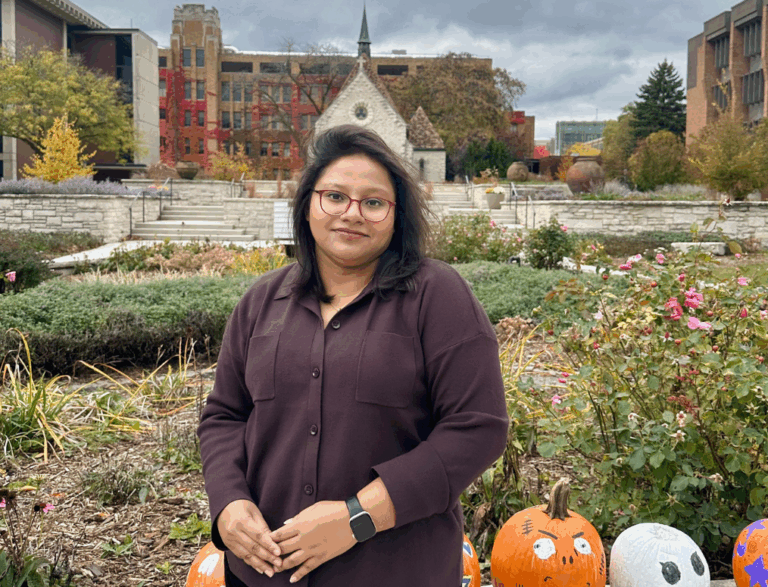
When Sumaiya Chowdhury walks across Marquette University’s campus, she carries stories from halfway around the world, from the lively streets of Dhaka, Bangladesh, to the quiet study spaces of Raynor Library. Now pursuing her Ph.D. in the Department of Biological Sciences, Chowdhury is one of the many international students whose experiences are being celebrated during International Education Week. Every November, IEW highlights the value of global education and cultural exchange, reminding campus communities of how international students enrich learning and connection at universities across the United States.
For Chowdhury, her journey to Marquette reflects that very spirit of curiosity and discovery that IEW honors. Her research explores the intricate processes of life at the cellular level. “I study how cells organize specific proteins and RNA into tiny droplet like compartments called biomolecular condensates,” she explains. “My work focuses on understanding how cell signaling regulates the formation of these condensates, which is important because disruptions in this process can contribute to diseases such as cancer and neurodegenerative disorders.”
Her path to Marquette began in 2022, when she came across a paper written by Dr. Lisa Petrella, a faculty member in the Department of Biological Sciences. “I reached out to her and expressed my interest in working with her,” Chowdhury recalls. “She encouraged me to apply for the Ph.D. program, and now I’m fortunate to be pursuing my research under her mentorship.”
Before arriving in Milwaukee, Chowdhury’s academic journey had already taken her across continents. She earned her undergraduate degree in environmental sciences from the University of Dhaka in Bangladesh, and later completed a master’s degree in Ecotoxicology at the University of Koblenz in Germany. Those experiences, she says, shaped her passion for research and gave her a global perspective on science and education.
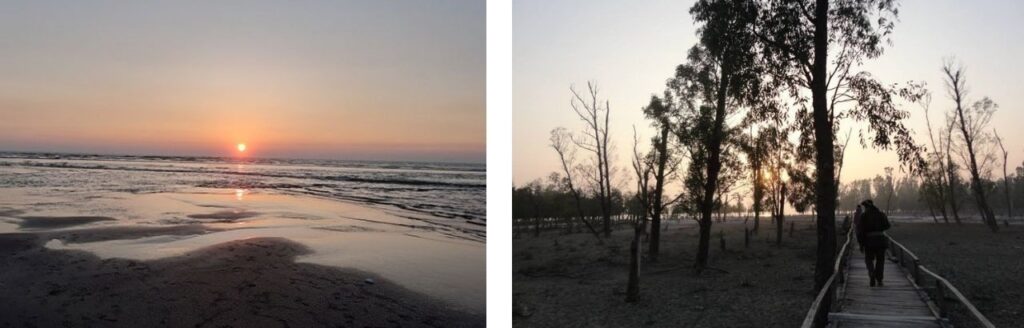
Growing up in Dhaka, a large city known for its vibrant energy and cultural richness, played a major role in forming that outlook. “Dhaka is a busy and colorful place filled with people, cars, and rickshaws everywhere,” she says fondly. “The streets are always lively with the sounds of traffic and street vendors calling out. Despite the noise and crowds, the city has many parks, lakes, and historical sites that show its beauty.”
Family is central to her story, too. As the eldest of three sisters, Chowdhury describes her childhood home as “full of laughter and noise.” Shared meals were often the heart of family gatherings, especially when her mother cooked her favorite dish, biryani, a fragrant rice and meat dish that is a staple of Bangladeshi cuisine.

Since moving to the United States, Chowdhury has continued to explore culture through food. “As a foodie, I enjoy trying a variety of cuisines,” she says with a smile. “Trying different foods has been a fun way to experience American culture.”
Despite being far from home, she has found a strong sense of belonging at Marquette. “The community here is very welcoming and supportive,” she says. “Although I come from a different continent and English is not my first language, I have never felt discriminated against. People here are encouraging and appreciative, which makes it easy to feel included.”
Most days, Chowdhury can be found in her lab or tucked into a quiet corner of Raynor Library, immersed in her research. Her work, rooted in curiosity and aimed at improving human health, embodies Marquette’s mission of pursuing knowledge that serves humanity.
Reflecting on her journey, Chowdhury feels both grateful and inspired. “I’ve always loved learning,” she says. “Every step, from my childhood in Bangladesh to my studies in Germany and now at Marquette, has brought me closer to understanding how science can make a difference in people’s lives.”
Through her research, her global journey, and her commitment to discovery, Sumaiya Chowdhury truly lives out one of Marquette’s core values: Be the Difference, both in the lab and across borders.