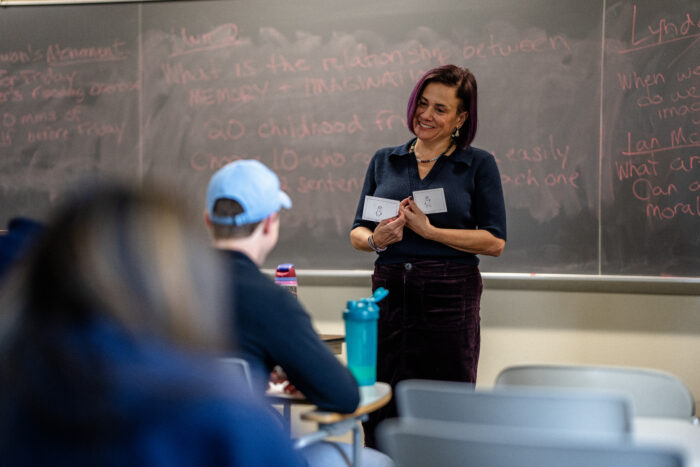


Sharon Dolovich is a professor of law at UCLA and founding director of the UCLA Prison Law and Policy Program and the UCLA Law Behind Bars Data Project. Her research focuses primarily on the Eighth Amendment, prison conditions, and the state’s obligations to the incarcerated. This is an edited text of the Barrock Lecture on Criminal Law that Professor Dolovich delivered at Marquette Law School on May 13, 2025. An extended version will appear in the Marquette Law Review.
Illustrations by Taylor Callery
I want to talk with you about correctional officers—a.k.a. “COs.” In particular, I’m going to lay out some of the harms COs experience as a result of their work. My aim is for us to think together about how broadening our lens to take account of those harms may help clarify the moral character of American carceral practice.
Coming to Consider Correctional Officers
Features of American prisons can make it hard to see that COs pay a considerable price for doing the job we ask them to do. Sharing how I came to recognize that COs are among the casualties of the system may also help you to understand this.
So how did I get here? Why COs? I’ve only recently started thinking about prisons and punishment from the perspective of COs. This may seem strange, since I’ve spent the past 25 years thinking, writing, and teaching about prisons and prison law. But if there has been one question guiding my work, it has been what the state owes the people we incarcerate. And when this is your framework—when you are thinking about what the state owes its prisoners—you’re not typically thinking about COs.
Or if you are, you’re not thinking about them especially sympathetically. Those who know something about prisons won’t be surprised to hear that the agencies that run our carceral facilities routinely fail to satisfy the state’s duty of care toward the people we incarcerate. Over the years, I’ve found myself looking closely at many of the worst conditions that people endure in our prisons and jails: solitary confinement, physical violence, sexual violence, excessive force, grossly inadequate medical care, untreated mental illness, and all manner of dehumanizing treatment. True, you can’t think about all this without also thinking about COs. But from this vantage, it can be hard to think about them favorably, because the way prisons operate, whenever a person is put in solitary or subjected to force or denied access to medical care, the harm is always being inflicted directly, personally, at ground level by individual COs.
The problem compounds when you teach the constitutional law of prisoners’ rights, as I do. The structure of these cases is adversarial, and the COs are always on the side of reducing prisoners’ constitutional protections. So when you read these cases, you are pretty much always reading about COs who have personally inflicted serious harm on people in their custody, yet who are insisting on the justifiable and fully constitutional nature of their own conduct.

All this is to say: when you are in this conceptual universe, it can be hard to feel warmly disposed toward those who wear the uniform.
Now, even so, I was always very aware of the fraught and difficult position correctional officers occupy. Over the years, I’ve often made the point that COs are in a tough position: that we rely on them to do a job that is difficult, thankless, and often dangerous; that they work in volatile and sometimes violent facilities; and that they are often understandably afraid while they are at work. I’ve said all this many times, and I meant it. But it was hard to resist the pull of the us vs. them framing that shapes prison life, and easy to fall into being only minimally sympathetic to the experience of prison staff.
That was before. Then I started talking to COs. Really talking. And more importantly, really listening. This development came about somewhat unexpectedly. In 2022, I launched an empirical study on sleep deprivation in prison. The plan was to interview two groups. First, I would interview people who were formerly incarcerated and recently released from custody, about their experiences of trying to sleep in prison, the obstacles to getting enough sleep inside, and how being sleep deprived affected the quality of their lives and the operation of the prison more generally. And second, I would interview people currently working as correctional officers, about their experiences of shift work and mandatory overtime, about when and how much and how well they sleep, and how not getting enough sleep affects their physical, psychological, and emotional health and quality of life outside the prison, as well as their ability to do their job.
I’ve now done over 80 interviews with people all over the country—almost 40 with formerly incarcerated subjects and more than 40 with COs. And over the course of the CO interviews, I found myself finally able to fully see the humanity of the people who play this role—and the suffering they experience just because they do the job we ask them to.
I did the interviews on Zoom, which allowed me to talk to people all around the country. These were long conversations—they averaged about an hour and 40 minutes. One CO interview was 3 hours and 20 minutes. For a group that is famously taciturn, most of the people I talked to had a lot to say, much of it extremely personal. And although the focus was on sleep, sleep turned out to be a window into the full experience of being a correctional officer.
Honestly, I was not prepared for just how much pain and suffering I would hear about in the CO interviews. My interviews helped me see that we can’t fully understand the harms incarceration inflicts and what it means for a society to rely so heavily on imprisonment as a policy strategy without taking account of the experience of the roughly 350,000 people working as COs in the United States right now.
To be clear, there is no doubt that prisoners suffer considerably more from incarceration than COs. But this doesn’t need to be a competition. Suffering is suffering, and if we are going to be able to fully reckon with the implications of our collective enthusiasm for locking people up, we need to face it all. This means taking seriously the impact not only on those we lock away but also on those we ask to carry the keys.
The Work of Correctional Officers and Its Toll
Let us now consider what the work of a CO entails and the toll it takes on those who do it—and on their families. Take first some of the key comorbidities of the CO role. Studies consistently show that correctional officers are disproportionately likely to experience depression, suicidality, and post-traumatic stress disorder (PTSD). They also seem to rely more heavily on alcohol, and they die relatively young. I’m going to drill down a little on each of these, with the goal of driving home that this is a population that is seriously suffering. On each point, there is much more supporting evidence than I mention here or will even be able to cite in the law review version of this lecture.
First, depression. According to several studies, the rate of depression among COs is roughly three times the national average, with 26–30 percent of American COs reporting symptoms of depression. One study surveyed 3,800 Connecticut COs about symptoms known to correlate with depression. It found that roughly 25 percent of participants reported “a lack of emotional responsiveness,” 20 percent reported “an inability to find pleasure in anything,” and 13 percent reported feelings “of hopelessness and/or worthlessness.”
Then there is suicidality. National studies have found that COs are about 40 percent more likely than the national average to die by suicide. Wide variance across states suggests that the national numbers may cloak an even more serious problem. In New Jersey, COs die by suicide at 2.5 times the rate in the state in general; in California, at 4 times the overall rate; in Massachusetts, at 7 times the national average and at almost 12 times the suicide rate in the state as a whole. In the Connecticut CO survey, 3 percent of respondents reported thoughts of ending their lives at least once a month, and an additional 6 percent reported such thoughts at least once or twice in the previous six months.
As for PTSD, studies show extremely elevated rates among people who work in prisons. One study found a PTSD rate among COs of 34 percent. By way of contrast, the estimated rate of PTSD among Vietnam vets is 30 percent. Other studies found somewhat lower rates of PTSD among COs, ranging from 19 percent to 26 percent. But even these lower numbers are still striking, given that the national rate is around 3 percent. To some extent, the PTSD findings may reflect the high proportion of COs who are ex-military. But to judge from my interviews, they are also a function of the deeply distressing and traumatizing experiences that are part and parcel of the work itself.
Alcohol use is a tough issue to get a handle on, for a variety of reasons. Studies vary widely in how they measure and define alcohol use/overuse; and, again, COs in general are pretty tight-lipped about what they experience. Still: one study of 335 COs in two northeastern prisons reported that 11.1 percent consumed 15 or more drinks per week, more than double the national rate. And in a study of 4,300 California COs, almost 28 percent self-reported that they sometimes or often consumed six or more drinks at a sitting.
There is no way to sugarcoat this: studies uniformly find the average life expectancy of American COs to be only 59 years, a full 19 years shorter than the national average of 78 years.
Then there is early mortality. There is no way to sugarcoat this: studies uniformly find the average life expectancy of American COs to be only 59 years, a full 19 years shorter than the national average of 78 years. And they know it. In my interviews, it was heartbreaking to hear people talking matter-of-factly about how they don’t expect to live long into retirement. One person reported being told in the academy that “the average age that COs die is around 59 years old.” And right now, he said, “the eligible age to retire is 55, so they tell us, ‘for those four years after retirement, live your best life, because you’re probably gonna die.’”
There is also evidence that COs are more likely to suffer from anxiety at greater rates than the population as a whole. And, of course, I’ve gone through these conditions one at a time. But we should also expect significant interaction effects among these various comorbidities, which will only deepen and exacerbate the harm.
To pose my go-to question: What is going on here? By way of answer, let’s consider what we are asking of those we rely on to do this work.
When the state decides to incarcerate, whether pretrial or as punishment for crime, the people marked for this treatment are removed to locked facilities. They cannot leave. They are forced into close quarters with strangers. They have no control over their environment or their lives, and they depend on prison officials to meet virtually all their needs. The institutions where they live are typically ugly, crowded, volatile, and frequently violent. People who are incarcerated are themselves likely to be angry, resentful, scared, depressed, frustrated, and traumatized.
To make this system function, we need people who are willing to serve as COs. Those who fill this role have direct contact, every day, with those locked up in the facilities where they work. They thus have front-row seats to just how much suffering is experienced every day by those who are incarcerated.
Think about what this means. Every day, when they go into work, COs are seeing, up close and personal, the untreated medical needs, the untreated mental illness, the isolation and alienation from loved ones, the boredom, the fear, the physical violence, the sexual assault, the self-harm, and the desperation experienced by the people we lock away. And when individuals suffer harm in custody, it is COs themselves who are most often immediately responsible. COs are the ones who carry the keys, who enforce the prison rules, who lock people in solitary, who gatekeep access to medical and mental health care, who have a license to use force and often do.
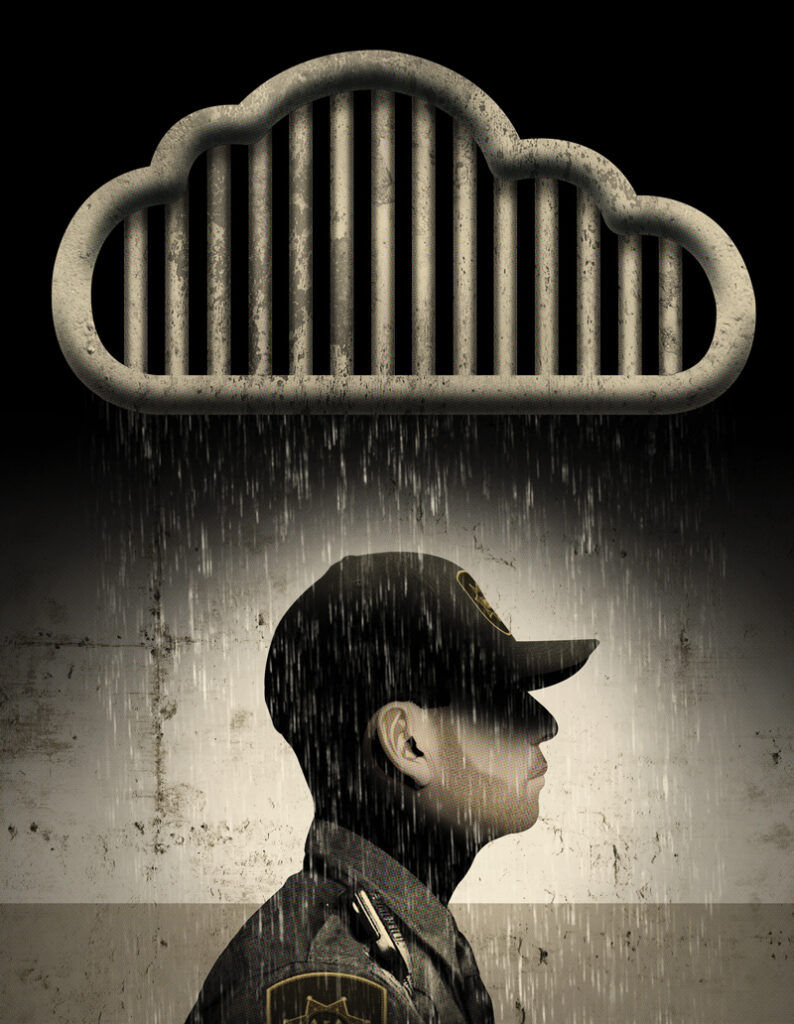
Imagine if, every day, when you went to work, this was how you spent your time. It is hard to think this experience wouldn’t corrode a person’s mental health, not to mention their moral compass. If COs were to fully face the scale of prisoners’ suffering, they could well experience a threat to what we might call their moral integrity.
How are COs supposed to manage such a profound threat to their self-regard and moral psychology? One way, observed criminologist John Irwin, is that COs can choose to “embrace the view that prisoners are moral inferiors who deserve their state of reduced circumstances.”
But this narrative of dehumanization, and the moral blinders it enables, can never function perfectly. Ultimately, it is obvious that the people we lock away are fellow human beings, who suffer and feel pain and despair just like the rest of us. So this is the tricky moral position COs are in, day after day: needing, for their own moral survival, to believe that the incarcerated people surrounding them, whose painful conditions of life they are directly responsible for, are not truly full human beings like themselves, when it is obviously the case that prisoners are in fact human. My strong sense is that, along with all the traumatic experiences to which COs are regularly exposed, this moral quandary and the deep emotional conflict it creates help explain the raft of mental health challenges that COs wrestle with.
In my interviews, one theme that came through loud and clear was that no one grows up wanting to be a CO. They do it for one reason only: for the money. The salary and benefits COs earn make it possible for them to provide for their families and to bring home far more than in most cases they otherwise could. Prisons in particular tend to be in rural areas, where there are few opportunities for people without college degrees to make a decent living. When the COs I spoke to referred to other local employment options, they mostly mentioned Walmart or working in warehouses, where the pay is usually far worse and the benefits are often nonexistent.
So they sign on as COs, agreeing to do what author Eyal Press calls “dirty work” in exchange for the chance of six-figure salaries, pension, and benefits. But there is a cost to this choice. Press defines dirty work as work that, though “solving various ‘problems’ that many Americans want taken care of,” leaves those who do it “stigmatized and shamed.” This is work that, in Press’s characterization, elicits “disgust” from society writ large, and both this societal judgment and the workers’ own knowledge of what they are called upon to do each day saddle them with “moral burdens and emotional hardships,” including “stigma, self-reproach, corroded dignity and shattered self-esteem.”
And it is not only the COs themselves who pay a price for the work they do. Their families also disproportionately suffer, both from divorce and from higher than average incidence of domestic violence.
And it is not only the COs themselves who pay a price for the work they do. Their families also disproportionately suffer, both from divorce and from higher than average incidence of domestic violence. In the interests of space, I won’t be able to get into the data here. For now, I’ll just note that these two issues force us to consider that, when COs leave for the day, they may be bringing some of the toxicity of the carceral environment home with them.
It is possible that higher than average rates of divorce and domestic violence among COs may reflect the personality and general orientation of those who take the job. But I think this explanation is too quick and easy. It fails to take seriously the likely effect of asking people to spend their days wielding virtually unchecked power over fellow human beings in a dehumanizing environment.
Among other things—and this brings us back to their families—COs while at work get used to ordering people around and to getting irritated and annoyed at the people who are constantly asking them for things. And once this becomes your orientation, it isn’t as if you can easily slough it off once you get home. I heard this a lot in my interviews. Here’s how one CO put it:
“You try your best to separate it—work is work, home at home. But then I’ll catch myself barking orders at my girlfriend like she was an inmate. And there’s been times when she’s turned to me and said, ‘I’m not one of your inmates. Stop talking to me like that.’”
Needless to say, this kind of disposition makes it hard to maintain the kind of trusting, loving, mutually respectful relationship that sustains a marriage.
My sense, moreover, is that these same dynamics also help explain the elevated rates of domestic violence in CO households.
Where does all this leave us? I have been trying to convey two main points: First, COs are vulnerable to a host of deeply troubling comorbidities, as are their families. Second, these pathological dimensions of the experience are no accident, but are instead directly produced by the character of the institutions in which COs spend their working hours.
To be sure, not every CO suffers from every condition I’ve mentioned. Some few fortunates who wear the uniform may well avoid them altogether. But occupational hazards do not become irrelevant just because they do not impact 100 percent of the people who do the job. If a given workforce disproportionately experiences serious pathologies, attention must be paid.
Why We Might Not Care—and Why We Should
I invite you to consider with me, from two directions, the question of why we should care about COs at all. Let’s begin with the reasons some might think we shouldn’t especially care about the harms COs disproportionately experience as a result of their work.
Reason 1: COs chose this work, and they get paid well for it. And if they don’t want the job, they can just quit.
We’ve already seen that people who take this job do it because it is the best pathway available to financial security for themselves and their families. To frame this decision as simply a matter of individual choice is to display an almost willful refusal to recognize the way structural economic forces well beyond individual control can compel people to take on work they would strongly prefer not to do, precisely because they know it will take a real toll on their mental and physical health. They sign up for it anyway because they feel they have no real options.
We are, I hope, long past thinking that serious occupational hazards are of no moral moment because those who face the dangers agreed to take the job.
Reason 2: COs often abuse their authority and do bad things to people in custody. When prisoners experience violence or other harms, it is often at the hands of COs or because COs didn’t care enough to keep them safe. And now you want us to care about them?
My answer here is simple: Why yes, in fact I do. It is certainly true that COs too often abuse their authority. The Federal Reporter is full of cases recounting brutal and unwarranted violence and egregious failures of care by COs against prisoners. Yet the fact that some COs inflict serious harm on the incarcerated does not justify indifference to the suffering that they themselves experience.
Of course, when people do bad things, there should be a way to hold them accountable. But membership in society’s moral circle should not be restricted only to those we happen to like or who never transgress.
For me, the defining moral imperative of collective life is the universal recognition of shared humanity. And that moral imperative obliges us to affirm the humanity—and recognize the suffering—even of people who have done wrong. This means we are not off the hook for the harms COs suffer just because some (or even many) people who work as COs abuse their power over those in their custody.
Reason 3: The incarcerated have it worse.
Anyone who knows anything about prison knows this to be true. Of course, people who are incarcerated have it worse than COs—way worse. But as I have said, this is not a contest. The point is not to rank suffering but rather to develop a more complete picture of the human toll of our national obsession with imprisonment. Such a picture must include the toll incarceration takes on those who work as COs.
COs are human beings. If there is reason to think there is real suffering here, we cannot look away. We are obliged . . . to do what we can to change the conditions that expose the people who do this work to so many toxic effects.
So I arrive at the affirmative case: the reasons we should care about the CO experience, even granting that prisoners have it worse. First and most obvious is the fundamental moral imperative: COs are human beings. If there is reason to think there is real suffering here, we cannot look away. We are obliged to bear witness and to do what we can to change the conditions that expose the people who do this work to so many toxic effects. We are, in short, morally compelled to care.
I know some may be unmoved by the idea of a shared moral obligation toward COs and are, perhaps, more concerned that those we incarcerate are treated humanely. For those in this group, there is a second, more instrumental reason to take seriously the multiple comorbidities COs experience: when COs are depressed and traumatized and sleep deprived, they are unable do the job we need them to do. And as a result, people in prison wind up experiencing worse conditions and worse treatment than they would if COs were fully capacitated.
There is something of a shared confusion over the nature of carceral punishment. People often seem to think that the scale of a criminal penalty is determined by the sentencing judge. Yes, once a person is duly convicted, judges decide (within the statutory range) the length of time that a person will spend in prison. But COs substantially shape the actual punishment people experience, in the way they do their job and how they interact every day with those inside. And the more traumatized, and incapacitated, and exhausted, and on edge that COs are, the harsher a facility’s conditions of confinement will be. To put it simply, if prisons are going to be safe and humane places to live, they must be safe and humane places to work.
This brings me to the third reason why we should care about COs. Or maybe better put, this is a reason we are obligated to care. In this country, at this very moment, almost 2 million people are living under lock and key in a vast national network of carceral facilities. How vast? In the United States, there are more than 6,100 prisons, jails, and detention centers. And every one of them is crammed full of human beings who are in many cases experiencing unimaginable pain, suffering, and degradation. Whatever each of us may feel as individuals about this situation, we are all culpable for its existence.
And the culpability extends still further, because prisons and jails do not run themselves. At present, as already mentioned, there are almost 350,000 correctional officers in the United States. These people are doing work that we need them to do to feed our commitment to imprisonment. And in exchange for a living wage and benefits, they are playing a role we know full well is disproportionately likely to leave them depressed, anxious, addicted, traumatized, suicidal, and sleep-deprived, not to mention shamed and humiliated.
Here is not the place to run through the policy changes that may make some positive difference to COs’ daily experience or the considerable obstacles to making those changes. But this is a policy conversation we absolutely need to have—and we also need to be prepared to follow where it leads. It seems plain that seriously considering how to make the role of CO less destructive for those who do it will point us toward the need for a dramatic rethinking of the extent of our national reliance on the practice of imprisonment.
Accounting for the Suffering Our System Inflicts
I want to close by considering how focusing on the harms COs experience by virtue of their work can shed new light on the cruelty, futility, and morally compromised nature of the practice and help us to see more clearly what exactly incarceration is.
Let’s begin with a puzzle: Incarceration brutalizes everyone it touches, while largely failing to achieve the purposes it claims to serve. So why does it persist? And why does the United States continue to be so enthusiastic about it? Here’s one answer: there is a vast gulf between the political constituencies enthusiastic about putting people away and the daily reality experienced by those who live and work inside.
Ever since I started talking to COs, there is an image I can’t get out of my mind. Out there, dotted across the American landscape, in places that are out of the way and hard to reach, are thousands of locked facilities full of people we call prisoners, who are never allowed to leave, and people we call staff, who—as they will tell you themselves—are doing life on the installment plan. They also cannot really leave, at least not for long.
This place is surrounded by barbed wire and high walls. It is crowded full of
people. . . . Everyone is trapped. And everyone inside—incarcerated and CO alike—is suffering.
Imagine for a moment just one of these places. Let it stand in for all of them. This place is surrounded by barbed wire and high walls. It is crowded full of people. Some of them are prisoners. Some of them are staff. Everyone is trapped. And everyone inside—incarcerated and CO alike—is suffering. No one, whether CO or prisoner, has the space or the resources they need to heal, to recover, to get right with themselves. Everyone is just trying to survive. As a result, life inside is brittle and unstable and full of conflict.
Meanwhile, out here, the rest of us go about our lives and scarcely give a thought to the sites of trauma and suffering we call prisons and jails. If we think about them at all, we congratulate ourselves for making the tough policy decisions that keep society safe. The notion that mass imprisonment keeps us safe is frankly a delusion. But we get to indulge that delusion at the expense of the millions of prisoners and hundreds of thousands of staff who are forced to live daily with the toxic effects of what is really just the fever dream of people who have no real idea what our enthusiasm for imprisonment actually entails every day for flesh and blood humans.
For some readers, all this may call to mind Ursula le Guin’s short story, “The Ones Who Walk Away from Omelas.” Omelas is a beautiful city, full of happy, joyous people. It is free of guilt and strife and as far from wretched as it is possible to be. You might ask: how do they manage it? Alas. In a basement somewhere in Omelas, there is a small, dank, dirty room. And locked in this room there is an innocent child, who despite their innocence is kept naked and starved and abused and denied light and kindness and care and everything else that makes life worth living. It is only because this single, tormented child lives this cruel and painful existence that the citizens of Omelas can live the charmed life they all enjoy. If the torture of this child were to stop, the spell would be broken and the ordinary sorrows of human life would immediately swamp all the goodness and grace that currently define life for everyone else in the city. Everyone in Omelas knows this. Some people in Omelas are sometimes distressed by the cruelty, but for the most part, just about everyone finds a way to make peace with it.
To me, what this story captures perfectly is the massive gulf—the utter disconnect—between the daily miserable experience of those we lock away and the rich daily lives of those people in whose name the suffering is being inflicted (i.e., all of us).
Some might object that America is nothing like Omelas. In Omelas, the tortured child is completely innocent, whereas the people we incarcerate are generally guilty of crimes. Or else they have given us probable cause to think they are. Or they have come here illegally, warranting (we say) their administrative detention.
It would take a whole other lecture for me to explain why I think this way of seeing things, of justifying our massive carceral enterprise, is both profoundly misguided and does not survive scrutiny. The familiar justifications do not hold up. But even assuming the justifications held and even assuming the brutality of American carceral practice could be justified as to those we incarcerate, this effort to distinguish us from Omelas carries a fatal flaw, which we are now fully equipped to see.
Le Guin’s story, it turns out, has a blind spot: she makes no mention of the individuals on whom the people of Omelas depend to keep that child locked away. Yet someone has to superintend the arrangement. Someone has to fill the food bowl and the water jug. Someone has to be the one to rattle the door and “come in and kick the child to make it stand up” for the occasional visitors who come by, and to lock the door again on the way out.
For Le Guin, and for the people of Omelas, there is no justifying the incarceration and brutal treatment of the innocent child. So there is no need even to notice the cruelty inherent in forcing some members of society to be the ones to operationalize a plainly brutal practice.
What about us? In our collective imagination, we have thoroughly justified our brutal carceral practice and totally naturalized the idea of locking people away in dank, dark basements full of trauma and violence. We have blinded ourselves to the cruelty we are daily manifesting toward those we incarcerate. As a result, it may only be once we stop to focus on the human toll on the people upon whom we depend to make the system run that we can really, fully see the true moral character of the whole enterprise.
In every society, there are going to be morally unpalatable jobs that still need doing. But those of us who benefit because others do that work don’t get to just pretend it isn’t happening. We are obliged to look squarely at the suffering that is being endured on our behalf, to do what we can, first to understand it, then to mitigate it as much as possible. And if we’re lucky, in the seeing of what we may otherwise have pretended away, we might come to understand in a new light something true, if admittedly ugly, about the moral foundations of our shared world. In this case, what we might newly see is that every carceral facility is a hermetically sealed site of trauma and suffering experienced by everyone inside, not only the incarcerated but also the staff.
Le Guin’s story, interestingly, is called “The Ones Who Walk Away from Omelas.” It closes by describing those citizens of Omelas who can’t accept the bargain, and so they walk away. We don’t have that luxury. So the least we can do is to be clear-eyed about the moral implications of our choices. At a minimum, this demands a full accounting of the suffering that others must endure thanks to our own seemingly unquenchable thirst for imprisonment, including those others we pay to do our dirty work.
This article was first featured in the Fall 2025 issue of Marquette Lawyer Magazine.