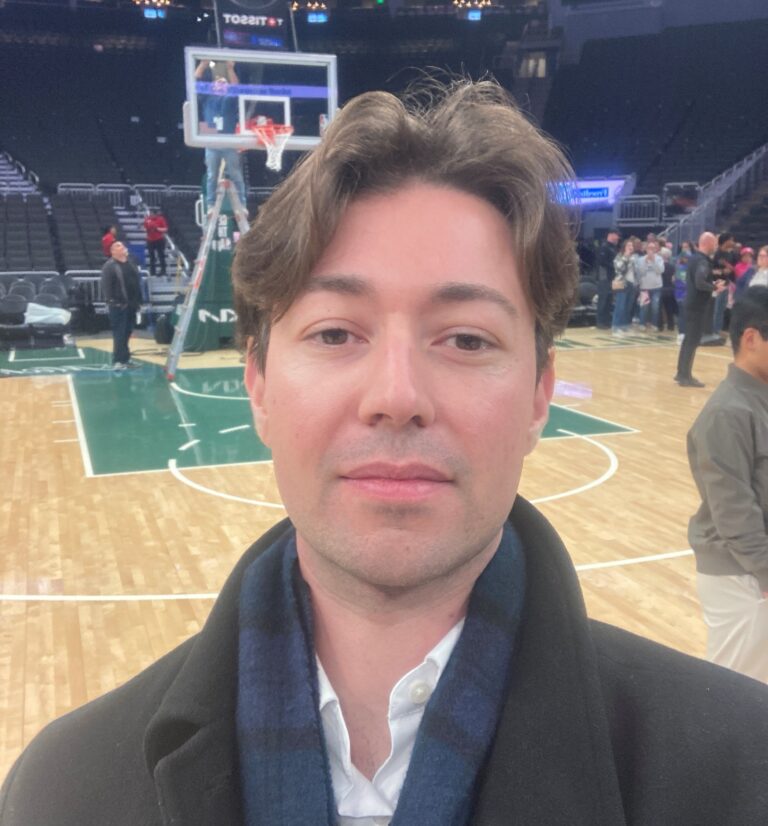
Ioannis Kaliampos, a doctoral student in Religious Studies in the Department of Theology, has journeyed from the small village of Vasilika, Greece, to Milwaukee, Wisconsin on a path that reflects both deep roots and global curiosity. This November, as universities across the United States celebrate International Education Week from November 17 to 21, a joint initiative of the U.S. Department of State and the U.S. Department of Education highlighting the value of international education and cultural exchange. This week, the Graduate School is recognizing the diverse stories of international graduate students like Ioannis, whose experiences enrich campus life.
Growing up in Vasilika, a quiet village of about 3,000 people near Thessaloniki, Kaliampos recalls a childhood shaped by community, history, and the rhythms of rural life. The village’s weathered homes, a centuries-old church, and the scent of freshly baked bread from its many bakeries provided a vivid backdrop to his early years. “The run-down houses still carry the wounds of wars long past,” he said, “but everyone smiles at you on the streets, happy to be alive.” Summers were filled with berry bushes and fig trees, and mornings began with the crow of a rooster rather than an alarm clock.
Family, as in much of Greece, was central. “Greek families tend to be rather big,” he said with a laugh. “I grew up not just with my parents and siblings but surrounded by cousins, uncles, and grandparents.” That closeness extended into the village itself, where faith was woven into daily life. “People back home are really connected to a spiritual world,” he reflected. “Prayer is lived; it is everywhere around you.”

Education also played a formative role. Greek schools, he said, gave him a broad perspective on life through the study of Ancient Greek, Latin, tragedies, and history. Breaks between classes were spent outdoors under the Mediterranean sun, first playing sports and later, as he grew older, talking with friends beneath the trees. “It was fun and relaxed,” he remembered. “Many historical aspects of Greek education are still used today, although it has its faults, has offered me a way to see the world differently.”
Kaliampos’ academic journey took him from Greece to England, where he pursued higher education at the University of Chester for his bachelor’s degree and later at the University of Oxford for his master’s. He recalls the rain-soaked streets of Chester, frequent trips to nearby Liverpool, and long study days in Oxford that ended with lively pub conversations about philosophy and politics. “We would spend hours talking about women, philosophy, and politics over pints and cigars,” he said. “It is very much the tradition there, and I miss it a lot.”

His next step brought him across the Atlantic to Marquette University, a transition inspired by Dr. Marcus Plested, a Professor in the Department of Theology, who encouraged him to explore new academic frontiers. Now a doctoral student specializing in Historical Theology, Kaliampos focuses his research on early Christian approaches to thanatology, the study of death. His work explores how early Christian and Syrian communities treated and remembered the deceased, using archaeological evidence to understand the connection between memory, ritual, and daily life. “In Mediterranean cultures, remembering the dead is an everyday practice,” he explained. “Those left behind continue to live through the lives of those who have passed. I ask why this is no longer the case today, especially in the West.”
At Marquette, Kaliampos has begun finding community among his fellow graduate students and colleagues. While still exploring campus life, he appreciates moments of quiet reflection and the occasional indulgence in a new favorite snack, jalapeño and cheddar popcorn from Sendik’s, best enjoyed while watching movies.
As International Education Week invites the Marquette community to celebrate global learning, Kaliampos’ story serves as a reminder of how far curiosity and scholarship can travel. From the hills of Vasilika to the classrooms of Marquette, his journey speaks to the enduring value of cultural exchange and the shared pursuit of meaning across borders.