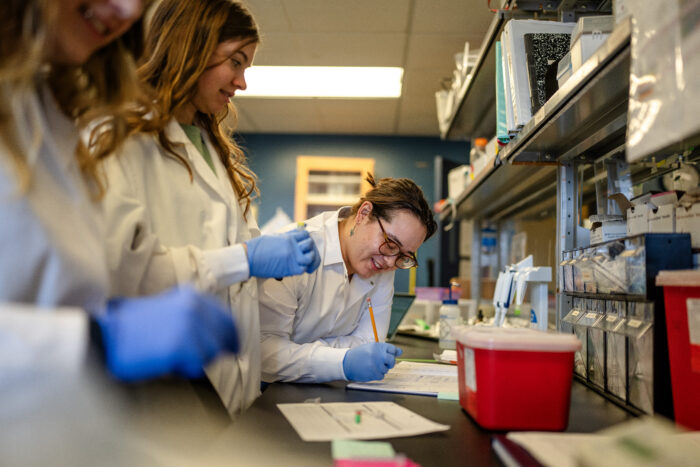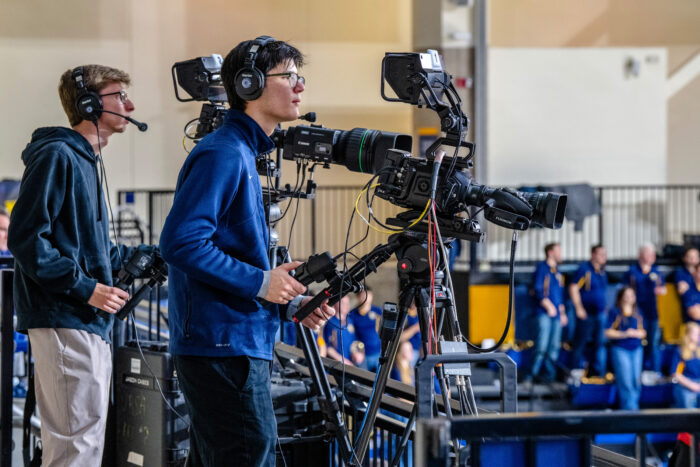
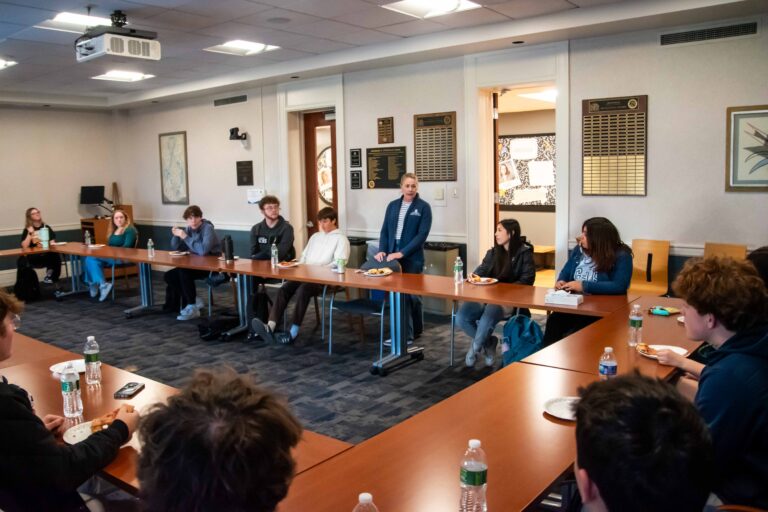
Several times during the fall semester, Acting Dean Dr. Kati Berg sat down to lunch with a group of first-year students in the Diederich College of Communication. The meal is a chance for the students to ask the dean questions, as well as an opportunity for them to bond with each other.
It’s also mandatory.
“This year, we actually made it a requirement for course credit that every first-year student attends an event of some kind with the dean,” says Erin O’Brien, director of recruitment and student success in the Diederich College of Communication.
The credit is for COMM 1050, otherwise known as Communication Pathways. The course is a first-year seminar, designed for new students to acclimate to college life. Guest speakers from across the university attend COMM 1050 to speak about topics ranging from applying to internships to study abroad to finding the right major or minor.
Acting Provost Sarah Feldner had the idea as the former dean to add optional events to the class — lunches and soccer matches and plays that might give students a chance to get to know each other. The events were well-received, and the college soon expanded them to mandatory status for each first-year student.
“One of the biggest reasons why communication students choose Marquette is the closeness with faculty and staff,” Berg says. “If they feel empowered to come have a meal with the dean, hopefully they’ll also feel empowered to go to their professor’s office hours or reach out to their adviser when they need help.”
Students like Zach Hanson benefit from the practice. A multi-interested, first-year student in the college, Hanson took the opportunity at his lunch with Berg to also introduce himself to his fellow students. He especially enjoyed his interactions with the college’s Comm Coaches, a group of student mentors who help new undergraduates transition to college life.
“We were all talking about what drove us to be here and to be students in the College of Communication,” Hanson says. “I was a little apprehensive thinking that it was going to be some super formal thing, but it was casual, and I was able to just talk to people, both faculty and students. That was really nice.”
The student-dean events are grounded in theories about the best way to set young learners up for success. Research shows that colleges are most likely to lose students after their first year, which makes creating an immediate sense of belonging crucial for retaining learners. More than 90 percent of first-year communication students came back to the college after the 2024-25 academic year, a figure nearly 10 points higher than the national average for four-year institutions.
Things like this make students feel like they’re a part of the fabric of Marquette, which, of course, they are.”
Erin O’Brien, Director of Recruitment and Student Success at the Diederich College of Communication
Keeping that retention number as high as possible is one of O’Brien’s greatest goals. She sees firsthand the obstacles that students face when they start college. Some are first-generation students, with no advance knowledge about how to navigate the higher ed system. Some move from far away and have a hard time adjusting to life in a place removed from their family and friends. Some find it difficult to deal with the academic burden.
Classes like COMM 1050 are part of “putting students on the same footing” at an early juncture, according to O’Brien.
“They’re in this huge transition period and many of them are just figuring out what they want to major in or how they want to get involved,” O’Brien says. “It’s so valuable to have Dean Berg there or the Comm Coaches there to provide guidance.”
Hanson laughed as he remembered one of the Comm Coaches telling him to get involved in the Logrolling Club. While he didn’t end up signing up for logrolling, he did put his name down for Marquette MARDI GRAS, a student-led volunteer organization focusing on disaster relief, and for the Fugees, Marquette’s improv troupe. He also appreciates how professors always start their classes by telling students what events are happening around the college.
“I’m getting to do all these things I’ve never done before. This is all brand-new territory to me, and yet I feel more like myself than I did in high school because of things like meeting with the dean,” Hanson says.
It’s a very different experience than O’Brien remembers when she was in college.
“I don’t even think I knew who the dean of my program was,” O’Brien says.
While first-year students may soon forget the lunch or the soccer match that they attended alongside Berg as part of their first class at Marquette, the sense of community that those events establish may stick around much longer: to graduation and perhaps beyond.
“Things like this make students feel like they’re a part of the fabric of Marquette, which, of course, they are. We want to continue to foster that feeling of connection to the institution,” O’Brien says.