
You probably have a picture in your head of the stereotypical hacker: black hoodie, dark shades, alone in a basement, typing away at a keyboard… While pop culture loves this image, the reality is far more nuanced.
Today, hackers come in many forms. While malicious hackers can pose serious threats to our data and safety, ethical hackers work to test and secure the technologies used in day-to-day life. Medical equipment, traffic lights, airplanes and personal devices all run on systems that are vulnerable to cyber-attacks. To protect these systems, cybersecurity professionals turn to ethical hacking: a proactive approach that identifies and fixes potential vulnerabilities before malicious hackers attempt to misuse technology.
Ethical hacking is more than just a test of coding knowledge; it is a collaborative process focused on highlighting the biggest technological issues of today and planning how to best prepare technology for the future. These skills are on full display as Marquette students, in Computer Science 3840: Ethical Hacking, learn how to work together to find, debate and impact the future of technology and cybersecurity.
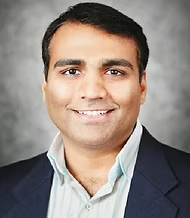
Chirag Malkan, adjunct professor of cybersecurity, has been on the front lines of ethical hacking for most of his career with companies such as GE Healthcare, Rockwell Automation, and Malkan Solutions LLC — his own cybersecurity consultancy agency. Having graduated from Marquette in 2004 with a Master’s of Science in Electrical and Computer Engineering, Malkan has had over two decades of experience in cybersecurity and software development. Malkan returned to Marquette in 2024 to help educate the next generation of cybersecurity professionals, preparing them to learn the skills of an ethical hacker.
What is ethical hacking?
Picture this: a roller coaster is about to open to the public, but first it needs a safety check. Technicians will look for every loose screw, every squeaky wheel, or any bent metal to ensure that nothing will make the rollercoaster run off the track.
Malkan explains that ethical hackers are just like these roller coaster technicians, making sure everything is as safe as possible before the public is able to use it — or misuse it. Ethical hackers work to prevent cyberattacks by identifying potential weaknesses and building defenses around them. Malkan’s courses help students look at the small details to find these weaknesses and patch them before something awful could happen.
Learning to be an ethical hacker
You’ve seen the scene in a movie: a heist crew ready to break into a bank. They’re all doing whatever it takes to get the job done, working together to get every detail just right. Ethical hacking follows similar principles — ones that Malkan hopes students bring into the field.
“The cornerstone of ethical hacking is helping the community,” says Malkan, guiding students to understand that working together is what really solves large problems. Ethical hackers never work alone, and multiple approaches help build the best defenses in cybersecurity. Malkan knows that cybersecurity is not something done just in the classroom — students need to connect with the community to fully realize the most important issues they will face in their careers.
“Cybersecurity is always a team sport.”
Malkan also serves on the board for Security for the Folks, a grassroots cybersecurity movement in Wisconsin, and the think tank behind the real-world inspired projects within the Ethical Hacking class. Vikram Malkan, a student at Colorado Technical University, founded this community to unite cybersecurity professionals in Wisconsin, offering LinkedIn-style networking and connection opportunities for ethical hackers.

Security for the Folks’ community leadership team includes Karol Lejmbach, Marquette computer science Ph.D. candidate and researcher, and Aaron Wasserman, senior security engineer at Praetorian.
Both are motivated by making the vision stand out in Wisconsin. They aim to grow and leave their mark by developing the next generation of cybersecurity professionals to protect Wisconsin’s critical infrastructure and businesses. Getting involved and building community is always a top priority for Malkan, and his connections help elevate students’ cybersecurity skills far beyond the classroom.
Regardless of experience as an ethical hacker, Malkan always offers one piece of advice: tinker. Understanding cybersecurity holistically involves constant experimentation, failing, and trying again. Nothing is 100% correct on the very first try, but learning to find small improvements is key to building the best cybersecurity defense possible.
Malkan suggests that the best way to tinker is by debating the big questions of today — from artificial intelligence to data regulations. Engaging in these debates and conversations helps students better understand the technologies they are working with and the broader implications that cybersecurity can have on the world and our future.
Cybersecurity in action
Students from all majors can explore the impact of technology on their future by minoring in cybersecurity. Adding a cybersecurity minor enables students from all disciplines to understand the safety, ethics and growth of technology that impacts every imaginable field of study. Malkan extends his gratitude to Dr. Debbie Perouli, associate professor of computer science, for bringing the cybersecurity minor to life and offering students the chance to grow as critical and connected thinkers in the digital age.
Both in the classroom and out in the community, Malkan continues to prepare students to be leaders of tomorrow — equipping them with the skills and perspectives of ethical hackers. Through teaching students critical cybersecurity skills and connecting them with local professionals, Malkan prepares students to tackle the biggest technological challenges of the future.
Interested in learning about cybersecurity? Reach out to Chirag Malkan to join the community and take the first steps to becoming an ethical hacker yourself.