
When seniors Leo Ruffolo and Brennan Wills were signing up for fall classes, an English course titled Frank Herbert’s “Dune” caught their attention. Both had read the science fiction novel and thought taking a deeper dive into the storyline and characters would be interesting.
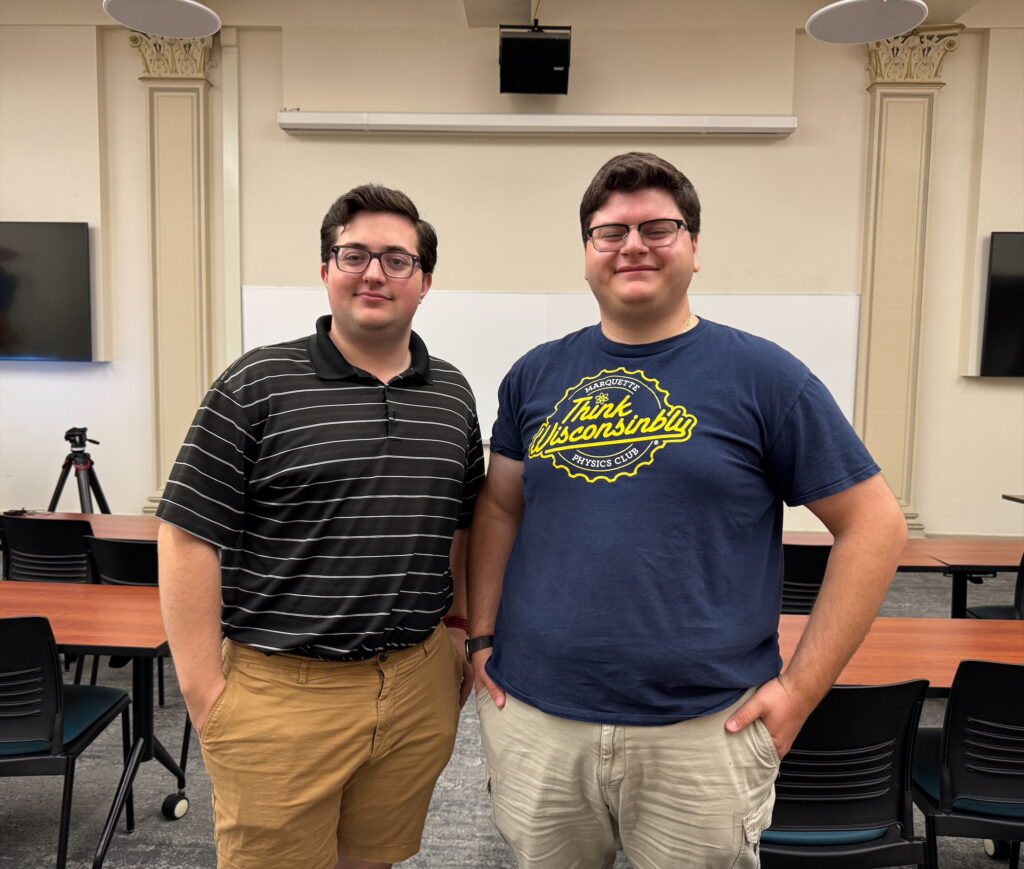
“I love ‘Dune.’ It’s one of my favorite books ever, so when one of my friends told me about the class, I knew I had to sign up for it no matter what,” says Ruffolo, a physics and mechanical engineering major. “What could be better than having a class solely devoted to reading, learning about and discussing such a great book.”
“When I found out Dr. [Gerry] Canavan was teaching it, that was just the icing on the cake,” says Wills, a double major in digital media and history. “I already had a good grasp of the content and the themes, and I knew I would enjoy learning more.”
This year marks the novel’s 60th anniversary. Canavan, chair professor of English, explains the book’s premise.
“’Dune’ takes place 20,000 years in the future at a time when humanity has colonized the universe,” Canavan explains. “They never found any aliens, so it’s a world of humans. The current emperor’s family has been in charge for around 10,000 years. It’s the story of a child, Paul Atreides, who we’re told from the first pages, is going to rise up to become this important figure and take over the galaxy. And so, we see the story of his ascent.”
This is the first time Canavan has offered the class, and it won’t be his last. The course ended up being completely full at 50 students.
“It was a super popular class and a lot larger than our usual courses,” he says.
Canavan typically teaches a class size of around 30 students. This class nearly doubled and even had a waiting list.
The English literature course meets for 50 minutes on Mondays, Wednesdays and Fridays. Two of the three days they meet in a large group; on Fridays they break into smaller groups for discussion.
“Monday and Wednesday are devoted to the text of ‘Dune’ broken up into around 50 pages a day,” Canavan says. “We talk about the influences — we talk about the things the author is thinking about, and then on Friday, we do criticism broken up in the three groups: religion-politics, ecology and environmentalism, and drugs.”
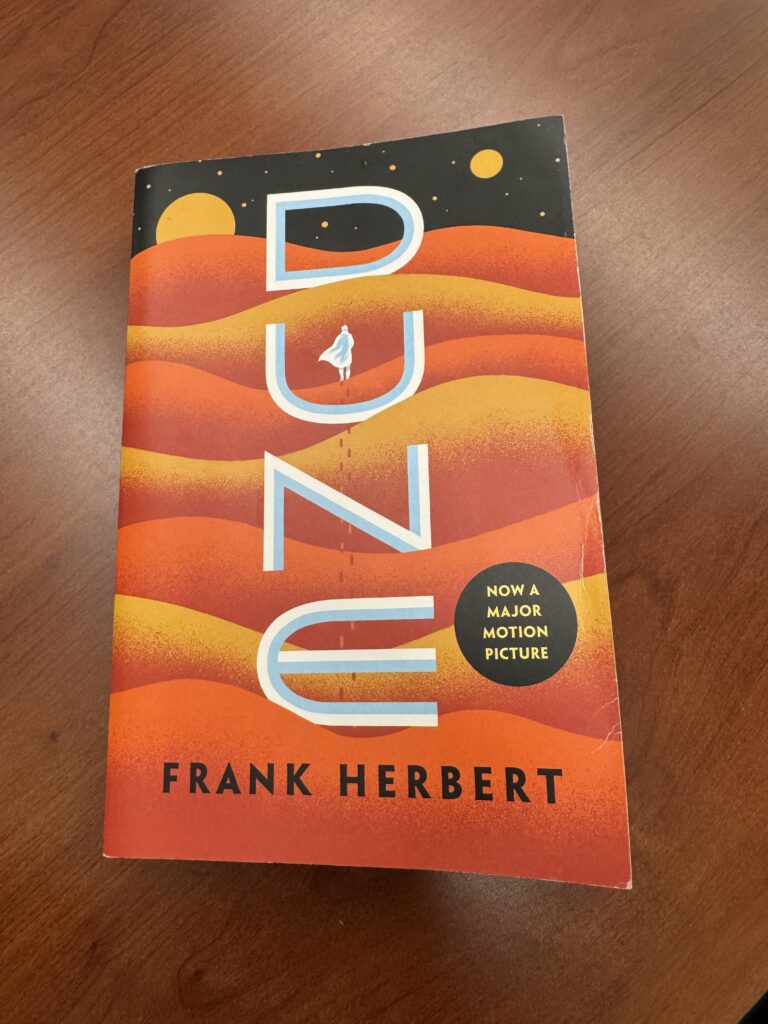
Although the book is six decades old, its themes are relatable to modern society, environment and culture.
“I would say that Frank Herbert wrote ‘Dune’ as a response to the world around him in the 1950s and 1960s, so there are some outdated ideas in there, but a lot of it can still be applied today,” Ruffolo explains. “The ideas brought forward about control, both governmental and personal, are almost timeless. The constant threats of messiahs and fanaticism are present throughout the book and the series. I think that is something we need to focus on and always stay vigilant about, especially now with social media.”
Longtime “Dune” fan Canavan agrees that, although the context of the book is decades old, it still translates to today’s world.
“I think one of the key concepts is energy analysis,” Canavan says. “It’s not hard to see that the spice is oil and that oil is the substance that makes modernity possible. It makes global capital impossible because it’s been mined and extracted from so many places. There’s now a handful of key locations that have what’s remaining of it, and so those spaces become sites of important global contestation.”
“Dune” proves to be a story that transcends time, and it’s once again found a place in the 21st century with a new audience enjoying the movie remakes by director Denis Villeneuve with Timothee Chalamet playing the main character Atreides.
Wills admits that it was the latest round of “Dune” movies that initially piqued his interest in the storyline. And despite not loving the book at first, he says he finds himself immersed in the world-building of Herbert’s writing.
“The setting is incredible, and the status of the characters is very well-placed,” Wills says. “I enjoy Herbert’s integration of earth cultures and combining them in a way that wouldn’t have been thought of before.”

Canavan is no stranger to conducting unique classes. He taught courses on the comic book “Watchman,” another on J.R.R Tolkien’s “Lord of the Rings,” and because of its popularity, he’ll be offering the “Dune” class again.
“Once I have something in my bloodstream, I usually do it multiple times,” Canavan says. “I’m definitely going to do this class again in anticipation of the next movie, and then just keep seeing how it evolves the way the Tolkien class has.”
Ultimately, Canavan’s hope is that students’ excitement about the “Dune” series doesn’t end with the class.