

Many people hear the words “data analysis” or “data visualization” and think Microsoft Excel. Getting proficient in Excel, particularly in its advanced functions, was considered a crucial baseline for any job that involved analytics.
Hunter Sandidge couldn’t stand it.
“I’d see people come in and spend all their time doing what I would think of as low-value added work,” said Sandidge, director of fintech, applied artificial intelligence and business intelligence in Marquette Business’ Accelerating Ingenuity in Markets program. “Every day, they’d be grabbing data and making charts and doing pivot tables; that would be 80 percent of their time. And that would leave only a little window of time to figure out what to do about the things the data showed.”
CitizenDS is a potential answer to this problem. A startup company founded by Dr. Joe Wall, Flynn Chair of Accounting Ethics and Applied Innovation, CitizenDS makes it easier to visualize and act on large amounts of data. Users of the software can test correlations, discover trends and navigate complicated datasets without needing a background in data science.
“We want business owners to find actionable insights in less than three minutes of using our software,” Wall says.
But how might that work in practice? Imagine a Fortune 500 company wanting to understand how different employee attributes, such as the department the employee works in or their years of experience, impact salary. In Excel, there is no good function to assess a relationship between a numeric variable, such as salary, and a categorical variable, such as the employee’s department. Additionally, trying to figure out how each variable impacts and changes salary would be tedious, and only possible for someone with data analytics skills.
With CitizenDS, the user uploads a dataset of employees, sets the “salary” variable as the target and publishes the data. In less than a minute, CitizenDS will figure out what variables are most correlated to salary and informs the user. The program will make the charts, run the statistics and even explain in plain English what it says.
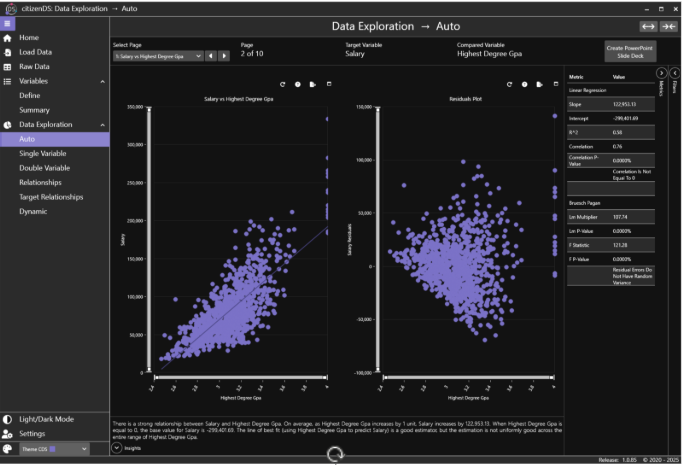
“We want people to be able to ask the questions they want without having to go to an Excel ribbon and navigate 9,000 functions, especially if they only ever use a couple,” Sandidge says. “The idea is to tell you quickly what you actually need to know to make this data usable.”
Sandidge provides CitizenDS free to his students in his fintech classes, allowing future data scientists to get hands-on with his software. Instead of spending time in his intro-level class teaching students how to navigate an interface, Sandidge can focus on teaching students how to interpret and query data sets. “What would you recommend this business do based on this histogram?” becomes the operative question instead of “how do you make a histogram?”
Junior Sophie Brisson found the tool extremely helpful in learning how to properly parse data. Although Brisson is an accounting major who hopes to go into public accounting, she wanted to gain a solid understanding of data science to ensure she remains competitive in an AI-driven business environment.
The first time Brisson used CitizenDS was for a class project analyzing the factors that make borrowers likely to default on bank loans. Normally, that work would take hours of trial and error in Excel, including multiple rounds of regression analysis and chart-building. CitizenDS shrunk that time down to minutes.
“It’s so cool to see data come to life like this.”
Sophie Brisson, junior in the College of Business Administration
“This is great because not every company is going to be able to pay for a data science team to help them interpret everything they have, and students certainly don’t have that money to spend,” Brisson says. “CitizenDS lets me leverage this data so easily. I feel like everything is right at my fingertips.”
“If your organization only has a few data scientists, there’s going to be this huge bottleneck of people waiting to have their ideas tested,” Wall says. “Anything that enables the average employee to do basic data science work is going to be a really good thing for innovation.”
It’s the latest in a string of self-made tools that Wall and Sandidge have deployed in their classes. Sandidge’s venture capital AI bot reviews student startup ideas and offers ways to refine their pitch to investors. Praximæ, a C-Corp joint venture among Wall, Sandidge and Marquette University, offers modular courses that allow learners to customize their curricula according to what they most want to learn — these are already in use in AIM classes.
These tools allow program faculty to spend more time teaching students the kinds of high-value, technical skills employers want, and students like Brisson are happier for it.
“It’s so cool to see data come to life like this,” Brisson says.