
At every one of the men’s basketball team’s workout sessions this summer, the scene played out the same way.
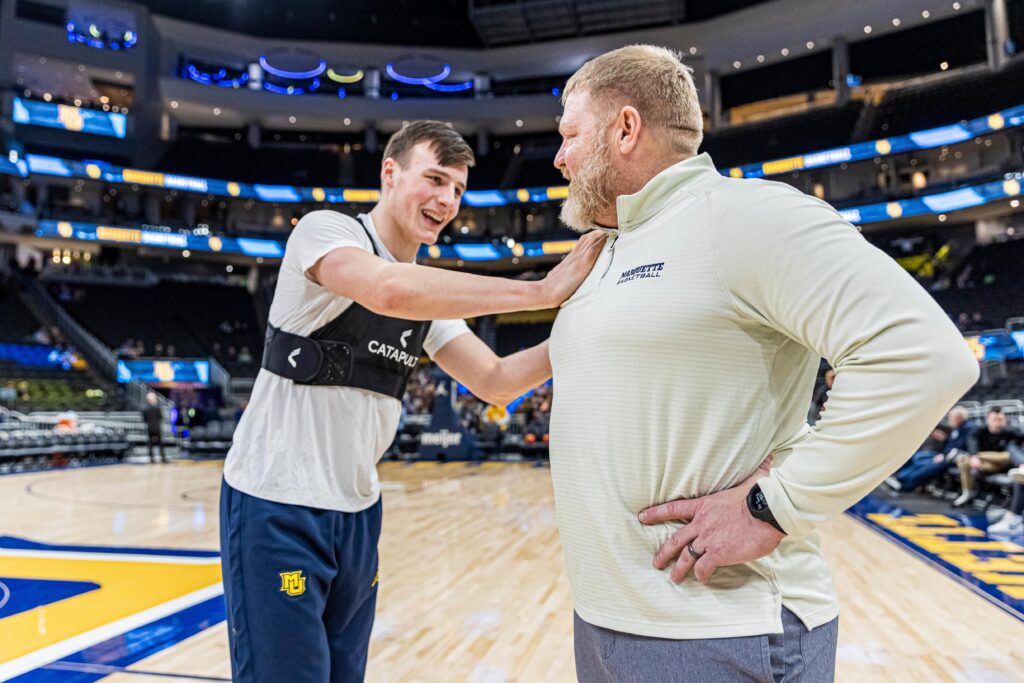
After warm-up stretches or before a high-intensity drill, 15 teammates would amass like a swarm of hornets around big man Caedin Hamilton. As they jostled and let out war whoops, Hamilton would move within inches of an assistant coach or even a visitor he’d never met before. He’d throw back his arms, thrust out his chest, bare his teeth and roar, “I’m the biggest, baddest, toughest (bleep) in the Big East,” before stomping off.
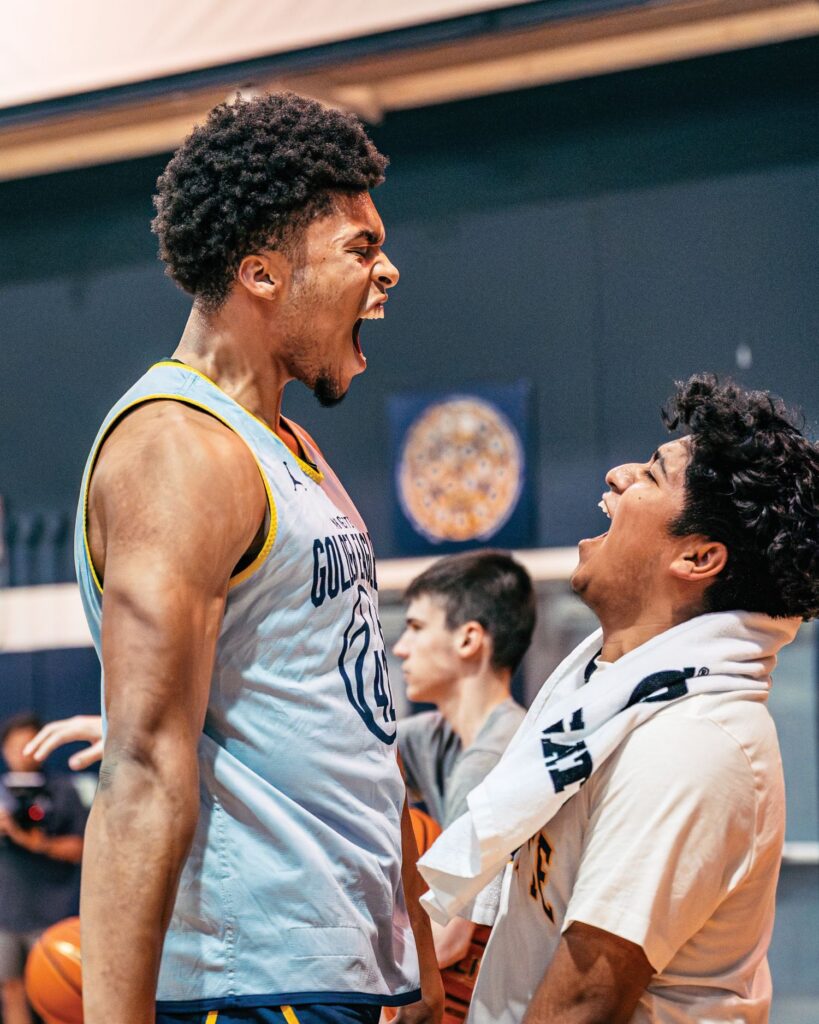
If your impressions of Hamilton are still stuck on him as an unassuming, round-shouldered first-year redshirt or the more chiseled but raw bench sub from last year, it’s time for an update based on the team experience Head Coach Shaka Smart has dubbed the Summer of Explosive Growth.
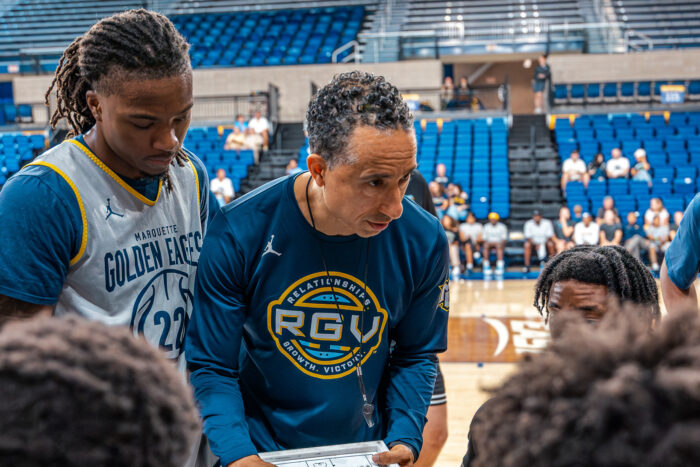
Throughout June and July, team sessions were demanding physically, mentally and emotionally — the March-level intensity in the Al McGuire Center leavened only somewhat by evening outings for kayaking, laser tag and player vs. staff softball. The pace of play was breakneck. If players weren’t in position for their turn to burst into a drill, they’d get sent off to push a tractor tire the width of the gym. If Coach Smart broke the flow with an errant pass, he would close the practice pushing the tire himself.
After the graduation of three team leaders in May, Smart needs new difference makers to emerge and existing ones such as Chase Ross to elevate their influence. To accomplish that, explosive growth is written into the personal and player development plans that serve as road maps for each team member.
In addition to daily toughness incantations, Hamilton’s plan challenged him to hoist 10,000 hook shots this offseason, as tracked by a life-size silhouette on Smart’s office door. Strips peeled off every 1,000 shots revealed Hamilton mid-snarl.
Toughest of all were the twice-weekly sessions with fellow big men on an electric ladder device, the Versaclimber. “It’s a total body workout that just gasses you,” explains Todd Smith, assistant athletic director of applied sports science and performance.
Thinking of everything the machine required of him brought tears to Hamilton’s eyes during meetings with coaches and support staff. But by the last week of summer practices, when Smart asked him about the Versaclimber at a Chicago alumni event, resolve had replaced tears. “It’s kind of terrible, to be honest,” Hamilton deadpanned to the crowd, sharing a story of waking at 4 a.m. and pushing through dread of the workout awaiting him. “But I did it. I’m conquering it,” he said.
“I’m proud of you, champ,” said the coach, with an approving nod that sent an underlying message: At that moment, Hamilton was indeed the biggest, baddest, toughest Golden Eagle in the room.
Marquette leaders knew exactly what they were getting when they hired Smart in 2021.
By that point, the then coach of the University of Texas had developed a 27-page operating system — the “Culture Doc” — encompassing the passion and wisdom that have him regarded as a premier developer of student-athletes and team chemistry.
He utilized the document, crafted after the lone losing season of his head coaching career, as he met with the Marquette delegation in Austin and laid out his vision.
In so many words, he was posing two all-important questions, recalls Athletic Director Mike Broeker, Grad ’12, a deputy then, who joined the leaders at the time, AD Bill Scholl and President Michael R. Lovell, on the trip. “He was asking, ‘Do you believe in what I’ve described and are you willing to allow me to navigate this way?’ And the answer was just a resounding, ‘Yes.’”
Smart’s philosophy was about developing people as well as players, which resonated deeply in conversations that grew to include Smart’s wife, Maya. “I watched Shaka, Maya and Mike Lovell have this unbelievable two-hour conversation,” Broeker recalls, “and very little of it had to do with coaching basketball.”
You may also like:
Building Golden Eagles: A few unique ways Marquette basketball helps players develop on and off the court
Through customized development tools and a culture rooted in care for the whole person, Marquette’s men’s basketball program prepares student-athletes to excel in sports, academics and life.
Smart’s convictions were bold and admirable, given the climate emerging in college athletics. Changing NCAA regulations have yielded a transfer portal that makes it easy for student-athletes to switch schools. New opportunities to benefit financially have turned offseasons into something akin to free agency in pro sports. Each year, half of all D1 men’s college basketball players enter the portal to explore moves elsewhere.
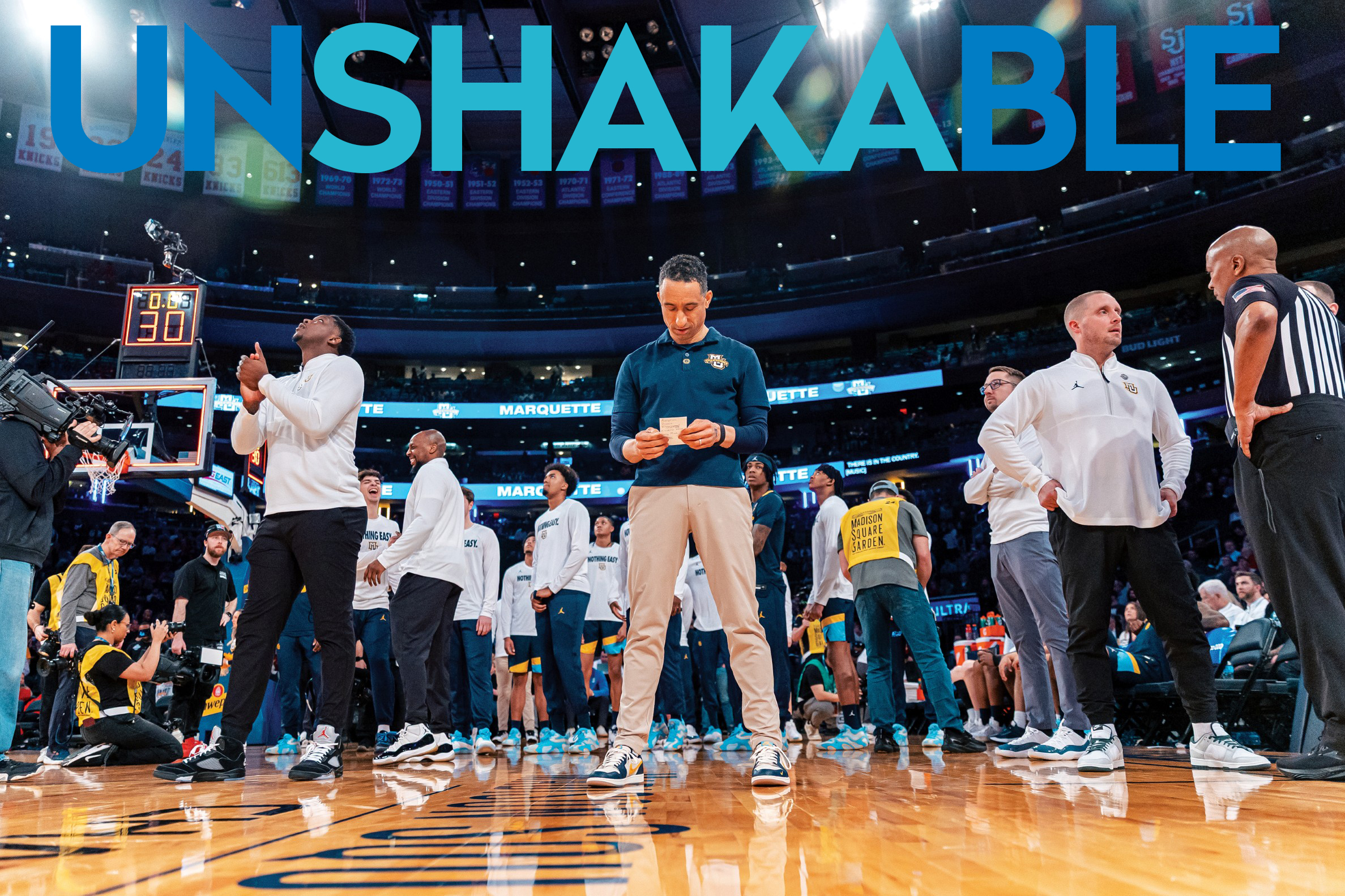
Smart went the other way. Based on a deep alignment with Marquette’s values, he embraced the opportunity to build a program truer than ever to his vision — with an unshakable focus on building long-term relationships, achieving dramatic growth and capturing victory on and off the court. He cultivated a staff and searched for players and families who matched this vision.
“What Shaka is doing is really one of one in college basketball,” says John Fanta, a broadcaster and analyst for NBC. “When you combine that with the success, that makes it extraordinary.”
“What Shaka is doing is really one of one in college basketball. When you combine that with the success, that makes it extraordinary.”
John Fanta, NBC broadcaster and analyst
These principles were put to a test in 2022 when Justin Lewis, the top player on Smart’s inaugural Marquette squad, opted for the NBA Draft following the team’s surprise run to the NCAA Tournament. Smart considered using the portal to restock with proven players to carry the load formerly borne by Lewis and graduating players. Instead, he prioritized those already invested in the program. Bringing in transfers “would have stunted the growth of our returning players,” Smart says. “If we value growth, that’s a contradiction.”
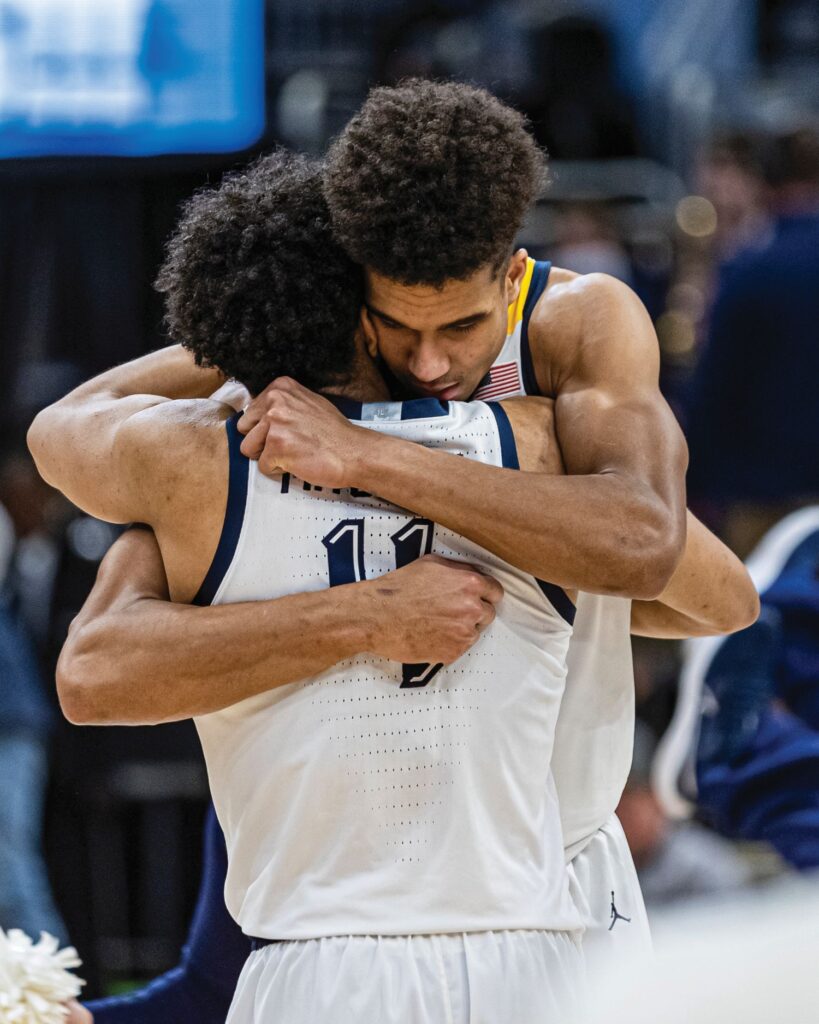
After an offseason focused on explosive growth, Smart was rewarded with breakouts from Tyler Kolek, Comm ’24; Oso Ighodaro, Bus Ad ’23, Grad ’24; “O-Max” Prosper; Stevie Mitchell, Bus Ad ’25; David Joplin, Comm ’25; and Kam Jones, Comm ’25. That core became the catalyst for something special — a pair of Big East titles, regular season and tournament; a run to the Sweet 16 of the NCAA Tournament; the second-best win percentage in the Big East over the last three years.
While victories grab headlines, what these teams came to embody culturally was just as impressive. A brotherhood was built through extraordinary bonding experiences such as annual October retreats, where players let their guard down. As Ighodaro has reflected, “When someone shares their childhood traumas, it makes you want to run through a wall for them.”
The Culture Doc remained a defining text, guiding relationships that are simultaneously confrontational and loving. Tenets such as “Feedback is our food” and “Everything we do is a domino” are built into every practice, player-player exchange, game and social outing. This wholehearted embrace of the program and one another is now the standard at Marquette, a hallmark of the culture those within the program call “Our Way.”
It’s resulted in a near unheard of level of stability and opportunity for holistic development. Marquette is the only high-major program in the country not to take an NCAA Division I transfer in the last four years. No active member of the team’s rotation has departed either. “You always hear that ‘We don’t go to the portal’ and ‘We’ve got the same players,’” observes Kam Jones. “We’re literally the same human beings, but we’re not the same players on the floor. Every year, everybody gets better.”
Jones embodies that phenomenon as well as anybody. He added pieces to his game each year, evolving from a sharpshooter into an elite floor leader and offensive focal point. There were certainly lucrative opportunities to look elsewhere, but he bought into the program’s tireless growth ethic and close, challenging relationships — and was rewarded for his trust with All-American honors and recently a roster spot with the NBA’s Indiana Pacers.
“Relationships are not just something we talk about. The coolest part is how genuine it is,” he says. “As far as wanting to leave Marquette, I don’t see why anyone would want that.”
In describing the origins of Our Way, Smart often goes back to his roots. “I’m a kid who was raised by a single mom. I looked at my coaches like they were 10 feet tall,” he says. “They put their arm around me and helped me become a better version of myself. That’s why I got into coaching, in addition to my maniacal desire to win. I have both reasons.”
Few things bring him more joy than seeing explosive growth and new maturity in a player like Hamilton — or Ighodaro, who played 38 minutes his freshman year and is now in the NBA. Few things make him light up like sharing the team’s collective 3.8 grade point average or speaking of Stevie Mitchell, last year’s Big East student-athlete of the year, having essentially a peer-to-peer exchange with an alumnus CEO of a company worth billions.
Still, there’s no doubt about Our Way’s chief drive: “Make no mistake about it, we come together at this specific place and time with a mission of creating and sustaining championship success,” Smart says. After last season’s disappointing first-round NCAA Tournament loss, he works as hard as ever for that summit.
While Our Way’s embrace of recruitment and retention is an outlier in this era of rampant roster turnover, that’s partly because it’s so difficult to attain. “Relationships are our biggest competitive advantage,” says the Culture Doc. Our Way is Marquette leaning into its core expertise and top differentiator.
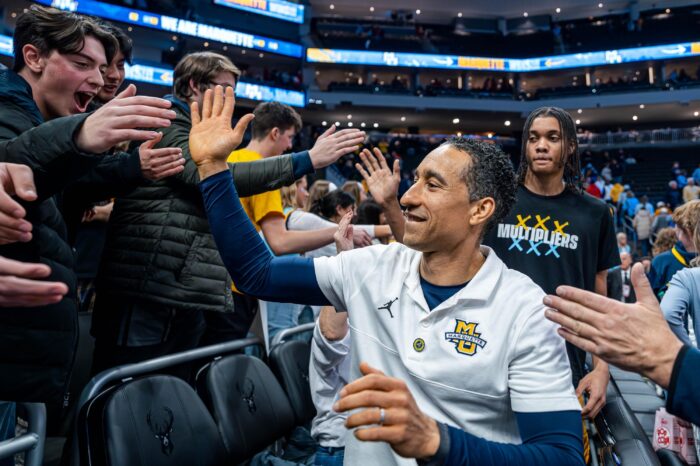
In truth, it’s how Marquette is already winning — achieving a culture of success that aligns with university values and makes fans feel proud as it whips them into delirium and leaves them cheering en masse for the kinds of achievements — like consecutive defensive stops — formerly tracked only by statisticians on their tablets. As players settle in for four years, fans build ties with them almost as strong as those players form with each other.
The results and unique identity are driving a surge of enthusiasm felt everywhere from the often sold-out upper tier of Fiserv Forum to Marquette’s admissions office, says Broeker. “It takes a lot of effort to coach a team. It takes more effort to build a program. And it takes an incredible amount of effort to build a community around a program,” he says. “For Shaka, it’s about building a community that can take incredible pride in what we’re doing.”
For Smart, the marriage of the Marquette community and the team’s special culture contributes to an atmosphere felt across campus. “Our guys truly feel Marquette is the place to be. I believe Marquette is the place to be,” Smart told alumni supporters this summer. “You, as a community, give off that energy too. That’s important because there’s also a lot of energy at other places. But we’re going against the grain: When we say Be The Difference, we want to Be. The. Difference.”