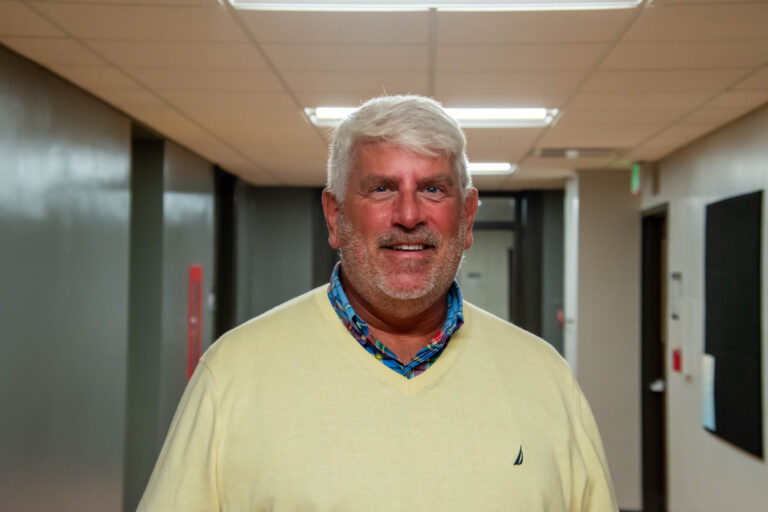
The Diederich College of Communication welcomes a new face to its advertising program, as Mike Oelhafen joins academia after 40 years in the ad industry.
To Oelhafen, one thing stands out as his most important mission: make sure the students in his class can get quality jobs when they graduate.
“I would rather hire someone who has at least some kind of classroom exposure to how the advertising industry really works, so they recognize what they’re getting into,” Oelhafen says.
Where did your passion for advertising and media strategy start?
I went to school in Madison, and after getting a Bachelor of Science in journalism there, I got my first job at an advertising agency in Chicago. The job specifically dealt with media planning and buying, and over the course of time, my roles evolved toward what interested me. I loved talking to people who created advertisements and working directly with clients.
You said that being laid off an account for the first time was one of the most important moments of your career. Why?
We had 13 people working on a piece of business and the client left our agency. Only one out of 13 of us was absorbed.
Losing your job is an opportunity to adjust your compass and to have a future that’s bigger than what you had where you were. You don’t even realize it until you’ve gone through it. It’s painful because you’re wondering, “Why me?” but it leads to something better.
I would also say that the first time I pulled an all-nighter is another important moment in my career. If you can handle that, you can handle anything.
You worked very closely with the public relations department when you were in advertising. Why?
I worked closely with the PR folks because they didn’t have the money to push messages out. I was the one who controlled the money, but I needed to know if an advertising campaign was credible or not. They would tell me. I could count on them to let me know whether my client was delusional for believing that their new product was revolutionary. They had a great sense of what the market was asking for and that helped me make better advertising decisions.
You are very familiar with a market research tool called MRI Simmons. What is that tool and how do you bring it into the classroom?
In the world of market research, there’s primary research that a company does on its own, and then there’s secondary research, which can be done by a research company, and they ask a lot of questions to a projectable sample of consumers. MRI Simmons is one of the major players in that area of secondary research.
Understanding how to interpret the results and learning what you get out of an MRI Simmons data search is important because students are going to be expected from their employers to do that as advertising professionals. I always try to look at where dollars are flowing in advertising firms’ budgets and tailor my classroom approach to that. MRI Simmons is so widely used that I felt it was important to teach it in my classes.
What are some of the things you looked for when you were hiring new college graduates?
I would hire people who have a good understanding of what it means to put money behind an advertiser’s message and how those media buying decisions get made. There’s a large element of learning on the job in this business — that’s just reality. I’m very happy to teach a new hire things, but it has to be someone with enough classroom experience to understand what it is they’re getting into. I could screen pretty well for interest and attitude; grads who came to me with insatiable curiosity, having applied themselves in the classroom, would get the jobs.