The International Conference on Environmental Systems is usually the realm of the most technologically advanced private aerospace companies. Collins Aerospace, NASA, Paragon Space Development Corporation and Honeywell — all owners of majorly impactful, classified space technology — are just some of the organizations that regularly attend.
This year, the conference welcomed a new group to take its place among those luminaries: six students and four faculty members from Marquette University.
“The students spent all of last school year working on some pretty cool research related to finance and AI for space applications, and their work got accepted into the ICES conference,” says Hunter Sandidge, the group’s leader and director of Fintech: Applied AI & Business Intelligence at AIM in the College of Business Administration. “Typically, only industry professionals and graduate students’ work is accepted. They all got to go to a foreign country to present their work and hang out with the smartest people in aerospace.”
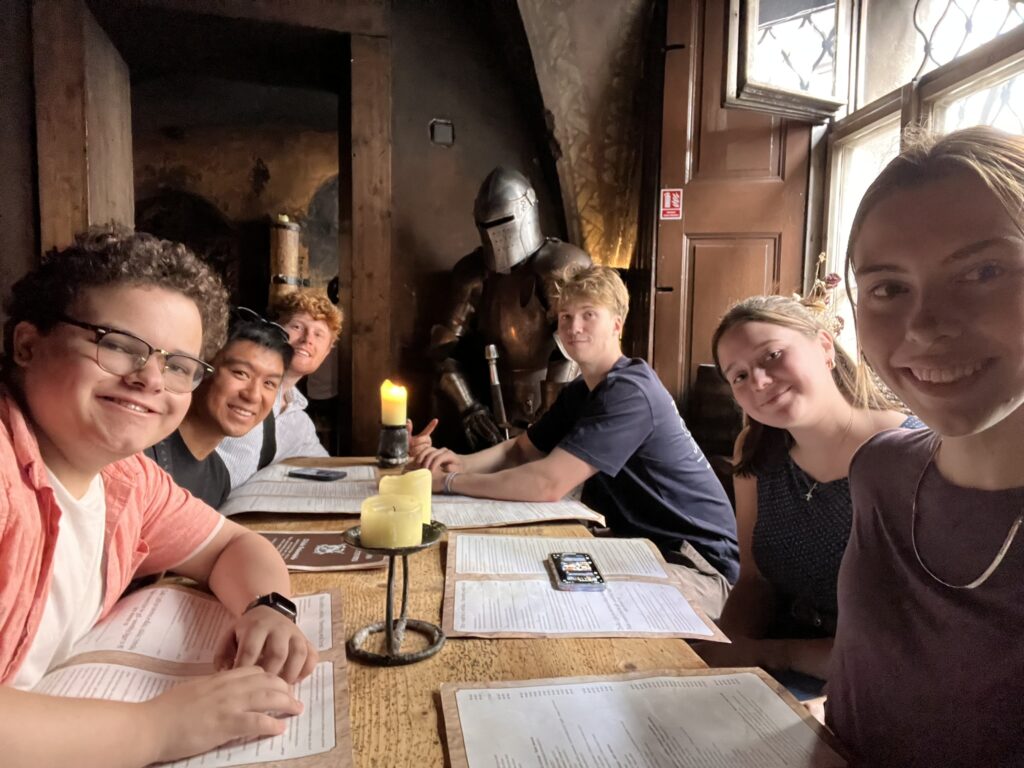
Marquette’s journey to ICES, an endeavor that started a year prior, culminated in Prague, the capital of the Czech Republic, where the traveling group presented four papers to conference attendees. The Marquette papers represented the only undergraduate submissions that were accepted to the conference.
That cohort included Sandidge; Flynn Chair of Accounting Ethics and Disruptive Technologies Dr. Joe Wall; Keyes Dean of Business Administration Andrew DeGuire; AIM Program Coordinator Andrea Golvach; and Department of Accounting Chair Dr. Kevin Rich, as well as students Sophia Guiter, Kate Dugan, Sam Brooks, Ian Ortega, Tyler Miller and Finn Cocoman.
“It was awesome to be an undergraduate and to see that we were pretty much the only ones at that level to get invited to this conference,” says Brooks, a senior AIM and information systems major.
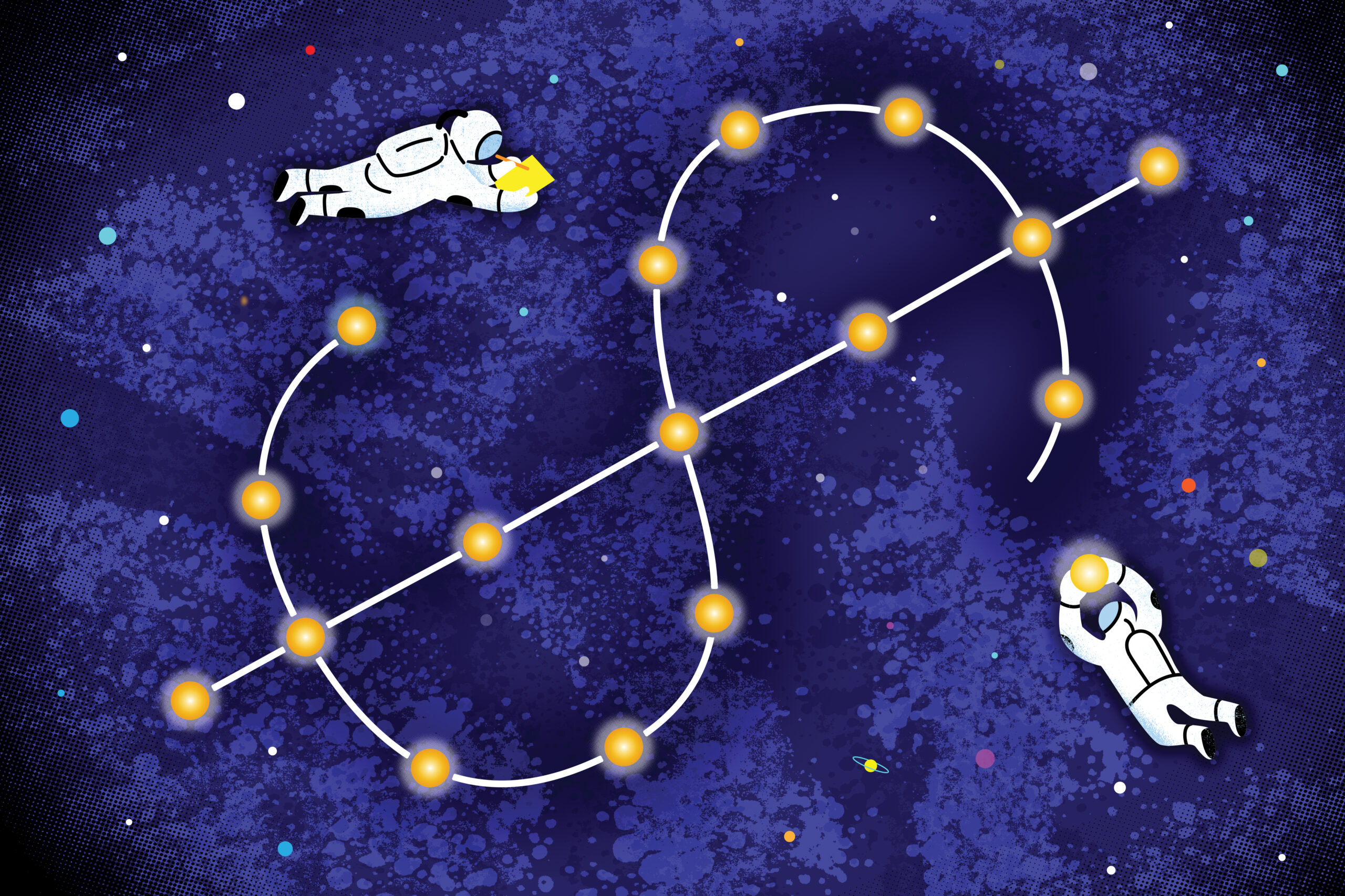
Brooks and his best friend Ortega, a senior biomedical engineering student who is also in AIM FinTech, submitted a paper that relied on concepts of retrieval augmented generation to make NASA more efficient. AI models that use RAG retrieve relevant information from specific knowledge bases outside of its training data, creating a better output without having to spend massive amounts of time or money retraining the model. Brooks and Ortega also used a ranking system that provided a more transparent search approach, as opposed to other search engines that have more opaque algorithms.
RAG is especially useful for subjects like aerospace in which vast amounts of highly technical knowledge are spread across many different databases. The combination of those two factors makes it hard for large language models to find specific papers. Instead, they often return search results that are not related to what the user requested, or they will invent papers that do not exist, a phenomenon commonly referred to as hallucination. Brooks and Ortega proposed a way to implement RAG that uses a minimum of computing power to generate more helpful responses.
“It’s allowing engineers to be more productive and efficient with their time, because you’ll have a consolidated source of information,” Ortega says. “It’s easier to find those relevant pieces of information with this tool.”
We open the door for others to take our work and advance it. The students posted all their code publicly.
Hunter Sandidge, director of Fintech: Applied AI & Business Intelligence at AIM
The road to Prague was far from easy. Most companies at the conference presented research that had taken them years to generate. The AIM students did it in a single academic year. Sandidge frequently came in on weekends, spending 12 hours in the lab with students on a Saturday and then eight more on Sunday during the run-up to the conference. Even down to the last minute, students practiced presentations for each other in their hotel rooms.
“You boot up your little laptop and you mock out your presentation, and you get feedback from people who aren’t rocket scientists; they’re your friends and they’ll tell you if they can understand it well,” Brooks says.
Other successful submissions from Marquette’s team included a paper on implementing environmental alterations to the International Space Station—such as changing the brightness of the station lights or altering the kinds of scents in the air—to increase astronaut productivity. Another paper looked at the key drivers of cost overruns, which are common in NASA’s budget.
Marquette was one of very few educational institutions at the conference, which meant that their research was shareable in a way that most of the other entrants’ were not.
“If it’s a private company, they’re presenting on the technology and its capabilities, but they’re not giving the secret sauce away because that’s all proprietary,” Sandidge says. “We open the door for others to take our work and advance it. The students who did the RAG work posted all that code publicly. Someone from NASA came up to me at the conference and said they wanted to do something with it.”
Sandidge is confident that this conference is far from a one-off; rather, it is a first effort toward a larger goal of Marquette becoming a space finance hotspot. While NASA has higher ed partnerships for engineering and astronaut training, it does not have any go-to institutions for the economics of space exploration. Now that private companies such as SpaceX and Blue Origin have become major players in the industry, Sandidge thinks the space finance niche will grow quickly.
“There’s a lot of cool, exotic stuff that’s going to be going on not just with NASA, but with private partnerships too, and we want to be part of it,” Sandidge says.
Students like Ortega, who want to work on the bleeding edge of technology, couldn’t agree more.
“I loved being in a room with the people who have the same mindset on innovation that I do and just trying out new things with them,” Ortega says.