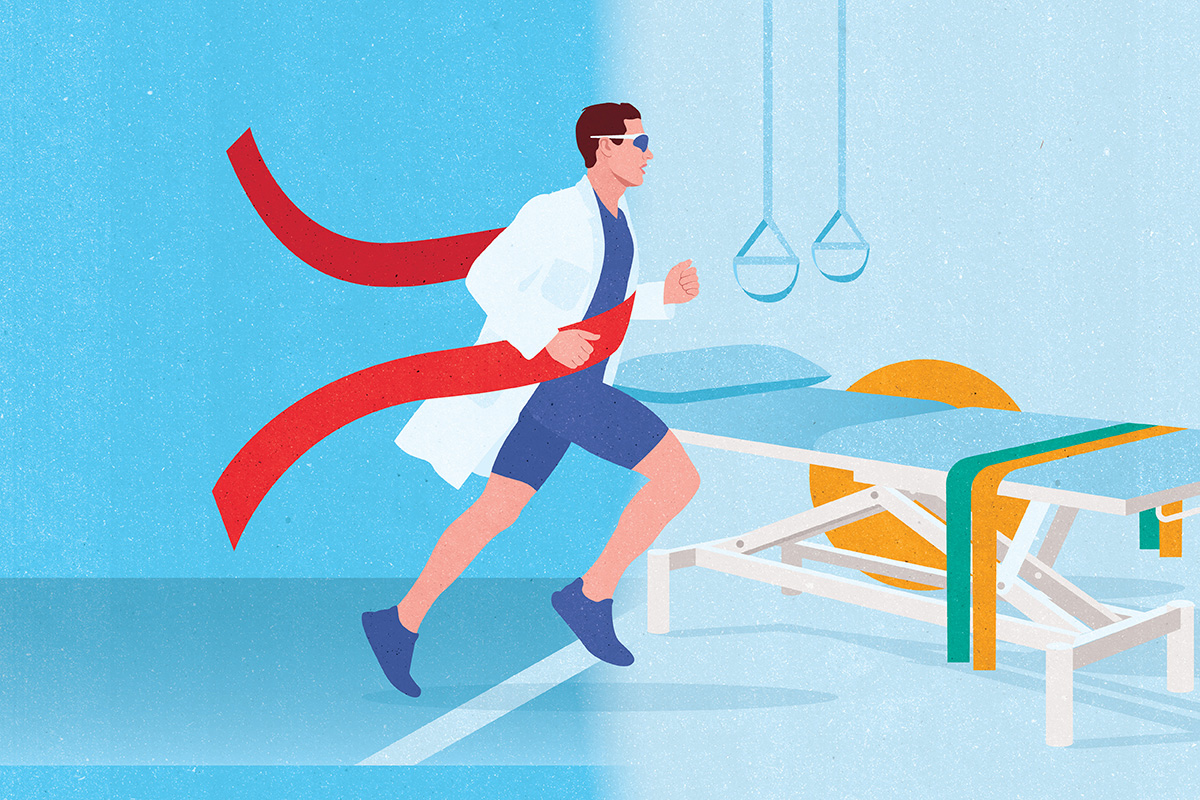
Dr. Jacob Capin was finishing up his usual morning bicycle ride, zooming up from the lake toward the Marquette campus and thinking about his research as an assistant professor of physical therapy, when a large black pickup truck blew through a red light and plowed into him. “It launched me up into the air, and I landed on the other side of the road,” he remembers. “Luckily, I had a stack of papers in my backpack, along with a double-packed lunch of chicken sandwiches that acted as an airbag.”
While he wasn’t seriously hurt from the accident, he still has a scar on his hip three years later. He didn’t let it slow him down, however—the very next day, he was back training for a half Ironman, consisting of a 1.2-mile swim, a 56-mile bike ride and a 13.1-mile run, less than two weeks later. The incident demonstrates Capin’s enthusiasm for accomplishment both athletically and academically. Since picking up endurance sports 13 years ago, he has participated in over 100 triathlon and Ironman competitions and sped his way to the top of the sport. Along with more than two dozen victories, he is the reigning national champion in the Olympic Distance Triathlon. “I’ve always had some kind of intrinsic drive and motivation to succeed,” he says, “striving to make the most of my opportunities and abilities.”
His own near-miss notwithstanding, Capin also thinks a lot about the effect of injuries on athletic activity, particularly on former college athletes like himself. There’s evidence showing that in fact, former college athletes are less likely to exercise later in life, and less healthy overall compared with non-athlete peers. Some speculate that decline results from missing the structure that organized sports provide. Capin points out, however, that past studies have failed to tease out the relative activity levels of former athletes who have experienced significant injury.
“You think athletes are super-healthy, and in some ways they are,” Capin says. “But there are also challenges including pain and prior injury that can limit long-term health.” He is currently in the midst of a massive long-term study at Marquette involving hundreds of participants to more closely examine the long-lasting effects of high school or college sports injuries. It’s funded by a prestigious $1.9 million National Institutes of Health Director’s Early Independence Award, offered to young scientists showing extraordinary promise. The results, due out next year, could help point to ways to manage injury and physical activity into middle age.
Long Shadow of Injury
Capin’s luck in avoiding serious injury extends to his own sports career. Growing up in rural Virginia, “I made a game out of everything,” he says, “even bouncing a ball up and down the steps.” Playing sports of every kind followed, until by college he had focused on basketball. After a disappointing stint playing Division I at Campbell College, he transferred to Christopher Newport University, where he saw significantly more time on the court, going to the NCAA Tournament twice with the team.
He focused his studies on kinesiology, the study of human movement, combining elements of anatomy, physiology and biomechanics, going on to earn a Ph.D. in biomechanics and movement science at the University of Delaware. In his own career, he’d witnessed the devastating effects of injuries among teammates, particularly knee injuries involving the anterior cruciate ligament or ACL. “Sometimes it ended their career, sometimes they came back, but weren’t the same,” he says. During graduate school, he examined the long-term effects of ACL injuries on real patients in the university clinic.
That interest grew into his current study, now in its fourth year, involving more than 200 young people and 200 mid-life adults. He’s split the later group into three categories, including former athletes who have injuries, former athletes who haven’t had injuries and non-athletes. He and his team of students and research assistants have subjected them all to intensive physical workups at Marquette’s Athletic and Human Performance Research Center, including cardiovascular assessment, body composition scans and a fancy electromechanical dynamometer showing how much muscles work during exercise. In addition, participants wear a physical activity monitor for several weeks outside the lab and undergo extensive interviews about diet and exercise history.
“I do my best thinking and working through problems when I’m on a long bike ride or run. I’ll come in and scribble some notes, then eat, and then get the computer and write.”
Dr. Jacob Capin
“If we find that those with prior injury are less healthy on certain measures, it could place more emphasis on primary prevention of injuries, as well as on designing efficacious programs to transition out of competitive sports and manage prior injuries,” Capin says. While he has another year before releasing quantitative data, qualitative interviews with participants have borne out the significant pain injured athletes deal with later in life. They have also shown the difficulties student-athletes sometimes have without the all-consuming structure of games, practices and trainings. “They say, ‘I’m used to pushing myself to the absolute max— Is it really a workout if there’s no coach telling me that I have to do it?’”
Personal Bests
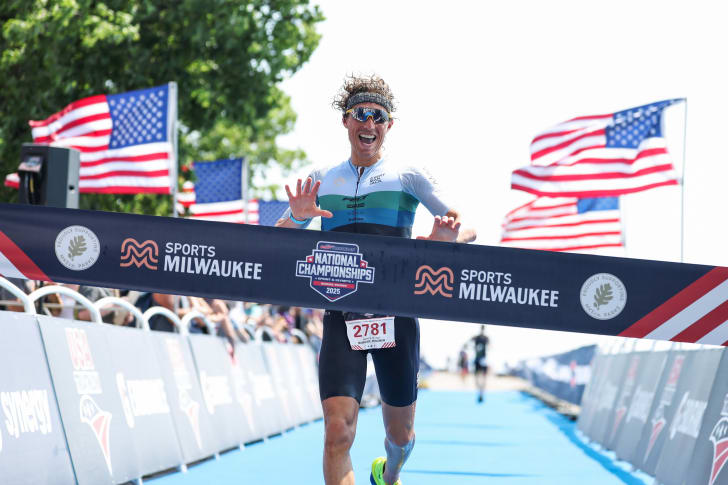
Capin avoided that problem by immediately throwing himself into training for endurance sports as soon as his basketball career ended. “The day after we lost the NCAA Tournament, I got on the treadmill to train before our 10 a.m. bus left the hotel,” he says. Since 2012, he’s won some 25 endurance competitions, including five half Ironmans. This year, he won three national championships — in triathlon, duathlon, and aqua bike — in the same weekend. And in a particularly sweet victory in August, he won the USA Triathlon Olympic Distance Triathlon National Championship right in Milwaukee.
The physical activity and the research complement each other, says Capin, who typically exercises for two to three hours every morning before coming into the office. “I do my best thinking and working through problems when I’m on a long bike ride or run,” he says. “I’ll come in and scribble some notes, then eat, and then get the computer and write.”
While winning is always exciting, part of the appeal is the way endurance challenges push the athlete to achieve personal goals. “I’ve had races where I’ve won and haven’t been satisfied with my performance, and then races where I’ve gotten second or third but given it everything I had,” he says. Case in point was a half ironman in Muncie, Indiana this year, where he started the running race with stomach pains, but pushed through mentally and even began increasing his speed compared with other runners around mile 10 — eventually placing third. “If there had been another two miles, I might have won it,” he says.
That was, coincidentally, the same race that he’d competed in three years earlier — just after his bicycle accident. As for that time? “I did win that one.”