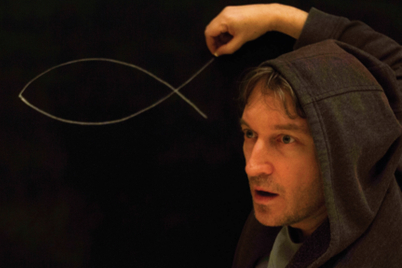
Rev. George Drance, S.J., Sp ’84, will present “The Gospel of Mark in Performance,” a solo show telling the story of Mark’s Gospel, with two performances at the Evan and Marion P. Helfaer Theatre, Sept. 18-19. Each day’s performance will be held at 4:30 p.m.
“The Gospel of Mark in Performance” seeks to reclaim the original power and urgency of this message, by telling the story as the early Christians might have told it — in underground meetings running from the empire’s forces.
With music composed by Elizabeth Swados, the stories of the Gospel span time and space to bring a contemporary audience back into the spirit of this ancient text. Drance originally performed this in 2014 at the world famous La MaMa Experimental Theatre Club.
The performances are sponsored by the Marquette Jesuit community, free and open to the public.
Drance has performed and directed in over 25 countries on five continents, serving such companies as Teatro la fragua in Honduras and Kenya’s Theatre YETU. He is the artistic director of the acclaimed Magis Theatre Company, praised by the New York Times for its artistic skill and daring, and serves as Artist-in-Residence at Fordham University.
Other acting credits include ETC, The Metropolitan Opera, The Public Theatre/New York Shakespeare Festival, American Repertory Theater and Ralph Lee’s Mettawee River Company. He has been on the faculty of the Marist International Center in Nairobi, Kenya, and at Red Cloud High School on the land of the Oglala Lakota Nation. Television credits include “The Blacklist” and “The Daily Show with Trevor Noah.”
Father Drance spoke with Marquette Today about returning to his alma mater, his acting background and performing “The Gospel of Mark in Performance.”
Were you part of the theatre program? If so, what was your experience like as a student at Marquette? What were some performances that stand out from your time on campus?
Yes, I was a theatre major at Marquette when I was here for my undergrad studies. I was honored to be one of the first to receive the Liberace Scholarship for performers. I have great memories of Marquette: committed instructors, a wonderful community spirit, and lessons and skills that I have taken with me in my work all around the globe.
As a Jesuit, as well as an actor, how does your acting career work in tandem with your faith and service to the church?
A good deal of what I do points to the interface between creativity and spirituality. To name just a few: I am a pastoral assistant at St. Malachy’s/The Actor’s Chapel in New York City. I am the chaplain of the Jesuit Media Lab, a group committed to encouraging artists to recognize the spirituality inherent in creative practice. My own company, the Magis Arts Collective, gives workshops in schools and prisons. I lead retreats for artists about how their craft and their spirituality can inform each other. Even my teaching at Fordham University is guided by how the spiritual and the creative work together.
Can you share your history with “The Gospel of Mark in Performance?”
I first developed this piece in response to Pope Francis’ “Evangelii Gaudium.” In it he called for a creative view of bringing the joy of the Gospel to a contemporary context. I studied the Gospels as part of my Master of Divinity program, and remember that not only was Mark the first Gospel, but that for years it had been passed on by oral tradition, by storytellers who moved from place to place, before it was written down sometime between 60 and 70 A.D. As a performer, this excited me. I am a resident artist at La MaMa ETC in New York City and wanted to portray the Gospel as if it were describing our life today. What if our time was like the first century, when an invading empire outlawed the Gospel? What might contemporary storytellers do to get the message across, even if they had to do it underground? Composer Elizabeth Swados wrote music for it, and it premiered at La MaMa in 2014.
What about this performance, or the format of this telling of the Gospel of Mark, speaks to you?
We imagine “the evangelist,” the storyteller constantly pursued by imperial forces. We imagine a community who had to find hidden places to meet in order to hear this forbidden message. Audiences have told me that is made them understand the Gospel better by placing it in an imaginative context similar to its own origins, and that the urgency of the stories in this way made it more impactful for them.
Are there any themes from the Gospel of Mark that translate more clearly in the show?
“Do not be afraid,” is a phrase that is constantly repeated in the Gospel. Above all, Christ wants us to be liberated from our fears, even if that means facing them head on. There is a deep freedom that we are invited to in the Gospel, that our fears only paralyze us if we let them. Christ constantly heals, restores, brings back to life those aspects of our lives that are diminished by the grip of fear and death. He wants the faithfulness of God’s promise of new life and the reality of that faithfulness in the telling of the Gospel to liberate us and sustain us.