
When Julia Emery, Comm ’25, got an email about the Communication Leadership Concentration Program (C-Lead), she figured it was worth a shot to apply. “I did see myself as a leader, but I wasn’t the loudest person in the room,” Emery says. She wondered if C-Lead could help her become that person — bold, commanding and the center of attention.
But after getting into the program and attending the spring 2023 LeaderShape retreat with her C-Lead cohort, Emery learned that she didn’t have to become that person. She could embrace her introverted traits to lead in her own way.
“Leaders can be all different kinds of people,” Emery says. Not everyone wants to be a CEO or high-ranking manager. Some, like Emery, prefer to lead behind the scenes, taking initiative on workplace projects and strengthening communications between teams.
Today Emery uses those skills in her role as an assistant account executive at Arc Worldwide, the commerce advertising arm of Publicis Groupe, an advertising and PR agency in Chicago. She credits C-Lead with helping her gain the confidence to network her way into her first full-time job after college.
Through mentorship, course work and connections, C-Lead helps students like Emery embrace their skills and make lasting connections that set the stage for their future careers.
A growing program
Inspired by the success of the Opus College of Engineering’s Excellence in Leadership program, or E-Lead, faculty in the Diederich College of Communication wanted to create a similar program tailored to communication students. They came up with C-Lead: a nine-credit concentration for students to sharpen their leadership skills, build relationships and prepare for a competitive job landscape after college. The program admits sophomores in the Diederich College, who participate every semester until graduation.
In 2019, applications launched for the first C-Lead cohort. By 2024, the number of applicants exceeded the spots in the program for the first time. Students from nearly all Diederich College majors have been represented so far, from theatre to corporate communication.
“It’s a hidden gem that not everybody knows about. I truly have enjoyed every aspect of C-Lead.”
Ellie Denk, senior
Each required class in the program is designed to help students build knowledge about leadership structures in real-world organizations, learn how leaders tackle challenges and periods of growth, and pinpoint their own strengths to explore how they can be most effective in their careers.
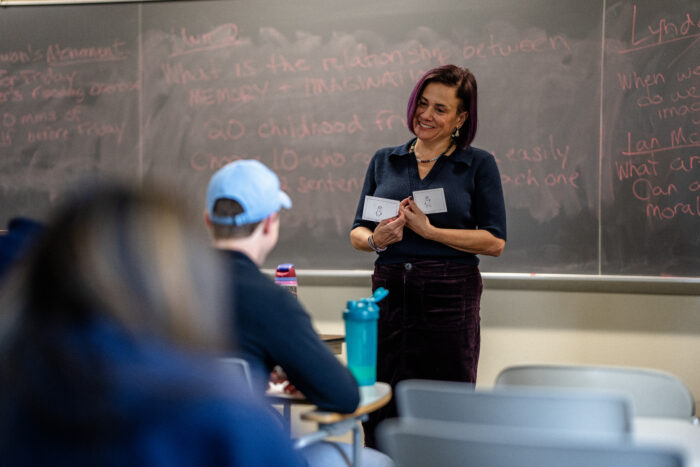
Julia Schultz, professor of practice who oversees the C-Lead program, teaches one of the core classes for C-Lead students: Leadership and Communication. “That is my favorite class to teach,” she says. “Part of it is because the C-Lead students are in it, and they’re just so eager to learn.”
Schultz’s seniors complete a project called The Leadership Challenge, where they assess international leadership scenarios in groups and determine what approaches would work best to tackle them.
“It’s a great way to look at different areas internationally and learn how leadership communication can help successfully address challenges,” Schultz explains. She also has students interview experts at Marquette, in the city of Milwaukee and throughout the state, to learn their perspectives on what has made them successful.
Outside of course work, C-Lead students are paired with a mentor in their desired field of work during junior year. Many are Marquette alumni or adjunct professors and friends of the college who were recommended by faculty for C-Lead mentorship.
Twenty students participate in C-Lead every year. The cohort size keeps the program competitive, but also intimate. Ellie Denk, a senior in the college, says she especially appreciates the small class sizes and mentorship opportunities.
“It’s a hidden gem that not everybody knows about,” Denk says of C-Lead. “But I truly have enjoyed every aspect of it.”
Building skills that last
When Denk started her C-Lead mentorship during junior year, she set some career goals — one being to get an internship during the summer before her senior year. Together, Denk and her mentor, Sarah Fracek, vice president of marketing communications at Trusted Fraternal Life and a Diederich College adjunct instructor, reworked Denk’s resume and practiced articulating the skills she gained at past internships. “She’s really helped me become a better-planned person, especially when it comes to talking about myself,” Denk says of Fracek.
Just a few months before graduation, Emery sent a series of “brave little emails,” cold-contacting people to learn more about a new role that had opened up.
That summer, Denk landed a gig at Clarios, a battery manufacturer in Glendale, Wisconsin. And she still keeps in touch with Fracek, even though the mentorship period is officially over.
“I’ve gained so much valuable insight from her in all sorts of aspects, whether relating to real life or in the corporate world,” Denk says.
Emery, the recent graduate, also talks to her mentor, Monica Oliver, Sp ’81, an Ohio-based leadership communication consultant and executive coach, to this day. “She helped me so much,” Emery says. Learning how to network effectively was a big takeaway for Emery, who picked up tactics from Oliver that she applied to land her first job out of college.
After an internship at Arc Worldwide during her junior year, Emery knew she wanted to go back to the company if it had a full-time job available. Just a few months before graduation, she sent a series of “brave little emails,” cold-contacting various people at the company to learn more about a new role that had opened up. “I didn’t expect anybody to answer, but luckily, everyone did answer,” she says.
Getting out of her comfort zone and having that “little push of bravery” when networking is something Emery plans to do now whenever she’s interested in an opportunity. So far, it’s worked — her casual inquiries led to an interview, and later a job.
“I don’t think I would be in the position I’m in if it wasn’t for C-Lead — what I learned through my mentor and through the classes that I was in,” Emery says.