Participants from more than 20 countries gathered in Perth, Australia this summer for the International Family Nursing Conference, a four-day event that engaged caregiving researchers from around the world. Three Marquette Nursing faculty members—Dr. Kim Whitmore, Dr. Joan Totka and Dr. Norah Johnson—made the trip to share their research on the subject.
“Family caregivers and people who are helping to care for individuals in their home with disabilities or chronic health conditions all face similar challenges,” Whitmore says. “By working together and learning from each other, I think we’re able to advance that science quicker.”
Marquette’s delegation to the conference presented plenty of new research, including Whitmore’s white papers on the value of respite care in the context of families. Respite care, or the concept of providing relief for caregivers of individuals with disabilities or illnesses, is becoming increasingly important in the context of America’s aging population. It is estimated that 48 million people provide roughly $600 billion of unpaid family care.
“If our health care system had to absorb that cost, it would collapse,” Whitmore says. “So we have to find ways to support family caregivers. For me, that’s what this conference was about.”
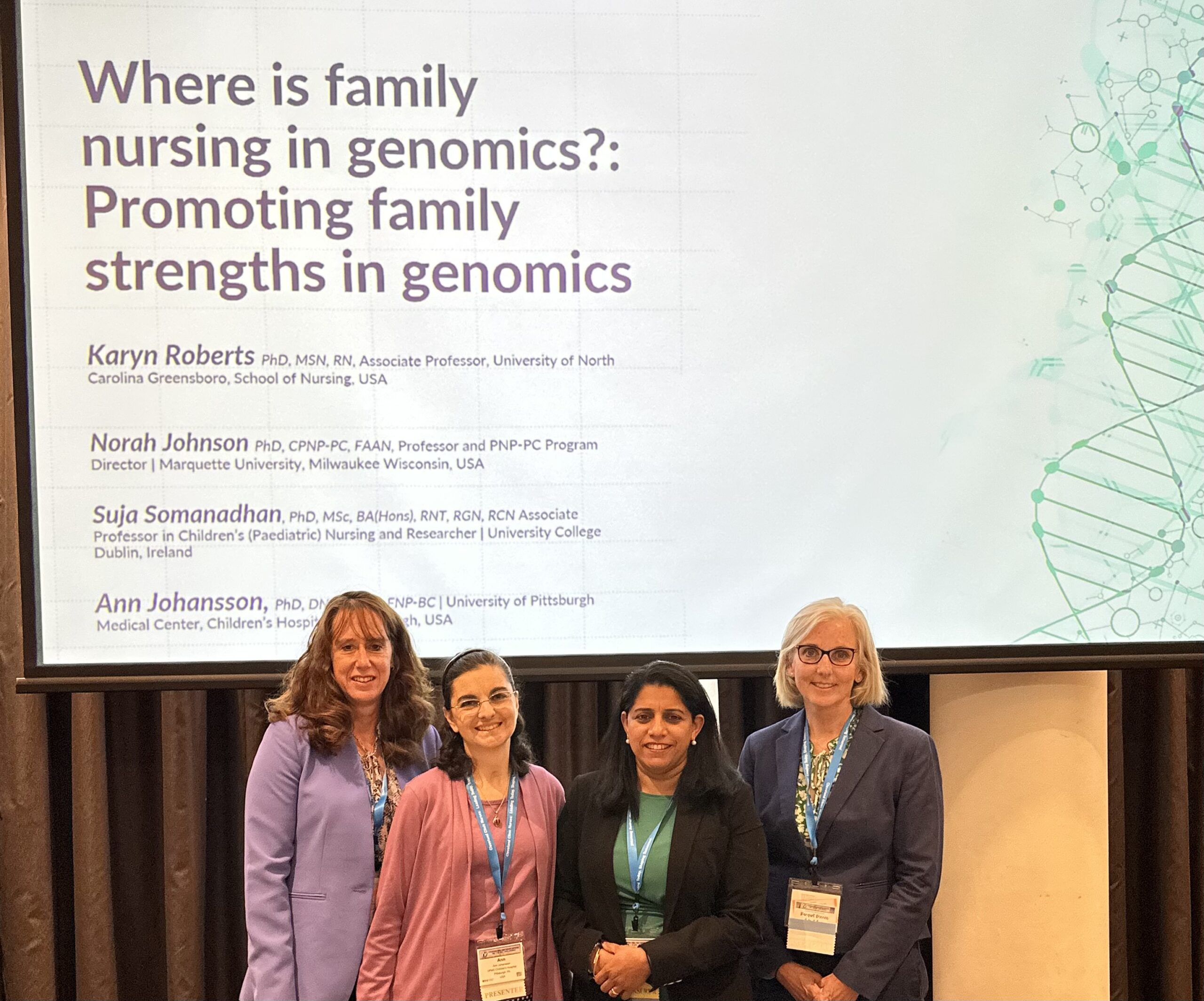
Johnson brought a different perspective to the conference as a researcher of genomics, or how an organism’s genes interact with its environment, particularly as it pertains to pediatric issues. As a teacher in a competency-based curriculum where students are judged on how well they perform crucial tasks, Johnson wanted to stay up to date on the latest literature in her field so she can bring it back to the classroom.
“In order to get reaccredited as a college, we’re going to have to show that our curriculum is in line with the latest best practices when it comes to genomics,” Johnson says. “When we’re graduating students, we need to demonstrate that not only did they pass all their tests, but they are actually able to demonstrate key competencies in this area.”
“Bringing the work these researchers do to my family nursing class is absolutely crucial,” Johnson adds.
Beyond learning and presenting, the conference was a window into the ways people around the world viewed nursing education in America. One of the most remarked-upon aspects of American nursing culture was the degree to which nursing is viewed as a distinct profession, instead of just a subordinate role to a physician.
“Historically, nurses were seen as hospital employees, but nursing has really come into its own here as a unique profession with a specialized body of knowledge. In other systems, things tend to be more hierarchical, with nurses working under doctors, so the respect that nursing is afforded in America is something other people noticed,” Johnson says.
The conference also provided opportunities to nurture connections across continents. Whitmore visited colleagues in the Sydney area who administered respite programs, gaining valuable perspective on recent policy changes in Australia and how they’ve impacted the country’s support infrastructure for caregivers.
Johnson, meanwhile, is working with an Irish hospital on education for staff on how to serve children with autism.
“There’s a certain level of intellectual humility you have to have in these conferences, seeing how people from around the world live,” Johnson says. “There is so much relationship-building and mentoring that comes out of experiences like this.”