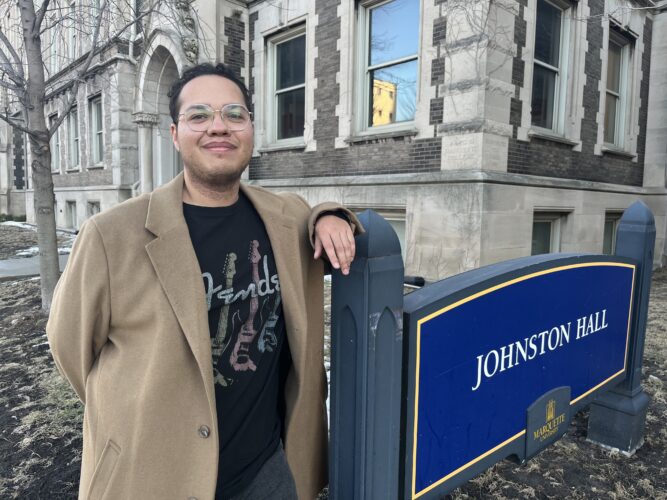

When Andrew Mizwicki was building his first chat bots, he’d always ask a question to test if they worked: “How many kangaroos are in Australia?”
Any answer at all meant Mizwicki needed to go back to the drawing board.
“The models I was building were meant to be subject matter experts in a particular area,” says Mizwicki, a Class of 2025 Marquette Business alumnus. “So, if I was building a model that analyzes Home Depot’s financial information and it gave me an answer to [the kangaroo] question, then I know it’s including information that shouldn’t be in there.”
Mizwicki is now taking the artificial intelligence skills he learned in the AIM Program to multinational investment firm William Blair where he is a junior quantitative associate and a crucial piece of his office’s efforts to build out its AI capabilities.
What first got you interested in building artificial intelligence models?
I first got into them when Dr. (Joe) Wall was showing me how they worked during my early days in the AIM program. He told me how they can help you improve your coding skills and give you more insight for research. I was skeptical at first about how accurate these models were — I didn’t know whether they were just making up information. But then when I sat down and started using them, it was clear to me how this stuff could apply to a lot of areas.
You built a few specialized chatbots when you were in the AIM program. Walk me through how you do that.
Basically, AI models are trained on data. ChatGPT is trained on pretty much the entire internet. All we were doing in AIM is building the same kinds of applications at a smaller scale. So, if I wanted to build one that was specifically an expert on Home Depot, I’d research the company and get their revenue, costs, operating expenses and other financial data.
You have to grab as much data as possible to train the model, then you have to use the right libraries and coding languages to build it. It goes from research to data extraction and retrieval to coding to development, then finally testing it with different prompts to see if it works.
Lots of companies want to use artificial intelligence more, but what does “more” actually mean in the context of William Blair? Do they view AI use differently than other firms?
When we think about using AI, we ask a few key questions: Can these models help us save time? Are there unique research angles or real-time data we can tap into that we couldn’t before? Can they help us stay ahead by spotting risk or areas of exposure earlier? That’s how we’re thinking about it. It’s not just about using AI because it’s the latest trend — it’s about whether it can drive value across what we do, from research to risk management to performance.
What is the most important aspect of building a good model or AI tool?
What you build is only as good as your data. You can construct the most intense, crazy mathematical model or have insanely detailed prompts for your chatbot, but if you don’t have enough data, or that data is handled incorrectly, you’re not going to be accurate.
That’s something we focused on a lot in the AIM program. Your data needs to be clean, and it needs to be understandable.
How did your experience at Marquette help you get to where you are now?
There’s so much encouragement and ability to access your professors. I spent a lot of time in Dr. Wall’s office hours, and it was the same for Hunter Sandidge, the two professors I worked with closely in AIM. I’d go to a lot of other professors’ office hours to ask questions about the space I was trying to get into. They’d give me the tools to apply the principles I was learning in class to the real world.