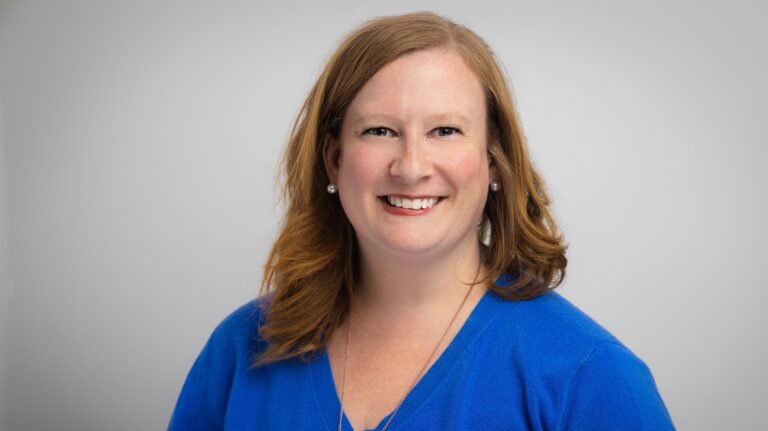
There are two things Kathleen Blaney will never forget about New York City in March 2020. The first is walking through Times Square and it being quiet enough to hear a pin drop. The second is what most frequently shattered that silence: ambulance sirens.
“It didn’t matter where you were, what time of day it was, there was always this backdrop of ambulance sirens,” Blaney says.
COVID-19 was a baptism by fire for Blaney, a Marquette Nursing alumna who served as the clinical director of New York City’s contact tracing program. Five years later, she is putting the skills she learned trying to control the pandemic’s spread to use, directing all nursing activities for ambulatory care and population health for New York City Health and Hospitals, the largest municipal public hospital system in the country. In a Q&A with Marquette Today, Blaney shares the lessons she learned from her career in public health.
What drew you to public health?
I was studying political science and starting to think through the ways our political decisions impact our care delivery system. I transferred into the College of Nursing my sophomore year and kept my political science minor. I think that ultimately led me to pursue public health as a career.
In nursing, we talked a lot about care for the whole patient, and then public health is really thinking about care for the whole population. I think there are a lot of real parallels between the two. Marquette being founded on the ideals of care for the whole person really helped me draw the connection.
Describe the nature of your work in New York City during COVID.
During the first wave, I was branch director for the health department’s Healthcare System Support Team, so we did a lot to enhance hospital capacity and identify alternate care spaces. My team also helped the city support surge staffing, evaluate our supply chain for personal protective equipment, and work hand-in-hand with our colleagues at the state and the CDC to develop guidance on management of patients, isolation and infection control.
I was then tasked with establishing the City’s COVID contact tracing program as part of Test and Trace Corps, an interagency group composed of leadership from the health department and from the city’s public hospital system. It was the country’s largest contact tracing program. We were performing outreach to all confirmed cases based on city lab data or state lab data. We were helping to evaluate their symptoms and when they should seek medical care, telling them how long they should isolate themselves and then offering them resources so that they could stay at home.
I also served as the clinical operations chief for the health department’s COVID response, managing teams responsible for surveillance, laboratory, provider communications and targeted vaccine outreach.
Five years later, what lessons should we have learned from the pandemic?
Public health is its own practice and a science separate from health care that needs to be understood in terms of health education. How are we communicating information about people’s health? How are we communicating the importance of vaccination? How are we making sure that we can test for and support outbreak response in areas that are at risk?
I worry that we’re seeing so much misinformation and mistrust in public health. I certainly hope that is something that we’re able to rectify before we’re faced with another emergency.
What’s one thing that future nurses should keep in mind as they decide on their career paths?
I did not go right from undergrad to a [medical-surgical] rotation, which I think is the most common way to go. There is a lot to be said about going that route. You learn so much by doing a med-surge or ICU rotation right after graduating, but I went into public health, and I don’t regret that, because I think public health needs more nurses. Graduates should keep an open mind about what type of positions they consider, because it’s how I found my calling.