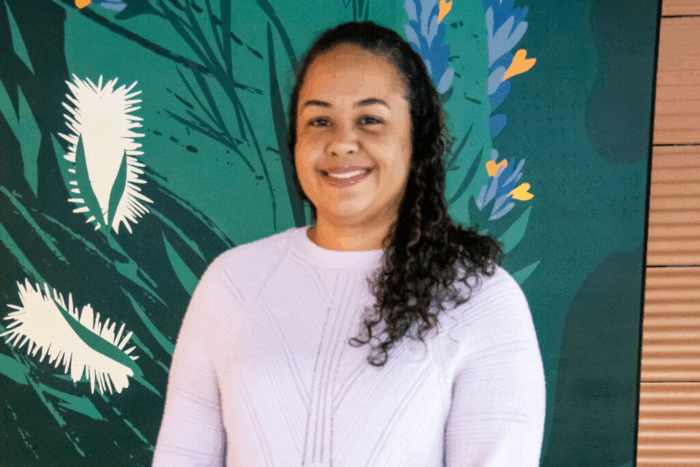

None of the students in Professor of Practice Dr. Kent Belasco’s class have ever met 19-year-old Nazareth Mendez, the woman on the screen at the front of the class. It is unlikely they ever will, nor will they ever go to Panama to buy her business’ products.
Yet, in just a few months, the students have the potential to transform her life merely by sharing what they know.
“I think this experience has added a lot of context to my education because I’ve been preparing to basically underwrite loans for large businesses, but now I see how using my skills on even a micro scale can impact people’s lives,” Class of 2025 graduate Jack Grahl says.
The project is part of Belasco’s Commercial Banking Program and included in the Loan Portfolio Management class, led by Adjunct Professor John Hazod, a chief financial officer for Demlang Builders Inc.
Thanks to a revolving loan fund with Town Bank and the assistance of nonprofit microlending organization Eskala, students had the chance to facilitate a loan to a business owner in Central America. Town Bank provides the capital, while Eskala contributes the network and knowledge of local conditions.
“Our goal is to educate students who have both the practical skills to effect change and the ethical grounding to discern how those skills are best used,” Belasco says. “Working with Eskala is an excellent chance to bring those missions together, and to provide much-needed capital to small businesses in countries such as Panama.”
In this case, the loan recipient, Mendez, runs a fruit stand at Penonome Market, roughly an hour’s drive away from her hometown of Cero Corral. Her mother, Maruquel, started the business more than a decade ago. Mendez hoped to secure a $5,000 loan to purchase fruit directly from farmers instead of through an intermediary, which would allow her to widen her stand’s slim profit margins.
“I get to say that I underwrote a loan for someone in Panama and helped her build something from the ground up. That’s probably something I’ll never forget.”
Jack Grahl, Class of 2025 graduate
That’s where the students’ business acumen comes in. Over the course of the class, future financiers like Class of 2025 graduate Colby Kruse counseled Mendez on what she needed to do to show her creditworthiness for the loan. While Eskala’s standards are more lenient than a bank’s, things like implementing basic expense tracking through Microsoft Excel—commonplace in America, but not in rural Panama—leave the business in better shape long term.
“We know her business had cash flows because she was using it to pay for living expenses for herself and her family, but we didn’t know how much. She also had a general picture of expenses versus income in her head, but those numbers weren’t on paper,” Kruse says.
Constructing the fundamental financial information of a business is challenging enough when everyone speaks the same language. It gets even trickier when the two parties speak through an interpreter.
“We don’t have a single Spanish speaker in the class, so we had to prepare questions in advance,” Kruse says.
Before advising Mendez on her business, the students built a relationship with her, spending hours asking questions about how she came to own a fruit stand and what kept her going. They learned that she was also a college student, majoring in criminal investigation. Her family still works, but she’s taken part-time responsibility for the fruit stand to provide them with extra income.
They also learned what her long-term goals for the business are: building a store, hiring more employees, and fostering self-sufficiency through an owned and operated farm. Honest dialogue about where Mendez’s fruit stand is headed made it easier for the students to build a business plan around it.
“You can’t just jump into a new relationship and be like, ‘Oh, what do you sell the food for and what do you make,’ because it’s just going to make the other person uncomfortable,” Grahl says. “You have to create that bond and show the other person that you want to help them.”
At the end of the semester, the students presented their recommendations to Mendez, along with the successfully underwritten loan. That loan, along with the work the students did to build Mendez’s financial tracking infrastructure, will provide immediate capital for Mendez to put to work. It will also give her a credit history for future loan requests from banks.
The students also got the chance to make a material difference for a real client before even graduating college.
“I get to say that I underwrote a loan for someone in Panama and helped her build something from the ground up. That’s probably something I’ll never forget,” Grahl says.